Coherence Is Not Truth
Why Fluent AI Answers Need Evidence

An answer can sound calm, be clearly structured, and use exactly the terms a team expects. It may nevertheless invent a premise, merge two document versions, or present an unsupported conclusion as settled information. The crucial question for organisations is therefore not merely, “Does this sound plausible?” It is: Which individual claim is supported by which source of evidence that is appropriate to the specific question and independent of the model text, and who may act on that basis?
This article explains why linguistic coherence and factual correctness are different properties. It connects philosophical questions about truth and justification with research on factual errors, source attribution, retrieval, and self-correction. A fully fictional course-provider case takes the questioning model through the steps A → B → D → C. From this, a claim ledger emerges that small businesses and course teams can adapt for limited, verifiable AI applications.
Core message: A factual claim that informs a decision is not justified because it is elegantly phrased, repeated, supplied with a link, or merely confirmed by a second model. It requires a traceable comparison with a source that is authoritative for the specific question and separate from the model output. Value judgements, forecasts, and causal explanations each require an appropriate method of justification and review.
For whom: Teams in small and medium-sized enterprises, course leaders, people responsible for AI use, and learners who need to review generated information professionally.
Learning outcome: After reading, you will be able to break an answer down into verifiable individual claims, formulate competing explanations, assess evidence by scope, and document a correction so that another person can follow it.
1. The Moment When a Plausible Answer Becomes a Risk
A fictional small continuing-education provider has an AI assistant answer questions about its own course programme. The enquiry is: “What prior knowledge do I need for the introductory course?” The assistant replies in a persuasive tone: “Python knowledge is mandatory for module two. Taking the course without programming experience would not make sense.” The answer sounds understandable. It uses a technical term, assigns it to a module, and recommends a clear course of action.
The official documents tell a different story. The approved programme explains that no programming experience is required. An optional supplementary sheet for an advanced exercise block recommends Python experience, but does not make it a condition for the introductory course. The assistant has combined two statements and turned a recommendation into an admission requirement.
The error is not an abstract curiosity. Incorrect information can deter people from an offering or trigger unnecessary preparation. In other areas of use, a similar answer could influence procurement, maintenance, or customer communications. The moral question also arises when a team mistakes fluent language for reliable information.
The case is entirely fictional and describes neither a real course nor a particular system. It is intended to make a review situation visible: A sentence can fit within a narrative without being supported by the authoritative source.
The practical risk consists of several steps: A plausible formulation draws attention; the claim is not broken into verifiable parts; a team adopts it because the answer conveys certainty; finally, the affected person bears the consequence. Decisions by people and organisations lie between model text and impact. That makes review a governance task, not merely a question of better prompts.
2. Coherence, Truth, and Justification Are Not the Same
Coherence first describes whether parts of a statement fit together: The sentences do not obviously contradict one another, an explanation has a recognisable structure, and the conclusion appears to follow from the preceding sentences. Coherence helps understanding. It is not proof that a claim corresponds to the world.
Truth concerns the state of affairs to which a claim relates. Whether the introductory course requires programming experience does not depend here on how convincing the sentence sounds. What matters are the valid course documents and the admission requirement actually adopted. In other questions, the situation may be less clear: Values, forecasts, or causal explanations demand more than finding a single document.
Justification asks why a person is entitled to regard a statement as true. This includes evidence that is relevant to precisely that claim, an appropriate method, a clear scope, and a willingness to change the statement in light of counterevidence. A source link without review justifies nothing yet. It may point to an outdated version, support only part of the sentence, or merely mention the topic.
The philosopher Charles S. Peirce describes scientific inquiry as a public way of testing beliefs against something that does not depend solely on our opinion. His essay The Fixation of Belief distinguishes this search for corrigible knowledge from methods by which people hold on to a belief. This does not provide a ready-made review procedure for AI work today. The connection is a methodological attitude: Justifications must be visible, challengeable, and corrigible for others. A model can help formulate questions. It cannot replace the shared review. [2]
This also makes the ethical dimension clearer. When an organisation uses AI outputs as information, it does not merely distribute information. It distributes access, attention, work, and the risks of error. Anyone who presents a false prerequisite as “objective” may exclude learners or place employees in the position of representing a claim that has not been verified. Responsibility lies with the roles that determine purpose, source, approval, and consequences.
A useful distinction is therefore: An answer is a proposal for a claim; evidence is a verifiable connection between the claim and a source appropriate to it. A source may be authoritative for a rule and inadequate for a forecast. This is an editorial working rule, not an experimentally validated truth algorithm.
3. Why a Language Model Can Formulate Persuasively Without Checking the Facts
Generative language models generate text on the basis of learned patterns and the respective context. The original study describes GPT-3 as an autoregressive language model; architecture and training differ between systems. [1] This gives rise to the working boundary of this article: Text generation is not automatically an independent check that a claim is supported by a current document or an external state of affairs. Source attribution and risk review are relevant to this comparison. [5, 10]
This is not an accusation that a model “lies.” The term hallucination is widespread, but it can suggest human intentions for which there is no evidence. NIST also uses the term confabulation for the risk phenomenon: content that a generative system presents confidently even though it is erroneous or false. This also includes outputs that depart from inputs or provided context, or contradict earlier statements in the same context. In this article, depending on the case, we speak more specifically of a false, unsupported, or contradictory generated claim. [10]
At least four situations need to be distinguished:
1. False claim: The statement conflicts with the state of affairs as checked using appropriate means.
2. Unsupported claim: The available documents do not support it. This does not automatically prove that it is false; its status remains open.
3. Contradiction of the provided material: The answer does not match a specified source or other parts of the context.
4. Incomplete or ambiguous statement: The source does not fully answer the question, or several plausible interpretations remain.
These categories are not a universal taxonomy from research. They are a practical framework for the claim ledger developed here. A value judgement such as “The course should be more accessible” must also not be equated with an empirical claim such as “Prior knowledge is required.” The former needs normative justification and the involvement of affected perspectives; the latter needs an appropriate factual source.
A further distinction concerns fluency and reliability. The fact that an answer appears human in grammar and style says little about whether its details are based on a source. The GPT-3 study showed that a large autoregressive language model could generate texts that human evaluators found difficult to distinguish from human-written news texts. The study demonstrates an ability to produce persuasive text in its experimental setting; it does not establish that such texts are factually correct. [1]
4. What Research Demonstrates—and What It Does Not Demonstrate
Research on generated text studies different tasks, models, and concepts of error. Its results must not be condensed into a timeless percentage for every current system. They do, however, show why organisations should not equate language quality with factual faithfulness.
4.1 Errors in Summaries
In 2020, Maynez and colleagues studied abstractive document summaries using human evaluation. In the systems tested, they found substantial amounts of content that was not faithful to the input documents. For the task studied, the work shows that a good-sounding summary can contain additional or altered content. It provides neither an error rate for all current chatbots nor a general statement about every generation task. [3]
4.2 Truthfulness Questions Are Measurable, but Task-Dependent
TruthfulQA was built with 817 questions from 38 categories that address widespread false beliefs or misconceptions. In the set of models tested in 2022, the best model examined was truthful on 58 percent of the questions; the comparative performance of humans was 94 percent. These figures belong to this exact benchmark and the systems of that time. They are not an estimate for a current product and not a judgement about the truth of every individual AI output. The methodological point is narrower: Truthfulness can require its own review and does not automatically follow from general language capability. [4]
4.3 A Source in the Context Does Not Yet Ground the Answer
Retrieval-augmented generation (RAG) first retrieves material and supplies the retrieved content as context to a language model. This creates an important evidence trail, but does not eliminate all errors. In the RAG answers it examined, the RAGTruth dataset still documents statements that are unsupported by retrieved content or contradict it. This does not mean that RAG is ineffective overall. It means that “a source was found” and “the claim is supported by this source” are two different review steps. [6]
4.4 Citations Must Be Reviewed for Their Content
The Attributable to Identified Sources procedure (AIS) by Rashkin and colleagues makes the connection between a generated statement about the external world and an independently provided source an object of evaluation. This is useful for teams because it shifts attention from the mere existence of a citation to the support it actually provides. AIS is an evaluation framework; it is not automatically a product that reliably checks every source. [5]
4.5 Certainty of Tone Is Not a Calibrated Probability
Wording such as “absolutely certain” sounds unambiguous. An actual confidence value of a model is a different, technical quantity. Calibration asks whether stated probabilities, across many comparable cases, match observed correctness. Jiang and colleagues found substantial calibration problems in the question-answering models T5, BART, and GPT-2 examined at the time, while also demonstrating methods for improvement. This does not justify a blanket statement about all current systems. It does justify treating uncalibrated certainty language neither as a measurement nor as evidence. [7]
In 2024, Farquhar and colleagues developed semantic entropy to detect a subset of arbitrary and erroneous outputs that they describe as confabulations. The approach can trigger additional caution or more targeted retrieval. The authors expressly limit it: It does not guarantee factuality and does not help when a system is systematically wrong. An uncertainty signal is therefore a triage indicator, not a certificate of truth. [8]
4.6 Repeating and “Checking Again” Is Not an Independent Control
When the same AI reviews its first answer in response to the request “Check yourself again,” this does not automatically create an independent source of evidence. Huang and colleagues studied intrinsic self-correction without external feedback in reasoning tasks. Under the conditions tested, reliable self-correction did not succeed; in some cases, performance worsened. This does not mean that every form of self-correction is useless. It means that another run without new evidence does not constitute independent confirmation. [9]
Language models can help with retrieval, structuring, and drafts. For factual claims that inform decisions, however, a team must still check whether source, statement, and context of use fit together. The voluntary NIST profile recommends source review, context-appropriate testing, and operational monitoring of errors; it is neither law nor a guarantee against error. [10]
5. Case Work: From a Persuasive Sentence to Verifiable Claims
Back to the fictional continuing-education provider. The assistant has produced a paragraph with three statements:
“Python knowledge is mandatory for module two. Taking the course without programming experience would not make sense. The official course description confirms this requirement.”
The sentences sound like a single piece of information. For a fair review, the team separates them:
| Claim | Statement | Required evidence | Preliminary status |
|---|---|---|---|
| C1 | Python knowledge is mandatory for module two. | Valid, approved programme or formally adopted admission rule. | CONTRADICTED by the approved introductory programme. |
| C2 | Taking the course without programming experience would not make sense. | Justification based on learning objectives and course design; also a normative decision on the target group. | UNSUPPORTED; the recommendation is not taken from the source. |
| C3 | The official course description confirms the requirement. | Version and section review of the official course description. | FALSE in the fictional case; the document says that no programming experience is required. |
| C4 | An advanced exercise block uses Python. | Valid supplementary sheet and its target audience. | SUPPORTED, but not equivalent to an admission requirement. |
The table separates four questions that the text has merged. C2 is especially important: “not sensible” is not merely a statement of fact. It can express an assessment or an access policy. Even if an advanced exercise block requires technical prior knowledge, it does not follow that the entire introductory course is unsuitable. Affected learners would be heard in the decision round if the team actually wanted to redesign access.
The case also includes a version question. The responsible person does not need to find just any PDF, but to identify the valid, approved source. A file from an earlier course cycle, a draft, and a supplementary sheet can all be authentic and still answer different questions. Source review therefore requires at least: document title, version, scope, responsible approval, and the passage that supports the claim.
An Example Claim Ledger
| Claim ID | Wording | Source and location | Review judgement | Limitation | Next step |
|---|---|---|---|---|---|
| C1 | “Python is mandatory.” | Approved introductory programme, “Requirements” section | Contradicted | Applies only to the reviewed version and this course. | Correct the statement; monitor new version changes. |
| C2 | “Without experience, the course is not sensible.” | No appropriate factual source; added in the assistant text | Open / value judgement | The source alone cannot decide educational suitability. | Consult the target group and alternative learning support. |
| C3 | “The official description confirms it.” | The same official description, “Participation” section | False in the case | The assistant names support that the passage does not provide. | Withdraw the citation and answer; send a correction notice. |
| C4 | “The optional advanced block uses Python.” | Approved supplementary sheet, target group “advanced exercise” | Supported, but narrowly limited | Recommendation for the supplementary block, not a requirement for the introductory course. | Retain the context in the answer text. |
A claim ledger is not a certificate. It is a record of work: Which statement was reviewed, against what, by which role, with what result, and with what remaining limitation? A second team member should be able to repeat the review without having to guess the entire chat history.
6. The Questioning Model Actually Changes the Answer
For this article, the questioning model is not a graphic at the edge of the page. It changes what may count as an answer. The sequence A → B → D → C prevents the team from treating an early plausible conclusion as finished knowledge.
A – Narrow the Initial Question
The initial question, “What prior knowledge do I need?”, is too broad as long as it remains unclear which course, which version, and which type of participation are being asked about. A specifies:
“Which requirements does the approved programme for the introductory course state in its current version, and which statements relate only to optional advanced exercises?”
This changes the object of review. The issue is no longer whether to infer the AI’s knowledge from its tone, but to compare individual statements with an identifiable source and scope.
B – Form Alternative Explanations
F-B should not produce a majority vote or an automatic probability calculation. It opens competing hypotheses that require different evidence:
| Hypothesis | What might have happened? | Which observation would distinguish it? |
|---|---|---|
| H1 | The answer correctly states a valid requirement. | The approved version contains an explicit admission requirement. |
| H2 | The answer mixes the introductory programme with the optional advanced block. | Both versions contain the word “Python,” but with different purposes or target audiences. |
| H3 | The answer fills an information gap with a plausible expectation. | The approved programme contains no corresponding rule; the answer points to no precise passage. |
The hypotheses are provisional. The AI can generate them, but the distinction is checked against the documents. A model proposal is a retrieval aid, not evidence. In the example, the approved programme version and separate supplementary sheet support H2. H3 remains relevant as a possible explanation for the unsupported recommendation. H1 is rejected for the claimed mandatory status.
This countercheck is precisely the knowledge gain of F-B: Without alternatives, the team could only ask whether the answer sounds “correct.” With alternatives, it asks which observation distinguishes between versions, scopes, and conclusions.
D – Error Loop with External Evidence
F-D records that the first answer failed. The next round must not simply smooth over the error linguistically. It needs new evidence or an independent review:
1. Secure the error: The original answer, model/system version, input, documents used, and context of use are documented with data minimisation. No personal, participant, or confidential original data go into the ledger; a role reference, document reference, version, and a redacted passage needed for the claim are sufficient. The team aligns access and retention with the use case.
2. Atomise claims: Each statement receives its own claim ID. Recommendations, facts, value judgements, and uncertainties are separated.
3. Determine the source: The appropriate, approved source is sought for each statement. Version and scope are reviewed.
4. Assess support: The source must support the specific claim, contradict it, or leave the question open. A mere topical connection is insufficient.
5. Independently cross-check: A knowledgeable person reviews claim and evidence; for consequential decisions, a party is consulted that does not merely repeat the first AI text.
6. Correct and feed back: The false or excessive statement is replaced with a bounded answer. Based on the use, potential harm, and applicable duties, the team considers whether and how affected people should be informed about earlier incorrect information.
7. Review repetition: The team tests whether the source is used correctly in the next run and logs deviations. A single successful repetition does not establish lasting freedom from error.
A useful test is asking the system to review its own answer. The result can provide clues, for example to a cited version or an alternative interpretation. It is not, however, an independent control step. If the system uses the same false requirement again, it has not confirmed its own claim through an independent source. Conversely, self-recognised uncertainty may be a reason to stop the claim and involve a person. [9]
F-D therefore changes the status of the original conclusion. The team rejects the premature statement “Python is mandatory” and instead formulates: “The approved introductory programme states no Python requirement. The supplementary sheet uses Python for an optional advanced exercise. For information about another course cycle, the current version must be reviewed.” This answer is less dramatic, but more precisely bounded and actionable.
C – A Robust Final Question and a Work Plan
Only after B and D does F-C consolidate the final question:
“Which statements about requirements and advanced exercises are supported in the approved course version, which come from another version or an evaluation, and how do we correct incorrect information before the next participation decision?”
A GROW step can turn this into the organisational plan:
Goal: Interested people receive accurate information without unnecessary technical access barriers.
Reality: The introductory programme and supplementary sheet were mixed; the source version was not visible in the answer.
Options: The answer is drafted manually, drafted from a clearly identified approved source, or forwarded to a responsible person in unclear cases.
Way forward: Before the next use, the team defines a current source list, a responsible role, a stop case, and a correction protocol.
GROW structures the next action. It proves neither the correctness of the information nor the effectiveness of the chosen method.
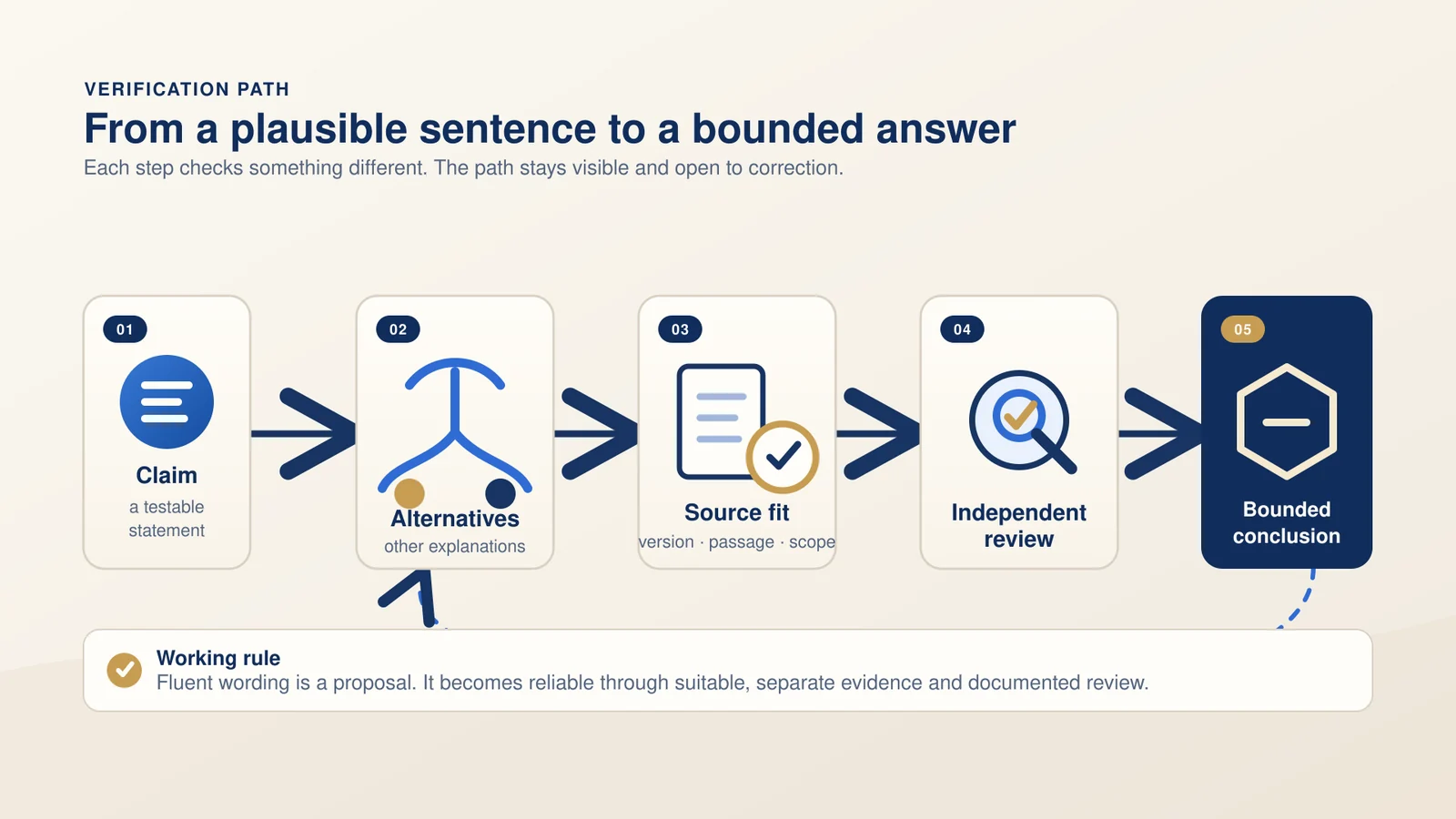
7. A Review Path for Small Teams
Small businesses do not need a multistage audit for every non-binding formulation. They need a rule that relates effort and consequences in a traceable way. The following procedure is an editorially developed working aid, not a validated risk scale and not a legal compliance review.
Step 1: Describe Use and Impact
Record what the answer is intended to do: draft, retrieval, summary, recommendation, or decision preparation. Ask who reads the output, who is affected by it, and what action it makes more likely. The same linguistic error does not have the same effect when it appears in an internal collection of ideas or in customer information that appears binding.
Step 2: Determine the Need for Review by Consequences
Consider at least four characteristics:
Possible harm: Can the claim affect access, money, safety, rights, or an important opportunity?
Reversibility: Can an incorrect decision be corrected easily and without lasting consequences?
Affected people: Can people challenge the output, receive different information, or refuse its use?
Access to evidence: Is there a current, authorised source and a person who can review it professionally?
If potential consequences are serious or difficult to reverse, a superficial plausibility review is insufficient. If an appropriate source is missing, the correct action is often not to answer or to forward the matter. “The AI found nothing” means neither that information is false nor that it can safely be assumed.
Step 3: Compare the Claim with the Source
Compare statement by statement. Ask: Does the source support the whole claim, only part of it, or none of it? Does the scope fit? Is the source current and authorised? Does another valid version conflict with it? Is a value judgement presented as fact? These questions apply equally to RAG systems and to a chat without retrieval.
Step 4: Define a Responsible Handoff
A clear distribution of roles can be small: One person is responsible for the use case, a knowledgeable role reviews sources, and an approval role decides on use or stop. In a small business, the same people may hold several roles; they must still make the review steps visibly distinct. A “human in the loop” helps only if that person has time, knowledge, access, and genuine intervention rights.
Step 5: Enable Correction and Learning
Log error types, affected claims, identified source gaps, and corrections. Observe whether certain documents are outdated, contradictory, or difficult to find. The organisational cause may lie in unclear approvals, a poorly maintained knowledge base, or an unsuitable allocation of tasks. A model error is not automatically only a model problem.
The voluntary NIST profile recommends checking sources and citations, not impermissibly generalising tests, and observing risks during operation. For small teams, this can be developed into proportionate practice with clear responsibility, a stop path, and a correction protocol; the specific design remains dependent on the use case. [10]
8. The Strongest Counterposition: Review Takes Time
A team can rightly object that full evidence review for every AI output would be too expensive. If an AI only sorts headings or shortens an internal draft linguistically, an elaborate approval process may cost more than the possible error. Review capacity is limited. Treating every task alike burdens employees and can prevent useful applications.
Even an approved source is not a general certificate of truth: It may be authoritative for an admission requirement and inadequate for an impact forecast, a value conflict, or a technical state of affairs. The ledger therefore checks whether source, claim, version, and scope fit together; unresolved source conflicts remain open.
This objection makes an important point. Responsible review does not mean manually approving every answer word for word before every use. It means knowing the purpose and consequences, setting the appropriate depth of review, and having a safe procedure for uncertainty. Low-risk, reversible assistance can be operated with sampling and clear labelling. A statement that affects access or safety needs a stronger chain of evidence and approval. A source that cannot be found or reviewed should trigger a boundary for the answer.
Technical measures can help: search in approved documents, version metadata, notices of missing sources, and sample-based tests. No single measure proves truth. A link can point to the wrong passage; a detector can miss systematic errors; a review can fail under time pressure. The combination depends on the task, data, model, user group, and error tolerance.
The appropriate response to review costs is selective review with explicit thresholds. For easily corrected drafts, effort can remain low. Where a statement shapes access or a difficult-to-reverse decision, stronger evidence and effective oversight are needed.
9. Course Exercise: Claim, Evidence, Judgement
This 60- to 75-minute exercise is intended for a small learning group or an SME team. It requires no real participant data. The fictional course case in this article is sufficient.
Learning Objectives
After the exercise, learners can:
1. break a generated answer down into at least three individually verifiable claims; 2. specify an appropriate source, a review procedure, and a scope for each statement; 3. identify at least two alternative explanations and distinguishing evidence with F-B; 4. correct a premature answer through F-D without treating a repeated AI response as independent confirmation; 5. formulate a responsible role, a stop case, and a revision condition.
Process
1. Read the initial answer (5 minutes). One person marks all factual claims, assessments, and action advice in the answer.
2. Separate claims (10 minutes). The team completes a claim ledger with wording, required source, and preliminary status. Each person should be able to understand exactly what is being reviewed.
3. Form alternatives with F-B (10 minutes). Small groups create two or more explanations. They name not only assumptions, but the observation that would distinguish between them.
4. Review the source (15 minutes). The course leader distributes three fictional documents: the approved introductory programme, an old programme document, and the optional Python supplementary sheet. The group identifies the version, scope, and exact passage. No source is used for more than it actually states.
5. Carry out the F-D loop (10 minutes). The team records the first expected conclusion, the counterevidence, the correction, and what remains open. A renewed model response may serve as a diagnostic clue; reviewed evidence and its documented assessment form the evidential path.
6. Decide the practice rule (10 minutes). The group determines who approves the information, when it stops, how a correction is communicated, and which change triggers renewed review.
7. Peer review (10–15 minutes). Another team checks whether each factual claim is truly supported by the cited passage and whether a value judgement appears as factual information.
Assessment Rubric
| Criterion | Met when … |
|---|---|
| Claim clarity | Each reviewed statement can be read independently of the neighbouring sentences. |
| Source fit | Source, version, location, and scope are identifiable. |
| Alternatives | At least two possible explanations are linked to distinguishing evidence. |
| Correctability | The initial statement is not silently overwritten; error, correction, and open points remain traceable. |
| Responsibility | One role can stop, another can review, or escalate the decision. |
| Perspective of affected people | The group asks how incorrect information affects access or options for action. |
The assessment measures the quality of justification in this exercise. It does not establish that a particular prompt, the questioning model, or an AI product is generally effective.
10. When Consultation or Expert Advice Is Added
In this article, F focuses on the question and on handling evidence. When generated information is to be used in reality, the consultation model K expands the analysis to include affected roles, values, governance, and feedback: Who would be affected by an incorrect course requirement, who maintains the approved source, and how do complaints feed back?
The model sequence follows the German-language SAKIZLI templates: questioning model F v5 (A → B → D → C), consultation model K with a four-step core cycle and five-step case-scenario sequence, and the separate five-phase advisory model R. These names and phases describe the templates; their application here is a didactic transfer, not external effectiveness validation.
The core cycle of the consultation model is Exploration, Reflection and Analysis, Decision and Recommendation, Feedback and Evaluation. If the case requires a pilot project, its implementation and final evaluation can be developed as further scenario steps. This longer case sequence is not equivalent to the separate five-phase advisory model R. K carries governance and learning; R takes on a specific expert-review question when contract, law, regulation, or technical due diligence is involved. Neither model replaces expert review or demonstrates its own effectiveness.
For this article, a small K transition can look like this:
| K step | Specific question in the case |
|---|---|
| Exploration | What information is actually used, which sources are approved, and who would be affected by an error? |
| Reflection and Analysis | Which claims are empirical, which are evaluative, and which counterposition or perspective of affected people is missing? |
| Decision and Recommendation | Does the assistant remain limited to drafts, may it answer narrowly defined questions, or must it forward the matter? |
| Feedback and Evaluation | How are incorrect answers reported, corrected, and reviewed again after a change to the course documents? |
If a question concerns real contractual terms or legal requirements for participation, this example is not used to construct legal advice. The team hands a precise expert-review assignment, including context, version, jurisdiction, and required evidence, to a qualified body. R organises this handoff; there is no blanket legal approval by the AI.
11. The Practical Checklist Before Publication or a Decision
☐ Output broken down into individual, verifiable claims.
☐ Factual claims, value judgements, forecasts, and recommendations marked.
☐ A current, authorised source or an open result recorded for every claim.
☐ Version, scope, and precise location reviewed.
☐ Claim and source compared directly; a citation or link alone does not count as review.
☐ At least one competing explanation and the distinguishing evidence recorded.
☐ Unsupported statement corrected, bounded, or withheld; no silent addition.
☐ Effects on affected people and possible exclusions assessed.
☐ Reviewer role and approval role named; stop and escalation path practically reachable.
☐ Correction path for incorrect information already passed on established.
☐ Limits of a test and open uncertainty explicitly stated.
☐ Forwarded to qualified advice only where there is an actual need for legal, regulatory, or contractual expertise.
The list is a learning and working template, not a guarantee that every risk will be found or that an applicable set of rules has been met. Its value lies in making a specific path of justification visible.
12. What Follows from This Article
A coherent answer can be useful as a draft. It can provide search terms, organise documents, highlight differences, and start a discussion. It is not, however, a substitute for reviewing what it claims. The decisive boundary lies between linguistic performance and traceable support.
The questioning model helps address this boundary in practice. F-A clarifies the claim and source at issue. F-B opens competing explanations rather than confirming the first plausible answer. F-D makes missing evidence and correction visible. Only then does F-C formulate a bounded final question and a work plan. K takes over when the knowledge question becomes an organisational decision involving affected people and rules. R is added only for a precise expert-review assignment.
For a small team, this does not mean distrusting every AI output. It means aligning the evidence standard with the possible impact, actually reading sources, and defining the correction path before use. If a statement is unsupported, it may remain open. If it conflicts with an authoritative source, it must be corrected. And if the consequences are serious, not answering is a defensible decision.
The guiding question for the next AI draft is: “What individual statement do you want to make, which evidence authoritative for this question supports it, and how will we know that we need to revise it?”
Sources
1. Brown, T. B. et al. (2020). “Language Models are Few-Shot Learners.” Advances in Neural Information Processing Systems 33, 1877–1901; arXiv:2005.14165. https://doi.org/10.48550/arXiv.2005.14165. Used for the narrowly limited technical context of autoregressive language models.
2. Peirce, C. S. (1877). “The Fixation of Belief.” Popular Science Monthly, 12, 1–15. Original text: https://www.peirce.org/writings/p107.html. Used as a philosophical perspective on publicly reviewable inquiry and corrigible beliefs; not as a ready-made AI review procedure.
3. Maynez, J., Narayan, S., Bohnet, B. & McDonald, R. (2020). “On Faithfulness and Factuality in Abstractive Summarization.” Proceedings of ACL 2020, 1906–1919. https://doi.org/10.18653/v1/2020.acl-main.173. The task and systems tested limit transferability.
4. Lin, S., Hilton, J. & Evans, O. (2022). “TruthfulQA: Measuring How Models Mimic Human Falsehoods.” Proceedings of ACL 2022, 3214–3252. https://doi.org/10.18653/v1/2022.acl-long.229. The figures in the text refer exclusively to the benchmark and the set of models tested at the time.
5. Rashkin, H. et al. (2023). “Measuring Attribution in Natural Language Generation Models.” Computational Linguistics, 49(4), 777–840. https://doi.org/10.1162/coli_a_00486. AIS is described as an evaluation approach, not as an automatic guarantee of truth.
6. Niu, C. et al. (2024). “RAGTruth: A Hallucination Corpus for Developing Trustworthy Retrieval-Augmented Language Models.” Proceedings of ACL 2024, 10862–10878. https://doi.org/10.18653/v1/2024.acl-long.585. Establishes error cases in the RAG outputs studied, not the general ineffectiveness of retrieval.
7. Jiang, Z., Araki, J., Ding, H. & Neubig, G. (2021). “How Can We Know When Language Models Know? On the Calibration of Language Models for Question Answering.” Transactions of the Association for Computational Linguistics, 9, 962–977. https://doi.org/10.1162/tacl_a_00407. Findings relate to the models and QA tasks of the time.
8. Farquhar, S. et al. (2024). “Detecting Hallucinations in Large Language Models Using Semantic Entropy.” Nature, 630, 625–630. https://doi.org/10.1038/s41586-024-07421-0. Detects a limited type of error; the approach does not guarantee factuality.
9. Huang, J. et al. (2024). “Large Language Models Cannot Self-Correct Reasoning Yet.” International Conference on Learning Representations 2024. https://proceedings.iclr.cc/paper_files/paper/2024/hash/8b4add8b0aa8749d80a34ca5d941c355-Abstract-Conference.html. Finding on intrinsic correction without external feedback in the reasoning tasks studied.
10. Autio, C. et al. (2024). Artificial Intelligence Risk Management Framework: Generative Artificial Intelligence Profile. NIST AI 600-1. https://doi.org/10.6028/NIST.AI.600-1. Voluntary, cross-sector risk-management guidance; not a legal standard and not a certificate of compliance.
Contextual note: This article combines primary research, a voluntary risk-management profile, and a philosophical primary text. The case work, checklist, and claim ledger are editorially developed teaching tools. Including them in this text does not claim scientific validation or guaranteed error prevention.
0 comments
● Loading comments…