People Stay in Charge — Responsibility in AI Projects
AI can research, draft, plan, analyze, and execute. But the more capable it becomes, the more important one non-automatable question becomes: Who decides what is correct, sufficient, acceptable, and truly finished?
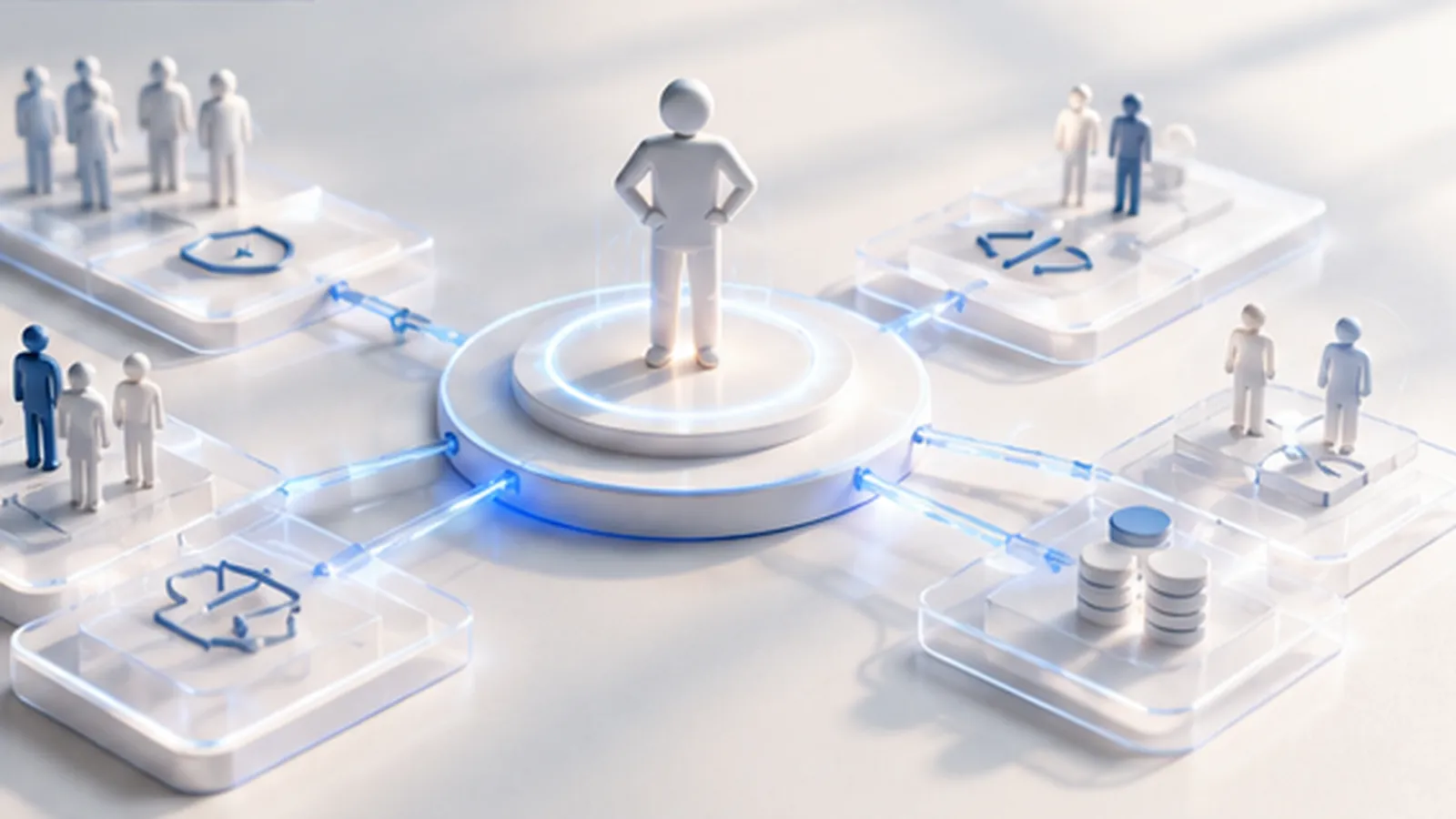
The biggest shift created by AI is not that people suddenly have less to do. In many projects, the opposite happens first. One person can use AI to cover tasks that previously required several roles, departments, or external providers. Research, concept development, writing, analysis, planning, prototyping, and documentation move closer together. Operational reach expands.
With that reach, responsibility expands as well.
Anyone using AI quickly becomes client, reviewer, integrator, and decision-maker at the same time. Even without a formal management title, a new form of project leadership emerges: tasks must be defined, results assessed, priorities set, quality thresholds established, and decisions made about when an output may actually be used. AI can take over a great deal of work. It cannot take responsibility for the outcome.
That is why people remain in charge of the whole.
This is not a nostalgic hierarchy or a claim that humans must dominate every individual step. It describes a functional boundary. A model can generate proposals. An agent can execute a plan. A tool can accelerate a process. But goals, values, risk acceptance, final approval, and accountability still require an identifiable authority.
Responsibility starts before the first prompt
Responsibility is often imagined as a final-stage activity: the output exists, and someone checks it. That is too late.
The first responsible decision happens at delegation. Whoever decides which task goes to a model determines where AI receives influence. Whoever selects the context shapes what the system can see. Whoever defines success criteria determines what the AI will optimize. Whoever grants permissions determines how far an agent may act independently.
Responsibility therefore begins not with final review, but with the architecture of delegation.
A badly worded task can create poor results. More dangerous is a task whose consequences nobody has understood. If an agent is told to "find the best solution" without defining quality, cost, safety, timing, user interests, or limits, the agent is not the primary governance problem. The project has failed to translate responsibility into controllable criteria.
Professional delegation therefore does not mean: "Do this for me." It means: "This is the objective, these are the boundaries, these are the criteria, this is where you may decide independently, and this is where approval is required."
AI expands reach — and therefore the span of leadership
A person with capable AI can prepare an enormous number of decisions in a short time. This creates the impression that work is disappearing. In reality, it is shifting.
Previously, much of the work consisted of producing material directly. Increasingly, work lies in selecting, evaluating, and integrating machine-generated options. A person may write less raw copy but must decide more rigorously which version is sound. They may type fewer lines of code but must judge architecture, behavior, and side effects. They may research less manually but must assess source quality, contradictions, and relevance.
Productivity therefore does not rise automatically. It rises only when human decision and review capacity keeps pace with machine generation capacity.
This is one of the central bottlenecks of modern AI projects: models can produce faster than humans can responsibly evaluate.
Adding more automation does not remove the problem. A second model can review the first. A reviewer agent can flag issues. Automated tests can detect technical deviations. These layers are valuable, but they do not answer the fundamental question: Who decides whether the verification architecture is sufficient and whether residual risk may be accepted?
Delegating work is not the same as delegating accountability
Handing over a task does not automatically hand over responsibility.
When a project manager delegates an analysis to a team member, project accountability usually does not move entirely to the executor. AI is similar. Operational execution may be highly automated while responsibility for selection, deployment, and approval remains with the human or organization.
This distinction matters because AI systems can sound extremely confident. An answer may appear complete, precise, and persuasive even when key assumptions are wrong. Polished language creates a psychological impression of competence. Responsible work therefore has to distinguish presentation quality from actual reliability.
A useful internal question is: Would I still stand behind this decision if someone asked me tomorrow to explain why it was made?
If the only answer is "because the AI said so," the accountable layer is missing.
What cannot be checked should not be used blindly
It is unrealistic to demand that every AI output be fully recalculated personally. Modern projects contain specialist knowledge, technical detail, and large information volumes. Accountability cannot mean that one individual masters every detail.
It does mean that critical claims and decisions require appropriate verification competence.
That competence may come from personal expertise, a domain specialist, a test procedure, an independent source, an automated verification tool, or a reviewer. What matters is that uncertainty becomes visible instead of being concealed by linguistic confidence.
| Situation | Weak response | Responsible response |
|---|---|---|
| Domain is familiar | Accept AI output directly | Check against expertise, data, and project goals |
| Domain is partly familiar | Treat plausible wording as truth | Identify critical points and verify them deliberately |
| Domain is unfamiliar | Operate blindly because the output looks professional | Bring in expertise, independent sources, or tests |
| Output cannot be verified | Publish anyway because time is short | Limit use, escalate, or do not use it |
| Error consequences are high | Trust model confidence alone | Require a higher verification and approval level |
This leads to an important boundary: Not everything that can be generated technically can be governed responsibly.
A system may be able to produce a legal argument, medical summary, financial plan, or safety-relevant code. Whether the project can competently verify and stand behind such output is a different question.
Human control is not continuous observation
"Humans remain responsible" is sometimes interpreted to mean that a person must watch every agent step in real time. That would eliminate much of the value of agentic systems.
Good control is not permanent surveillance. It is targeted control where decisions become irreversible, expensive, risky, or value-laden.
Between these points, AI can work with substantial autonomy. It can collect information, produce variants, draft content, run tests, prepare documentation, and correct known errors. What matters is that the system clearly defines when it may continue independently and when responsibility must return to a human authority.
Human authority should therefore be measured not by the number of manual interventions, but by the quality of the decision architecture.
A mature system does not ask for approval on every trivial step. It escalates when new risks emerge, scope changes, money is committed, external communication occurs, rights are affected, irreversible actions are triggered, or quality criteria are not clearly met.
The detailed design of such gates deserves its own article. For the responsibility layer, one principle is enough: autonomy may grow without making accountability invisible.
An 80-percent result is not automatically a product
AI can produce impressive intermediate results very quickly. A prototype works. A presentation looks polished. A text feels finished. An app runs in a demo. This speed makes it easy to confuse visible progress with product maturity.
Yet the gap between "basically works" and "responsibly ready to deliver" often contains the hardest work.
The last stretch includes edge cases, consistency, error handling, privacy, rights, documentation, user experience, repeatability, supportability, test coverage, and the question of whether the result remains reliable outside the demonstration scenario. This is where the human role shifts from ideation toward quality authority.
Not every internal experiment needs production quality. A proof of concept may be incomplete. A test may fail. A hypothesis may stay open. The problem starts when an immature state is treated as a finished deliverable even though customers, users, or other systems depend on it.
● Members only
Read the full article and download all files with a membership.
Unlock full article + downloads → Subscribe0 comments
● Loading comments…