Do not find the needle — find its most probable location
Good search need not hit one perfect sentence immediately. It can first identify the region of knowledge where a defensible answer is likely to exist.
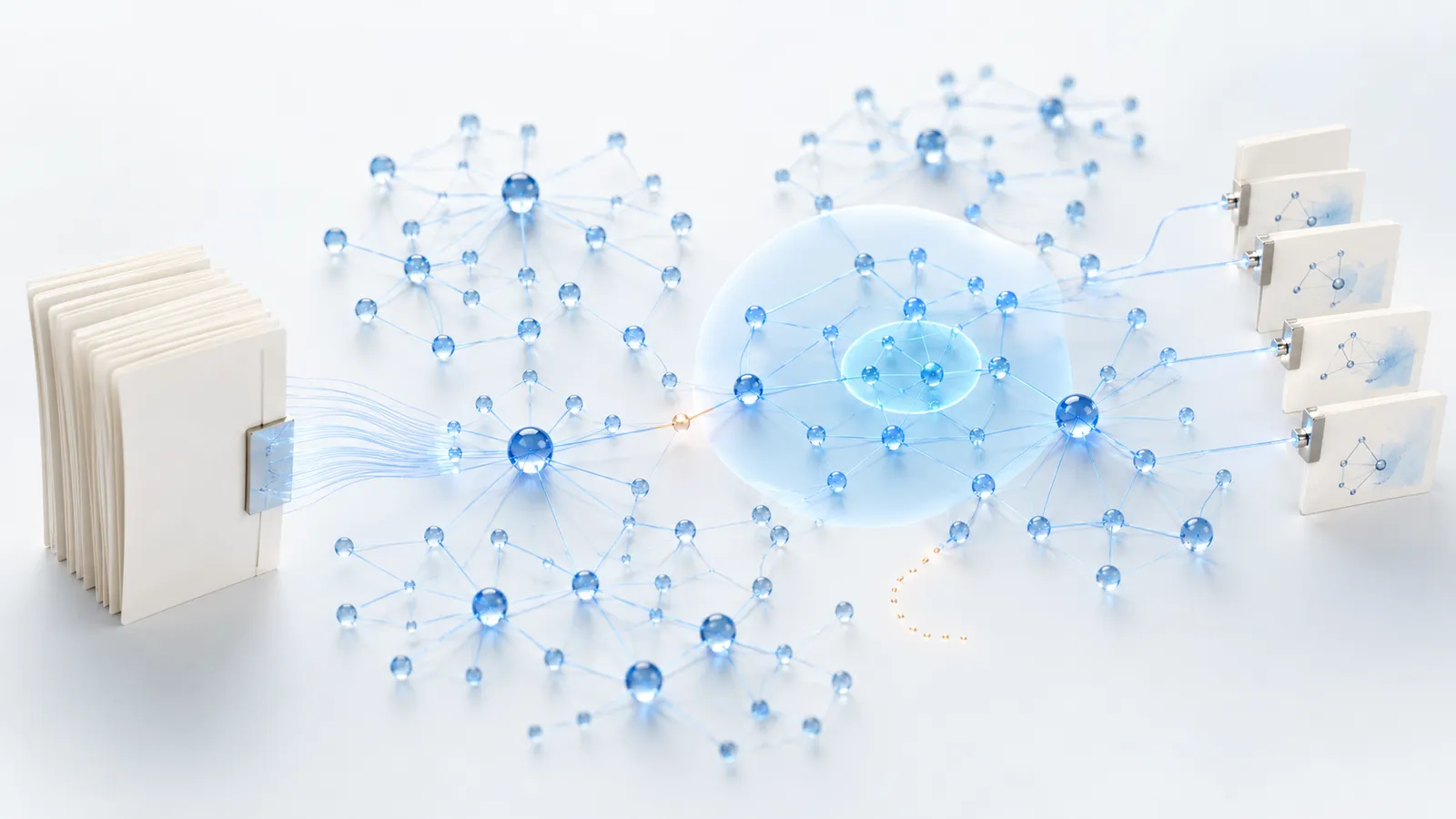
The needle-in-a-haystack metaphor assumes that one recognisable needle is hidden among irrelevant straw. Knowledge work is harder. We often know neither the wording of the evidence nor whether it appears in one document. An answer may emerge from relations among a concept, project, person, decision and later exception.
Vector search treats content as points in similarity space. Graphs add another view: objects and their relations. Retrieval can first identify a probable region—a community, neighbourhood or path—and only then retrieve concrete source passages.
A graph is a decision about meaning
A graph contains nodes and edges. Nodes may represent words, entities, documents, events, rules or data objects. Edges may express co-occurrence, citation, membership, cause, temporal order or a professionally defined relation.
The choice is not neutral. A text network connecting neighbouring words answers different questions from a knowledge graph with typed entities and relations. Co-occurrence reveals discourse structure; it does not prove causality. An edge between „risk" and „control" initially says only that both occur together within the chosen window.
Edges may be directed, weighted and linked to provenance. Without provenance, a relation becomes an unsupported claim. A production graph therefore links every entity and relation back to a passage, document version and extraction run.
Text networks reveal discourse structure
InfraNodus represents text as a network in its documented methodology: words become nodes and co-occurrence creates connections. Network metrics and community detection expose influential terms, thematic clusters and relations. This is useful when a corpus must first be explored.
The visualisation is not finished truth. Frequent words may dominate because of style or document length. Stopword rules, lemmatisation, language, co-occurrence window and filters change the graph. Analyses of the same text may differ when those parameters change.
Every analysis therefore needs reproducible configuration: imported sources, removed or merged terms, version and time span. Only then can a visible community be interpreted professionally.
Centrality shows attention, not automatic relevance
Centrality metrics describe different roles. Degree centrality counts direct connections. Betweenness centrality highlights nodes lying on many shortest paths and potentially bridging communities. Other methods weight important neighbours or edge direction.
A central node is not necessarily the answer. It may be a generic term used everywhere. In retrieval, centrality is one prioritisation signal beside query relevance, source quality, freshness and permission.
Bridge nodes are often valuable because they connect otherwise separated themes. A search for side effects of a decision may move through a bridge from product strategy to support incidents. The bridge suggests a path; underlying documents must still prove it.
Communities limit the probable search region
Community detection groups nodes more densely connected to one another than to the rest of the network. In a corpus, groups may represent topics, projects, actors or recurring arguments.
Retrieval can become a two-stage process. First identify the community matching the query; then search its entities, relations and source passages. This narrows the space without pretending that the first graph hit is the answer.
Boundaries depend on algorithm, resolution and graph construction. A topic may appear as one large group at coarse resolution and several subtopics at fine resolution. Systems should store algorithm, parameters and graph version with results.
Structural gaps are hypothesis spaces
A structural gap appears where two relevant regions are weakly connected. In ideation it may suggest an underexplored combination; in quality work it may reveal a missing relation.
A gap is not a discovery or automatic innovation. Terms may be written differently, a source may be absent, segmentation may have broken a relation, or no professional connection may exist. InfraNodus presents gaps as exploration prompts; responsible use treats them as hypotheses requiring evidence.
A gap workflow identifies the gap, proposes bridge concepts, searches additional sources, imports new evidence separately and tests whether the connection becomes stable. The visualisation guides research, not conclusions.
From graph view to retrieval
A network visualisation is not yet GraphRAG. Retrieval needs stable identities, typed relations, source references, permissions and a query plan. The graph is a navigation layer; answers remain bound to evidence.
A query may begin with entity linking. Mentions are mapped to existing entities. Retrieval then traverses a local neighbourhood: direct relations, relevant paths, community membership and associated chunks. Filters enforce validity, version and access. A reranker orders passages for the question.
The output is not a graph dump but a context packet containing entities, relation statements, community context and supporting chunks. Every relation carries source locations. Uncertain or model-inferred edges are labelled.
● Members only
Read the full article and download all files with a membership.
Unlock full article + downloads → Subscribe0 comments
● Loading comments…