An ethics workshop that allows dissent: roles, power, counterarguments and a decision
An educational format for continuing education and professional practice: three 90-minute sessions, one fictional case, and a reasoned decision that can be revised.

What this is about
An AI ethics workshop can easily fail in a familiar way: a group collects values, quickly finds wording that nobody wants to reject openly, and calls the result consensus. What often remains unclear is who made the decision, whose experience was absent, and what happens when practice contradicts the decision. The most agreeable version of a guiding principle can conceal power differences instead of making them workable.
This article therefore proposes a different task. The group should not have to prove that it agrees. It should work through a bounded decision so that assumptions, counterarguments, affected people, responsibilities and conditions for later revision remain visible. A decision is then not a full stop imposed on dissenting positions. It is a provisional rule for action, with a recorded objection and a route back to the table.
This matters especially where AI prepares work but does not fully automate it. The statement “a human checks it again” answers neither whether that review is possible under real time pressure nor who bears the cost of an error. A voluntary opt-out does not settle the matter either: people who can choose the alternative must understand it, be able to use it without disadvantage, and not feel pressured to justify their choice.
The casework below is entirely fictional. It is not a retelling of a real course or workplace situation, and it does not demonstrate that the workshop is effective.
Learning outcomes
After three sessions, participants can formulate an AI-related decision in a way that keeps the objective, clarification of terms and presumed cause distinct. In F-B, they can develop at least two competing hypotheses and a meta-question about benefit, power or the cost of error. They can distinguish an evidenced statement from an assumption, a value judgment and an open evidence gap. In K’s core cycle, they can map affected people and absent perspectives, represent a counterargument fairly, and formulate a recommendation with responsibility, objection and evaluation. They can explain why human review counts as oversight only under specific conditions of time and expertise, and they can examine a non-AI alternative on equal terms. Their final product is not a consensus paper, but a revised guiding question, a provisional decision and a traceable point of return.
The only case: draft feedback in a continuing-education course
A continuing-education course is considering using AI-generated first drafts of feedback on participants’ written reflections. A trainer reads and revises every draft before feedback is sent. No score is automated, no participation decision is automated, and the system gives no assessment. Participants can object to the use of their reflections for this purpose and then receive feedback without an AI draft.
The proposal sounds cautious. That is precisely why it is suitable for an ethics workshop. The question is not simply, “Is this allowed?” or “Is AI good for feedback?” It is: under what conditions would this approach be justifiable to participants and staff, and when would a non-AI solution be the better decision?
Several conflicts are already contained in that question. First, a first draft may save time but may also pre-shape tone or interpretation. Human review may be careful or may become routine sign-off. Second, participants are not merely data sources. Their reflections may contain uncertainty, criticism or personal learning experiences. Third, the benefit of acceleration may be distributed differently from the work. Trainers have to review drafts, identify errors and take responsibility for every follow-up question. Fourth, an opt-out is a real option only if non-AI feedback is equivalent, accessible and available without stigma.
The workshop does not treat this case as an abstract vote on technology. It asks about the decision situation: who is affected by processing and feedback? Who can identify, stop and correct an error? Who decides on the aim, data flow and exit? Which people are absent from the room although they bear consequences? And which claim about time savings, quality or workload is still only an assumption?
Two working models, two distinct tasks
The workshop sequence uses two models with distinct functions. Neither supplies an ethical answer. Both help organise the work so that a group can test and change its reasons.
The F-v5 question model follows the sequence A → B → D → C. In A, the group clarifies terms, goals and presumed causes: what does “better feedback” mean? Better for whom? Which bottleneck is supposed to be solved? B then opens a space for competing hypotheses and meta-questions. The group does not look only for a technical variant. It asks, for example: could the real problem be too little protected time for feedback? Would a clearer framework for human feedback bring the same benefit? Who benefits from the metric “faster,” and who bears the cost of a misinterpretation? In B, a group may leave several plausible and conflicting interpretations standing.
D is the revision loop. New feedback, missing evidence or an overlooked risk changes the working question and the options. The revision is recorded briefly: trigger, changed assumption or question, and the chosen iteration or fallback. Only C brings together the currently best guiding question or adapted task, the open points, criteria and a next step that can be checked. The handoff also includes a transparent process trace—starting question, important alternatives, feedback, change and open gaps—and a concrete GROW plan: Goal, Reality, Options and Way Forward. This is a planning structure, not an ethics seal. The order matters: the decision does not come immediately after brainstorming. Feedback returns through D before C fixes a question for action.
The K consultation and governance model structures the social and organisational side. Its four-step core is: Exploration → Reflection/Analysis → Decision/Recommendation → Feedback/Evaluation. Exploration makes participants, data, goals, work processes and missing perspectives visible. Reflection/Analysis examines reasons, power relations, risks and options. Decision/Recommendation assigns responsibilities, boundaries and a reasoned rule. Feedback/Evaluation checks what actually happens and, where needed, returns the matter to the question work.
For a later, clearly bounded case, a five-step scenario extension can be used: after Exploration, Reflection/Analysis and Decision comes a limited implementation or Pilot step; Evaluation concludes the sequence. These five steps are not the core of the K model and must not be equated with another five-phase model. In the workshop, the extension serves only to treat the agreed rule as a reversible trial. The core grammar remains the four-step cycle.
The models work together. F-B keeps competing hypotheses and meta-questions open. K-Exploration and K-Reflection/Analysis turn them into a consultation in which roles, voices and consequences do not disappear. When feedback disproves an assumption or an affected perspective changes the decision, the group returns through F-D to revision. Only then does it produce in F-C the current task or Prompt, the process trace and the GROW next step; in the K cycle it formulates a recommendation.
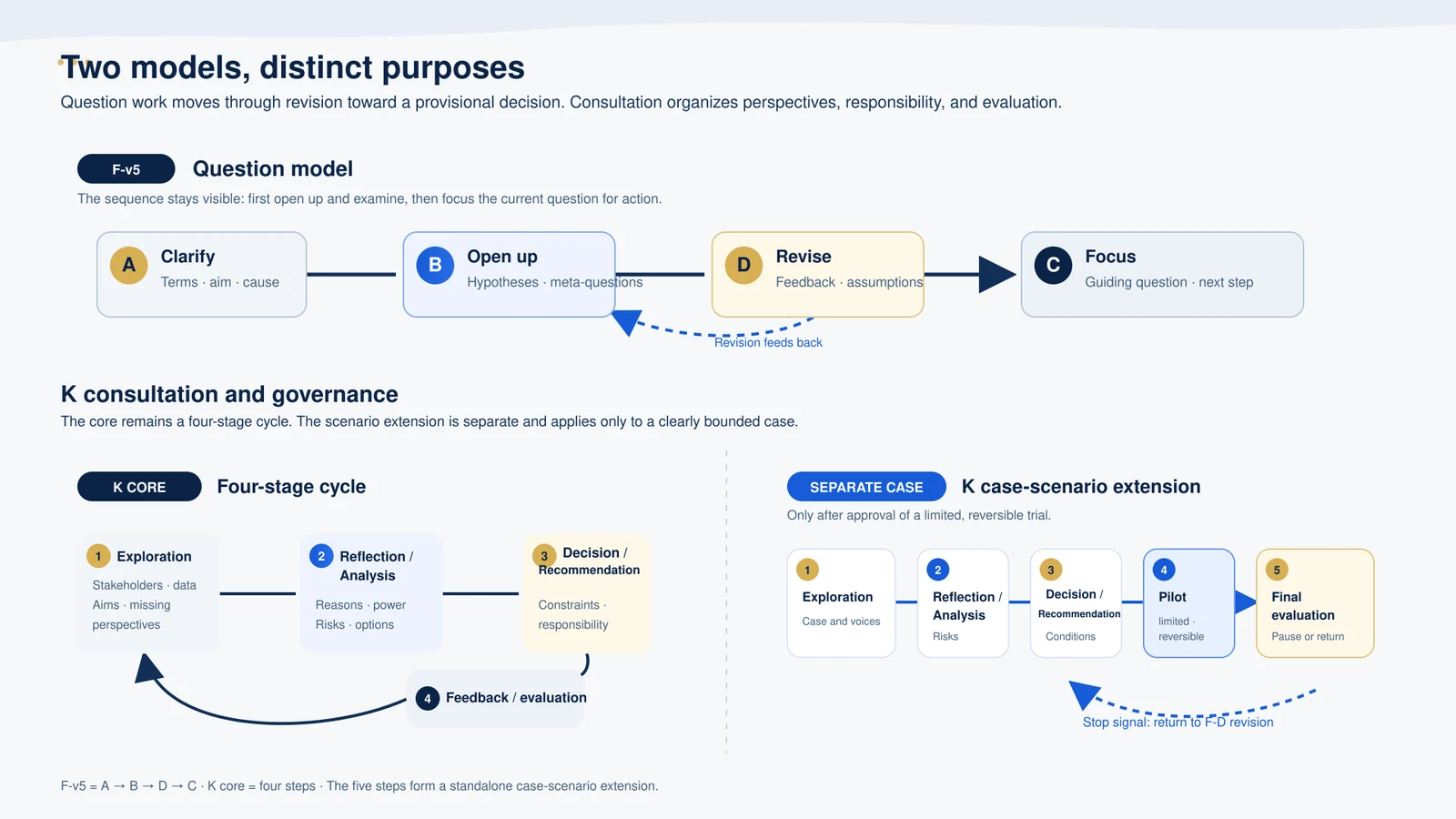
Why roles alone do not solve power
Roles are useful, but they are not neutral. Facilitation that distributes speaking time can prevent one person from determining the workshop. It can at the same time reinforce the false assumption that everyone has the same freedom, risk or language to dissent. In a course, participants may express agreement differently from teachers or programme managers because they depend on assessment, access to certificates or future offers. The person maintaining the technical process may also hold knowledge that others cannot readily examine.
Value pluralism does not mean that every claim is equally well reasoned or that decisions become impossible. It means that important goods—such as access to helpful feedback, privacy, autonomy and fair working conditions—can come into tension without being reducible to one common metric. Isaiah Berlin develops this idea in “The Pursuit of the Ideal” as a philosophical argument about human purposes. It does not entail arbitrary choice in this exercise: the group must examine reasons, make costs visible and state whose interests an option burdens. It may not, however, pretend that every conflict has a neutral overall score. This is a philosophical lens, not empirical evidence about AI feedback or the effectiveness of this workshop.
Roles in the workshop are therefore not theatrical labels. Each role receives a bounded task and a right to challenge something. The “affected-perspective” role does not claim to speak for all participants. It checks which affected people are absent and which questions must be returned to them. The “work consequences” role asks not only about efficiency, but also about time, qualifications, hidden extra work and the actual ability to refuse a review. The “evidence and assumptions” role separates what is evidenced from what is presumed. It may not replace a statement with a better guess; it marks the gap.
Management or an assigned decision role remains able and accountable to decide in a real organisation. The workshop must not simulate away that responsibility with a circle of chairs. If the person with decision-making power is absent, that limitation is recorded on the decision sheet. If they are in the room, a special rule applies: they speak last in the first analysis phase, may not frame a position as the expected course answer, and must address the recorded counterposition. Dissent is thus not without consequence, even when the final decision is not unanimous.
This attention to difference can be sharpened philosophically. Iris Marion Young argues that democratic communication must accommodate different forms of expression and social difference rather than demand an apparently neutral single voice. That is a lens here, not confirmation of the F or K model and not evidence that this workshop format works. It does, however, clarify a practical question: which discussion rule makes divergent experiential knowledge audible without dismissing it as merely a “personal opinion”?
The UNESCO Recommendation on the Ethics of Artificial Intelligence likewise places participation, transparency, responsibility and protection of human dignity in a normative relationship. It does not turn this course sequence into a legally binding assessment and does not replace local analysis of data, roles or responsibilities. As a second lens, it reminds us that people who bear a system’s consequences should not first be informed after the decision has been made.
The sequence: three 90-minute sessions
The format is designed for 12 to 24 people. In smaller groups, roles can be combined; in larger groups, two or three parallel groups work on the same case and then compare their decisions. There is deliberately only this one case. Further examples would diffuse attention and might imply that the same decision has to be found for every application.
Before the workshop, the facilitator prepares a case sheet, role cards, a visible board for evidence and assumptions, and a decision and carry-over sheet. The materials describe no real software and contain no personal reflection texts. The fictional case description is sufficient as a data basis. If the group adds external information, its source, date and scope are recorded on the evidence sheet.
Session 1: Open the question before discussing solutions
0–10 minutes: Safety framework and purpose. The facilitator explains: nobody will be assessed on whether they support AI. Assessment concerns the quality of reasoning, engagement with counterarguments, and the ability to reconsider one’s starting position for good reasons. Statements about personal experience are voluntary. Nobody has to disclose private learning or work situations. There are three routes for participation: speaking, a written card, or a confidential note to the facilitator. Notes are introduced into discussion only in anonymised, summarised form, if that is requested.
10–25 minutes: Read the case and clarify terms in F-A. Each person marks terms that remain undefined in the case: “first drafts,” “review,” “equivalent feedback,” “opt-out,” “time saving,” “confidential reflection.” The group does not then decide what these terms mean once and for all. It writes working definitions and the corresponding test questions. For example, human review is more than a click only if review time, relevant expertise, the right to intervene and documented correction are possible.
25–40 minutes: Cause and non-AI options. In small groups, participants investigate what problem is actually to be solved. The bottleneck may be the number of reflections; a shared feedback framework may be missing; paid preparation time may be lacking. Each group must formulate at least one non-AI option. This may be a clearer feedback framework used by trainers, a different rhythm for feedback, or additional protected working time. The non-AI option is not mentioned as a symbolic requirement; it is tested against the same criteria as the AI option: quality, time, workload, access, consequences of error and reversibility.
40–65 minutes: F-B with competing hypotheses and meta-questions. Groups now open at least three competing hypotheses: (1) AI drafts give trainers more time for individual additions. (2) AI drafts produce a template that pre-shapes review and may reduce quality. (3) The core problem is organisational; AI merely changes where work becomes visible. For each hypothesis, the group formulates a meta-question about power or distribution: who sets the target metric? Who can test the claim of time saving? Which person bears the consequence when feedback misreads a learning process? The result is not a collection of as many questions as possible. It is a manageable space of plausible interpretations that may conflict.
65–80 minutes: Separate evidence and assumptions. A board has two columns: “evidenced in the case or by a source” and “assumption/still to be checked.” The facilitator makes sure that a persuasive expectation does not slip into the first column. In the fictional case, it is given that every draft is to be reviewed by a trainer and that an opt-out is planned. Time savings, acceptance, error rate, equivalence of the alternative and actual depth of review are not evidenced. The group may leave statements marked “unknown.”
80–90 minutes: F-D, brief revision and handoff. Each group writes its starting question and a revised question. A possible revision is: “Under which documented conditions does an AI draft fully reviewed by trainers improve feedback without weakening equivalent access to non-AI feedback or professional responsibility?” The question remains provisional. Open assumptions and missing perspectives are handed over to Session 2.
Session 2: Conflict, affected people and the limit of voting
● Members only
Read the full article and download all files with a membership.
Unlock full article + downloads → Subscribe0 comments
● Loading comments…