Automation increases the need for control
Automation removes work steps, not accountability. The faster a system can act, the farther it can reach and the more often it can repeat decisions, the more precisely its boundaries, signals and intervention points must be designed.
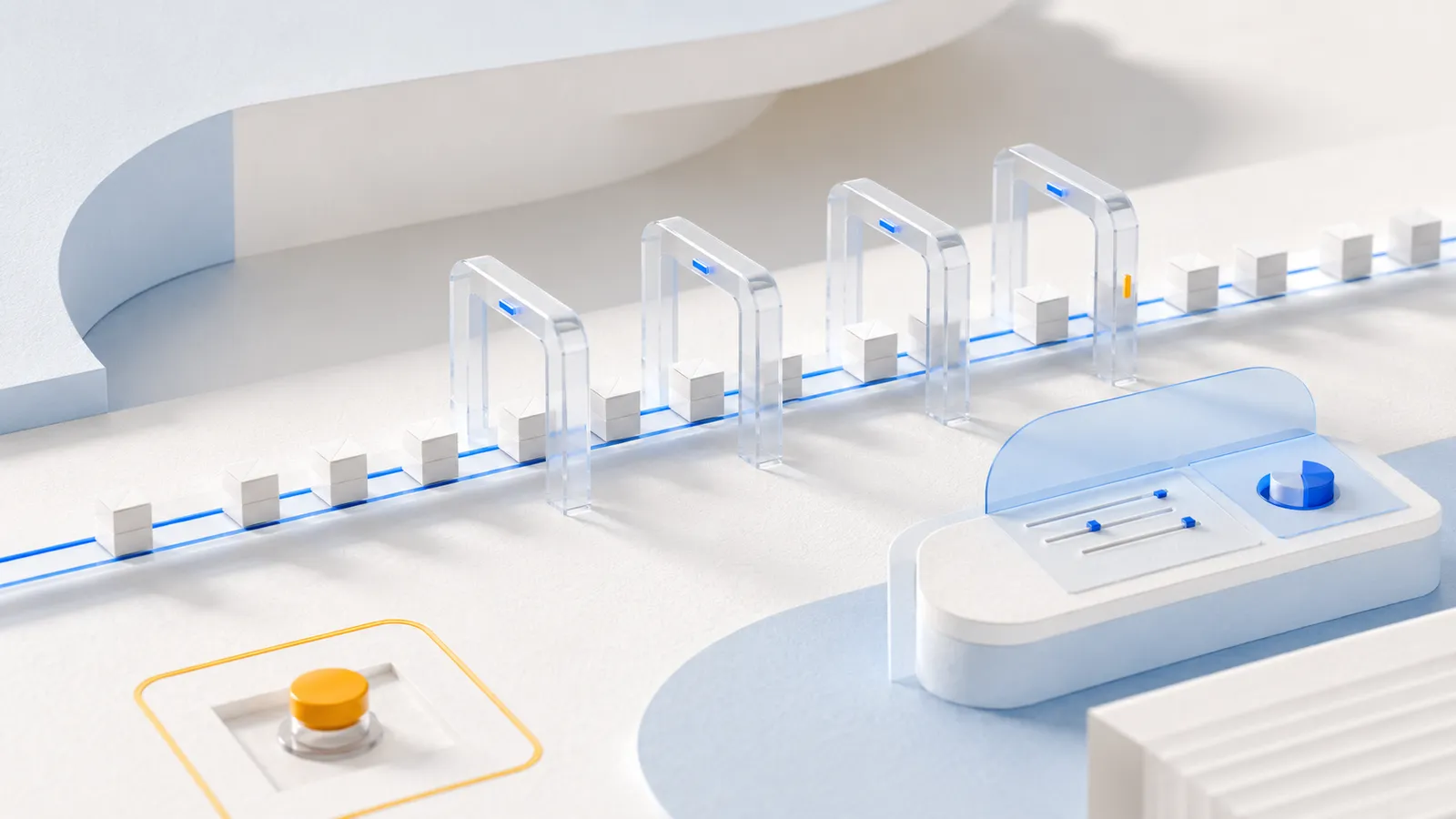
Human attention is present in every step of manual work. That process is slow and fallible, but it creates natural pauses. Automation removes the friction. A wrong record is classified not once but ten thousand times; an untested rule changes a collection rather than one file; a faulty message reaches a list rather than one person.
Control increases not because automation is inherently unsafe, but because speed, reach, repetition, chaining and invisibility multiply impact. Good control does not manually replay every automated step. It directs human attention to edge cases and consequential transitions while technical controls constrain routine execution.
Control must grow with impact radius
Step count is a poor measure of risk. Potential effect matters. Five hundred read queries against an isolated test copy may be safer than one write to a production master record.
An impact profile considers at least data sensitivity, target breadth, reversibility, external visibility, financial or legal consequence and propagation speed. Model uncertainty and task novelty add context. The combination does not produce a magical universal score; it supports a reasoned control class.
Control is proportional. Low-risk routine may flow. High-impact work needs narrower rights, smaller batches, stronger evidence and explicit approval.
An autonomy ladder replaces all-or-nothing thinking
Useful levels sit between manual work and unrestricted autonomy:
1 · Observe: read and analyse without changing anything.
2 · Recommend: propose actions with rationale and evidence.
3 · Prepare: create drafts, patches or transactions in isolation.
4 · Execute with approval: an authorised person confirms the concrete action set.
5 · Execute within limits: act independently inside narrow targets, quotas and time windows.
6 · Scale after evidence: expand reach only after stable results and review.
A task need not remain at one level. A new source, changed model, unfamiliar format or abnormal error rate can automatically downgrade it. Autonomy is a revocable operating licence, not a permanent property.
Risk budgets turn caution into executable boundaries
„Be careful" is not a control. A risk budget translates tolerance into measurable limits: maximum changed objects, allowed data classes, destination paths, cost, duration, error rate, external recipients and irreversible actions.
Budgets apply per run and cumulatively. Ten individually small actions may create one large effect, so volume and consequence are counted across time windows. Reaching a boundary stops execution or moves it into approval mode.
The executing agent cannot raise its own budget. A separate policy or owner decision changes the boundary. Control therefore remains outside the system that would benefit from relaxing it.
Approval gates belong before impact
A notification after execution is not approval. A gate precedes the consequential transition and shows the exact target, action, scope, data class, expected diff, risks, recovery route and evidence.
Approvals should be neither blanket nor incessant. „Approve all next steps" hides the action set; prompts for every harmless row create fatigue. Semantic batches are better: one bounded patch, recipient list, publication package or deletion set.
Very high impact may require dual authorisation from independent roles. It is not universal, but it is useful for irreversible, regulated or unusually broad changes.
Observability is more than possessing logs
A log may exist and still be useless. Controllable automation needs correlated signals: What was requested? Which versions, data and tools were used? Which decision caused a call? What changed? How long did it take? Which warnings appeared?
Traces connect steps across a run. Metrics expose volume, latency, error rates and budget consumption. Logs explain events. Shared run, project and action identifiers join the signals. Sensitive payloads and secrets are minimised or masked; observability must not become an unprotected second data store.
A dashboard becomes control only when thresholds lead to response. Every alert needs an owner, priority, escalation path and response expectation. Symptom-oriented alerts ask whether impact or a service objective is violated, not merely whether an internal component looks unusual.
Stop rules must be fast, external and tested
The executing system must not reason its way around a stop. Rules live outside freely editable instructions. They trigger on wrong destinations, exhausted budgets, repeated validation failure, missing approval, abnormal spread or loss of observability.
Several levels are needed: deny one action, pause the run, revoke write access, block a queue or isolate the service. An untested kill switch is decoration. Exercises verify that active jobs stop, credentials are revoked and queued actions do not resume unnoticed.
Stopping is only half the control. Recovery captures state, avoids duplicate processing, identifies affected objects and chooses rollback, correction run or manual handling.
● Members only
Read the full article and download all files with a membership.
Unlock full article + downloads → Subscribe0 comments
● Loading comments…