The hybrid AI architecture
Sovereignty does not come from running everything locally or everything in the cloud. It comes from deliberate routing, bounded hand-offs and dependable ways back.
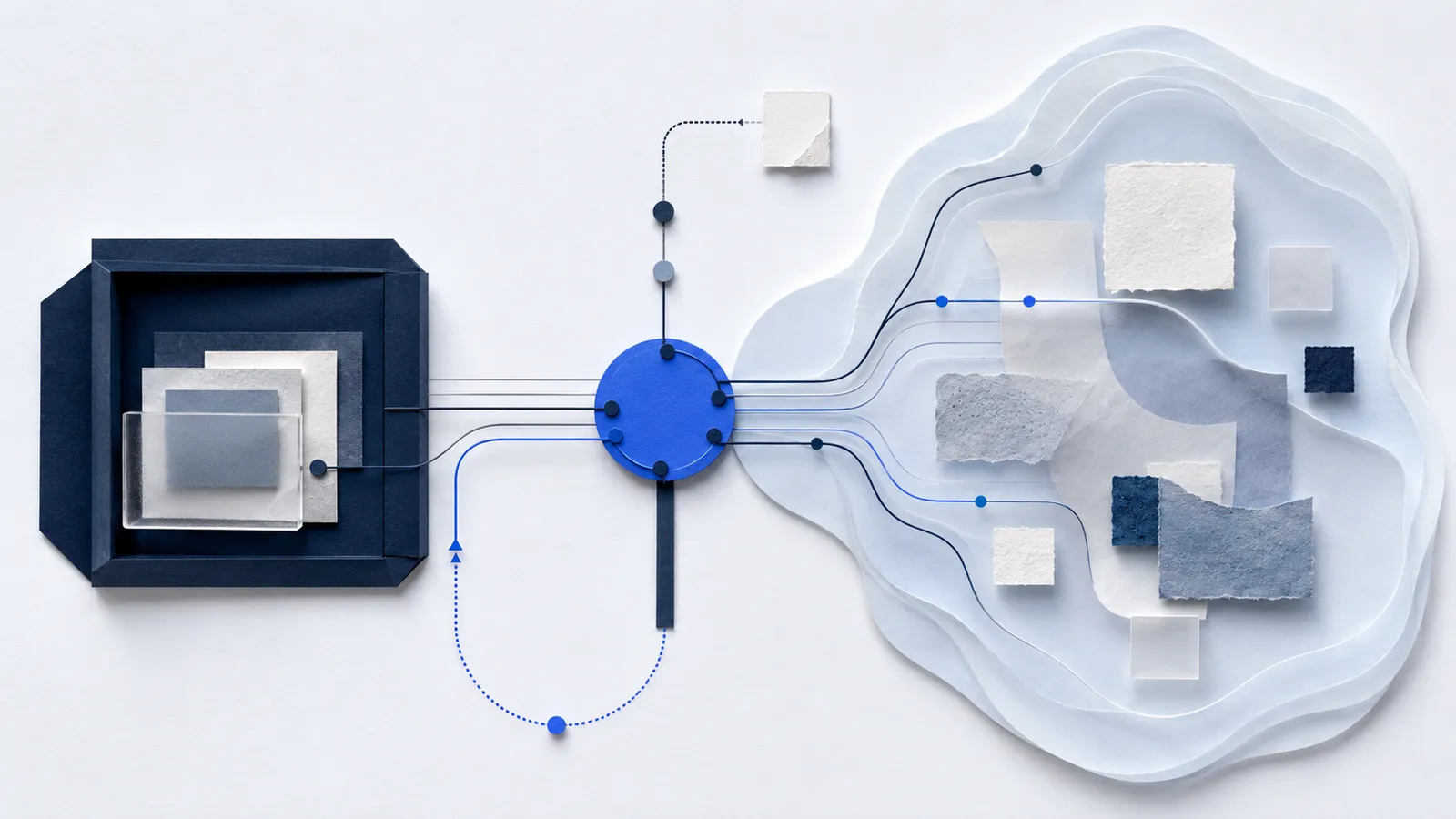
The choice between local and cloud AI is often framed as a matter of belief. Local means control; cloud means capability. Real projects are less simple. Public research, confidential document analysis and automated approval have different requirements. A hybrid architecture does not assign a whole organisation to one place. It breaks work into steps and asks at each one: Which data is needed, which capability matters, what effect may occur—and how can the outcome be verified?
Hybrid is division of labour, not compromise
A weak hybrid setup distributes tasks randomly across tools. A strong architecture gives each execution environment a clear role. Sensitive preprocessing may stay close to the data, a capable model may work on sanitised material and an independent verification layer may check the outcome.
The benefit is not connecting the largest number of systems. It is separating responsibilities. Data custody, processing, generation, verification and approval need not happen in the same place, but their transitions must be visible and justified.
Hybrid design therefore assigns every step the environment warranted by its data, capabilities and consequences. Architecture follows the work rather than the convenience of one tool.
Five criteria determine where work runs
The first is sensitivity. Which data does the step truly need, and may it leave the controlled area? The second is capability: Does the task require particular model quality, a large context window, images, tools or high speed?
Third is cost—not only price per request, but operation, maintenance, staff and verification load. Fourth is latency: Must the answer be immediate, can work be batched or can it run in the background? Fifth is verifiability. The harder an outcome is to check, the more tightly its effect should be bounded.
These criteria interact. A cheap model becomes expensive when every outcome requires repair. A powerful model is unsuitable when the required data cannot enter its environment. Routing is not a ranking of models; it is a mapping of requirements.
Three zones make the architecture readable
The controlled zone handles highly sensitive information, identities, internal raw data or secrets. It reduces, anonymises, extracts and checks material before transfer. It may be local or otherwise tightly controlled; access and purpose limitation matter more than the label.
The protected work zone contains approved internal information. Models can create drafts, analyses and structured intermediates there while access, logging and retention remain defined. The open capability zone uses only public, synthetic or sufficiently sanitised material and can employ specialised capabilities flexibly.
A task may cross zones, but never as an invisible bulk transfer. Every hand-off names fields, removal steps, purpose and return path. Data minimisation becomes a technical interface, not merely a policy statement.
The router needs rules, not intuition
A router may be a technical service, workflow or human-maintained decision table. Its role is the same: classify material, read requirements and choose an allowed execution path. It must not decide solely by model quality or availability.
Good routing rules are legible. If personal raw data is required, preprocessing stays in the controlled zone. If only a public sanitised excerpt is needed, generation may move to the open zone. If an outcome has external effect, independent review precedes approval.
Uncertainty is itself a routing condition. If sensitivity cannot be classified safely, the process chooses the tighter zone or stops. Automated routing is responsible only where its classification remains testable.
Fallbacks make architecture resilient
A hybrid architecture cannot assume that every model and service is always available. Outages, capacity limits, cost changes and quality problems must be planned. A fallback is not simply the next model in a list.
The replacement path must preserve the same data and effect boundaries. If a powerful service is unavailable, the process might create a smaller local version, reduce scope, queue the work or deliberately stop. None should silently open another data zone.
Resilience also includes degraded modes. A system may temporarily classify rather than draft, produce drafts rather than publish or use approved sources only. Less function is often safer than uncontrolled substitution.
● Members only
Read the full article and download all files with a membership.
Unlock full article + downloads → Subscribe0 comments
● Loading comments…