The order before the answer
Data as the operating system of artificial intelligence. A long-form essay: the quality of AI is not created first in the answer, but in the order that makes an answer possible, reviewable, and accountable.

Prologue: The Answer Begins Long Before the Answer
The answer was excellent.
It was precisely structured, concise enough for an executive brief and detailed enough to appear thoroughly professional. It presented three options, assigned an expected benefit to each, and ended with an unambiguous recommendation. Nobody in the room needed to ask what the system meant. It had performed the linguistic task exactly as one would expect from a capable artificial intelligence.
Only the recommendation was wrong.
The model had not misunderstood the question. The prompt had not been too short. Nor was the decisive information absent from the records. It existed in several versions: an early presentation, a later meeting note, a corrected table, and a short approval notice that superseded the earlier position. The people involved knew which version applied. The system knew only which version contained the fullest explanation and most closely resembled the wording of the question.
The older draft won.
It did not win an argument. Nobody had confirmed it as true. It was preferred by a technical selection chain whose criteria had been mistaken for professional validity. The file contained more matching terms, more extensive explanations, and several formulations semantically close to the query. The valid approval was shorter. Its filename was unremarkable. It lacked an explicit status field. The relation „supersedes the earlier draft" existed only in human memory.
The system therefore did what it could: it created a plausible order from the signals available to it. It then expressed that order in language that sounded certain.
This episode captures one of the central misunderstandings of our time. We inspect the visible answer and look for the source of its quality in the model. We improve prompts, change tools, enlarge context windows, and add more elaborate role descriptions. Yet a substantial part of what later appears as intelligence has already been determined before the model generates its first sentence: by the selection of sources, file formats, status fields, permissions, versions, relationships, and the rules that determine what the system is allowed to see.
An answer therefore does not begin with text entered into a box. It begins with the question of what kind of world the system encounters.
Can it distinguish a draft from an approval? Does a number retain its reporting period? Does the origin of a statement survive multiple transformations? Can the system tell whether two documents describe the same fact or merely use the same words? Can a withdrawn source also be removed from derived indexes, summaries, and intermediate outputs? Is the system permitted only to read information, or may it use that information to alter files, prepare decisions, and trigger effects beyond the screen?
These are not peripheral housekeeping questions. They determine what an AI system can do, what it can justify, and where its reliability ends.
The dominant story of artificial intelligence is a story about models: larger or smaller, open or proprietary, local or cloud-based, specialised or general. Models matter. In real applications, however, they are only one component in a longer chain. Before them lie sources, data models, access rules, and selection mechanisms. After them come reviews, approvals, storage operations, and actions. Between these stages, new states arise. They may be reused, modified, forgotten, or mistakenly elevated into truth.
Anyone who looks only at the model sees the most spectacular part of the system and misses its operating system.
That operating system is not a single product. It is the order through which data acquires meaning. It determines which source is active, which relationship applies, which uncertainty remains visible, and which step requires a human decision. It turns files into a governed knowledge space and a generated answer into a reviewable state of work. Without that order, even a highly capable model remains an eloquent guest in a building without a floor plan.
This essay is about that floor plan. It begins with the data foundation, moves through origin, formats, knowledge architectures, and retrieval, and reaches agentic systems that no longer merely read their environment but change it. It asks how autonomy can be bounded, quality evaluated, and data sovereignty made operational. It follows a simple but far-reaching proposition:
The quality of artificial intelligence is not created first in the answer. It is created in the order that makes an answer possible, reviewable, and accountable.
I. The Data Foundation Is the First Model Decision

A model does not see an organisation; it sees signals
People move through organisations with a large reserve of tacit knowledge. They know that a presentation was only an interim draft, that a spreadsheet belongs to an earlier quarter, or that a folder labelled „Final" does not contain the version that was eventually approved. Such knowledge is rarely documented in full. It lives in habits, conversations, responsibilities, and memory.
An AI system does not possess these certainties. It receives signals: text, filenames, timestamps, metadata, similarities, links, access rights, and the results of technical filters. When an important signal is absent, the result is not necessarily a visible gap. Often it is an estimate. The system selects the most plausible interpretation from the patterns still available.
That is both the strength of generative systems and a source of risk. They can bridge incompleteness through language. A strictly schema-oriented system may explicitly mark a missing value as null. A language model may instead compose a fluent sentence from neighbouring information. A reader may then struggle to tell whether the sentence came from one unambiguous source, from a synthesis of several sources, or from an addition made by the model itself.
The data foundation is therefore the first model decision even though it is often built long before a model is selected. Those who collect sources, separate workspaces, define statuses, assign permissions, and establish update paths determine the future system's field of possible knowledge. These decisions form an invisible pre-architecture: they decide what may become a candidate, what will be excluded, and which distinctions are machine-readable at all.
A document is not yet knowledge
A file may contain information without being usable as project knowledge. It may be inaccessible, incomplete, outdated, duplicated, or misclassified. It may record an important decision without indicating that the decision was later withdrawn. It may be technically readable and still lack the professional context required for proper use.
Several state transitions lie between raw material and operational knowledge.
Information must first be captured. The system must then identify the kind of object it is dealing with: a document, version, section, dataset, decision, or derived output. The object subsequently needs relationships. A table belongs to a report. A decision supersedes a draft. A section explains a metric. A translation derives from a specific source version. Only then can a system select the information purposefully and use it in a particular working context.
People perform many of these transitions unconsciously while reading. Headings, layout, and file order communicate meaning to them. During extraction, that meaning may disappear. A multi-column report becomes text blocks in the wrong sequence. A table becomes values without units. A meeting note becomes sentences without speakers or decision status. The content remains, but the conditions under which it may be used have been damaged.
A knowledge system must therefore preserve more than words. It must preserve the structure that explains how those words are to be understood.
The actual AI application emerges between code and data
A model on its own knows neither the current state of a project nor the rules of an organisation. The surrounding software connects inputs, sources, filters, retrieval, tools, permissions, and outputs into an application. The visible text generator is only part of that system.
The application's behaviour may change while the model remains identical. A new chunking rule changes which passages are retrieved together. A status filter removes drafts from the active search space. An updated terminology map brings synonyms together. A revised permission prevents confidential material from entering an answer. A new approval rule stops a file change before it becomes effective.
These examples show why AI quality cannot be described usefully as a property of the model alone. It is a system property. It arises from the interaction of data and code, professional definitions and technical contracts, retrieval and review.
A data contract makes this interaction explicit. It states which fields are expected, which units apply, which values may be absent, how freshness is measured, and what happens when a rule is violated. The contract does not promise that every value is true. It makes expectations testable. A pipeline can detect a missing unit, a date outside an admissible range, or a source without an approval status. Without a contract, these same problems remain irritating irregularities that surface only when the system produces a faulty answer.
The decisive architectural question is therefore not: Which model is the smartest? It is: Which chain connects a professional purpose with data, mechanism, control, and effect?
Quality begins with a purpose
„Clean data" is not a universal state. Data may be complete and still be unusable. A comprehensive list of historical contacts is of little help when current reachability matters. An exact record of a discussion may be unsuitable for a decision if it documents only an option that was rejected. A correctly measured number may mislead if its time period does not match the question being asked.
Data quality is purpose-dependent. Before values are cleaned, duplicates removed, or fields completed, the decision or action that the data is meant to support must be defined. Only then can the relevant dimensions be chosen: freshness, completeness, consistency, accuracy, uniqueness, representativeness, or traceability.
This sequence protects against a common kind of false precision. Teams invest heavily in the formal improvement of a dataset without asking whether the dataset represents the decision they need to make. Missing decimal places are corrected while the decisive target group is systematically absent. Filenames are standardised while nobody knows which versions are valid. A quality score rises while practical reliability remains unchanged.
A purpose-specific quality profile translates the objective into rules. A knowledge base intended to answer questions about current policy, for example, needs a validity period, approval status, accountable role, and visible supersession relation. A system intended to analyse customer statements may instead depend more heavily on representativeness, language, collection method, and potential bias. The same data can have different quality for these two purposes.
The question „Is the data good?" is replaced by a more precise one: „Is this data, in this state, sufficiently reliable for this task?"
More context can mean less orientation
When an answer appears incomplete, the intuitive response is to provide more material. Additional documents seem to increase the chance that the correct information is present. Yet a larger corpus also enlarges the space of possible mistakes.
Duplicate statements may appear several times in retrieval and seem more important than they are. Old interim versions may be linguistically richer than valid short approvals. Related documents may fill the available context even though they have no authority for the decision at hand. A system with a great deal of context may therefore see more facts and still understand less clearly which ones matter.
The answer is not artificial scarcity but curated accessibility. An active workspace contains the sources approved for a task. An archive preserves history, evidence, and rejected alternatives without allowing them to participate unfiltered in every answer. Rules stand between these two spaces: status, period, permission, purpose, and, where appropriate, an explicit research request.
The separation may be physical, through folders, or logical, through metadata. What matters is the distinction between „available" and „active for this use". A historical draft may remain discoverable without possessing the authority of a current approval. A confidential dataset may be catalogued without entering the candidate space of an unauthorised query.
Context quality is thus the craft of justified selection. It asks not only what can be added but also what must be excluded from a particular step.
The smallest unit of the foundation is a governed object
A robust data foundation does not necessarily begin with a large platform. It can begin with a small data card. The card describes an important object so that people and machines can recognise its role: stable identifier, type, source, status, validity, accountable role, protection class, relationships, and review date.
The value of such a card does not lie in the number of fields it contains. Every field must have an effect. Status determines whether the object appears in the active space. Validity bounds its use over time. Protection class controls access. A supersedes relation connects a new version with the one it replaces. A review date prevents information that was once confirmed from silently remaining valid forever.
This creates a small contract between professional meaning and technical implementation. The domain side defines significance and responsibility. The technical side implements filters, validations, and warnings. The system does not acquire absolute truth, but it acquires the ability to justify how it handles information.
Artificial intelligence can support this process. It can propose document types, identify possible duplicates, flag unusual values, and group contradictory statements. Yet for critical fields, a proposal must not silently become reality. A machine-suggested protection class is not an authorisation. A presumed approval is not approval. A detected successor becomes the valid version only when an accountable decision confirms the relation.
Human beings remain central not because machines are incapable of sorting data, but because purpose, meaning, and permissible consequences must be owned.
A foundation is not a project phase; it is an operating state
Data preparation is often treated as a phase completed before the „real" AI project begins. The system is then expected to move into production. This model fits poorly with living information spaces. Sources change, terms are redefined, responsibilities shift, errors are discovered, and decisions are withdrawn.
A data foundation must therefore be maintained. Inventory, qualification, curation, delivery, and evaluation form a recurring cycle. New sources are not merely uploaded; they are classified. Changed versions are not merely stored; they are connected to their predecessors. Retrieval is not merely monitored technically; it is tested with real questions to determine whether valid and permissible evidence is being found.
Production readiness begins after the demo. A demo proves that a system can produce a convincing result under prepared conditions. Operations means that the same application can withstand change, contradiction, missing information, and permission boundaries. It must not only avoid errors but make them visible. It needs observability: Which source was retrieved? Which filter applied? Which version was in the index? Why did a question remain unanswered? Where was a human decision required?
The data foundation is therefore not a static layer beneath the application. It is a controlled operating state. That leads directly to the next question: when information changes, how can a system know which statement was allowed to apply at which point in time?
II. Truth Requires Origin, Time, and Status

Operational truth is not a permanent label
The word truth becomes dangerous in technical projects when it is treated as a fixed property of a document. A report can be factually correct and no longer current. A decision may once have been valid and later superseded. A number can be exact but belong to another reporting period. A source can be authoritative and still represent only part of a situation.
For AI systems, it is therefore often more useful to think in terms of a governed state of validity than timeless truth. A statement may be used because its origin is known, its period is appropriate, its status is confirmed, and its purpose is permitted. These conditions can change. What served as the valid basis yesterday may be historical today.
The task of a knowledge system is not to hide this changeability. It must be able to represent it.
Repetition is not confirmation
People and search systems tend to treat repetition as a signal of importance. In many settings this is reasonable. If independent sources confirm the same fact, confidence may increase. In organisational repositories, however, repetition often reflects copying rather than independent evidence.
A number moves from a spreadsheet into a presentation, from the presentation into a meeting note, and from the note into a summary. Four documents now contain the number, but there is still only one evidential origin. If the source value was wrong, copying has amplified the error without creating any new confirmation.
This distinction matters for retrieval. A system that ranks passages independently may return several descendants of the same source. The answer then appears to rest on broad evidence even though all passages belong to one provenance chain. Duplicates are not only a storage problem; they can distort the visible balance of evidence.
Reliable systems group derivations by origin. They distinguish independent confirmation from repeated transmission. This does not mean removing every copy. A presentation, report, and meeting record serve different purposes. It means preserving the relation between them so that multiplicity is not mistaken for corroboration.
A golden record is not a golden filename
The idea of a golden record promises one dependable reference point. Its value is real, but the term is often simplified into „the one correct file". In practice, a golden record is better understood as a governed state with a defined process.
It needs a stable identity, a professional scope, recognised source inputs, validation rules, an accountable owner, and a lifecycle. It must be clear who can resolve conflicts, what triggers an update, when the record is reviewed, and how a new state supersedes the old one.
For a customer identity, the golden record may be assembled from several systems. For a policy, it may be the approved version of a document. For a metric, it may be a calculated data state with a documented formula and closed reporting period. In every case, authority is a relationship between content, process, and responsibility.
There need not be exactly one golden record for every possible question. Different purposes may require different governed views. An operational address, billing address, and legally registered address may all be correct if their scope is explicit. The demand for a single truth must not erase legitimate professional plurality.
A golden record creates clarity when it orders differences. It creates false certainty when it conceals them.
Provenance turns a result into a path
An answer becomes more defensible when its path of creation can be reconstructed. Provenance describes that path. It connects entities, activities, and agents: an original document, an extraction step, a cleaned table, an index, an answer run, a reviewing role, and an approved output.
This chain is more than a source link at the end of a text. A link shows where information can be found. Provenance shows how it was transformed. Was the document processed through optical character recognition? Were units normalised? Was a passage summarised or translated? Which versions of tools and rules participated? Which inputs were rejected? Who confirmed the professional meaning?
The unchanged original is an important anchor. Transformations should not silently replace it. Each derived representation receives its own identity and an explicit relation to its source. This makes it possible to locate an error: did it already exist in the original, arise during extraction or harmonisation, enter through retrieval, or appear only during synthesis?
Provenance is infrastructure for follow-up questions. It supports reproduction, correction, and withdrawal. It does not automatically prove that a statement is true. A fully documented chain may perfectly preserve the history of a professionally incorrect value. Origin does not replace source criticism or domain validation. It identifies what those reviews must examine.
Metadata gives provenance an operational form
Provenance has little effect if it is described only in a report written after the fact. It must be embedded in the objects and processes themselves. Metadata translates origin, time, and status into fields and relationships that technical systems can use.
Precision matters more than volume. A field named updated_at may refer to a content revision, an export date, or the last write operation in a filesystem. A field named approved remains ambiguous unless it is clear who may set it and for which purpose approval applies. A date without a time zone can misrepresent a state in distributed workflows.
Good metadata therefore begins by identifying the object being described. Documents, versions, sections, datasets, model artefacts, and AI outputs are different entities. They need stable identifiers and should not disappear into vague file identity. A filename such as final_new_2 may be a human workaround, but it is not a dependable version model.
Status values also require defined meaning. draft, reviewed, approved, superseded, withdrawn, and archived do more than describe a sequence. They trigger different rules. A draft may be acceptable for exploratory work but not for an external recommendation. A superseded version remains available for audit and history but should not enter a current answer without clear labelling. A withdrawn source may require the immediate review of dependent outputs.
Metadata is therefore operating logic. It determines what can be searched, displayed, combined, blocked, or escalated.
Time is a data relationship in its own right
Many conflicts look like contradictions even though they describe different moments. A revenue value may differ between January and February without either being wrong. A policy may contain different rules before and after an amendment. A project state can be „under review" in the morning and „approved" in the evening.
One modification timestamp is often insufficient for reliable processing. Time-critical applications benefit from distinguishing event time, valid time, and processing time: When did something happen? For which period does the information apply? When was it captured or transformed by the system?
The distinction becomes particularly important when delayed data arrives. A dataset imported today may correct an event from yesterday. A decision recorded after the fact may apply from an earlier effective date. Without temporal modelling, the new state overwrites the old one and the former knowledge state becomes impossible to reproduce.
A governed system should be able to answer two different questions: What did we know at that time? And what was valid at that time? The first concerns the information available then; the second concerns professional validity. For audits, incident analysis, and fair evaluation, the difference can be decisive.
Uncertainty must not disappear into style
Not every source conflict can be resolved through a golden record. Sources may contradict one another, remain incomplete, or use different methods. An accountable approval may be missing. A value may be plausible but insufficiently supported. Generative systems are linguistically capable of smoothing such fractures. This is precisely why the data architecture must carry uncertainty explicitly.
Uncertainty can be represented through a status, interval, confidence indicator, conflict relation, or open question. What matters is that it survives beyond a footnote and affects what the system is allowed to do. An unresolved critical discrepancy may limit the answer, require several scenarios, or trigger a human decision path.
Ignorance also has different states. „Unknown", „not collected", „not applicable", „not yet reviewed", and a technically empty field do not mean the same thing. If they are all represented as missing values, important information about the cause of the gap disappears.
A good system therefore does not appear intelligent because it always gives an unambiguous answer. It appears reliable because it recognises when ambiguity is not justified.
Versioning becomes useful only through professional meaning
Technical version control can preserve every state of a file. Operational traceability requires more. It must be clear why a state changed, what effect the change has, and which dependent objects may be affected.
A new version may correct a typographical error, alter professional meaning, or withdraw the content entirely. These cases need different reviews. A compatible addition may require only re-indexing. A changed definition may break historical comparisons. A withdrawal may require previously generated outputs to be marked or retracted.
Versioning therefore needs a reason for change, accountable role, approval, effective date, supersession relation, and, where necessary, a migration or rollback path. It turns file history into decision history.
It also makes possible a question that is still asked too rarely: Which results depend on this source? A forward trace follows the provenance chain from a changed entity to derived tables, indexes, answers, and publications. A backward trace leads from a statement to the sources and transformations that support it. Both directions are necessary. Without them, an error may be corrected while its effects remain distributed throughout the system.
Control means being able to revoke a state
A system is not controllable merely because people could theoretically intervene. Control is demonstrated when intervention has practical effect. Can an incorrect source be blocked? Are dependent indexes rebuilt? Does the system preserve which answers were produced before the correction? Can an approved change be rolled back? Is there a handoff that makes the present state and the next step understandable to someone else?
These abilities become even more important in agentic systems. As long as an AI merely proposes text, its effects remain limited. Once it changes files, migrates data, updates records, or invokes additional tools, new states arise. Every transition needs identity, input, result, permission, and correlation with the task. A later observer must be able to determine which step caused which change.
Provenance must not become an excuse to store everything without limit. Logs may contain confidential content, personal data, or credentials. Traceability also requires purpose limitation, access control, retention rules, and minimisation. A good audit trail is not maximally inquisitive. It preserves what is needed for reconstruction and accountability without creating an uncontrolled new data risk.
Responsibility begins where metadata ends
No schema can fully automate the meaning of a decision. A correctly set status field does not prove that the professional review was good. A hash can support integrity but cannot confirm truth. A complete provenance chain can document how an unsuitable dataset was processed flawlessly.
Human responsibility therefore does not enter only at the end as a symbolic approval. It begins with the definition of the rules. What counts as sufficiently current? Which source has authority for which purpose? Which deviation is critical? Who may alter a status? When must the system stop rather than continue from incomplete signals?
Technical architecture can enforce these decisions and make them visible. It cannot legitimise them by itself.
This brings us back to the error in the prologue. The recommendation was wrong not because the correct information did not exist, but because origin, time, and status were not effective system properties. The model received texts but no dependable order of validity.
The next layer concerns form itself. Even after origin and status are clarified, information may lose meaning during import, extraction, and segmentation. The choice between a table, document, Markdown, JSON, or another format is therefore not cosmetic. It decides which relationships, units, and boundaries survive further processing.
III. Formats Are Decisions About Future Work
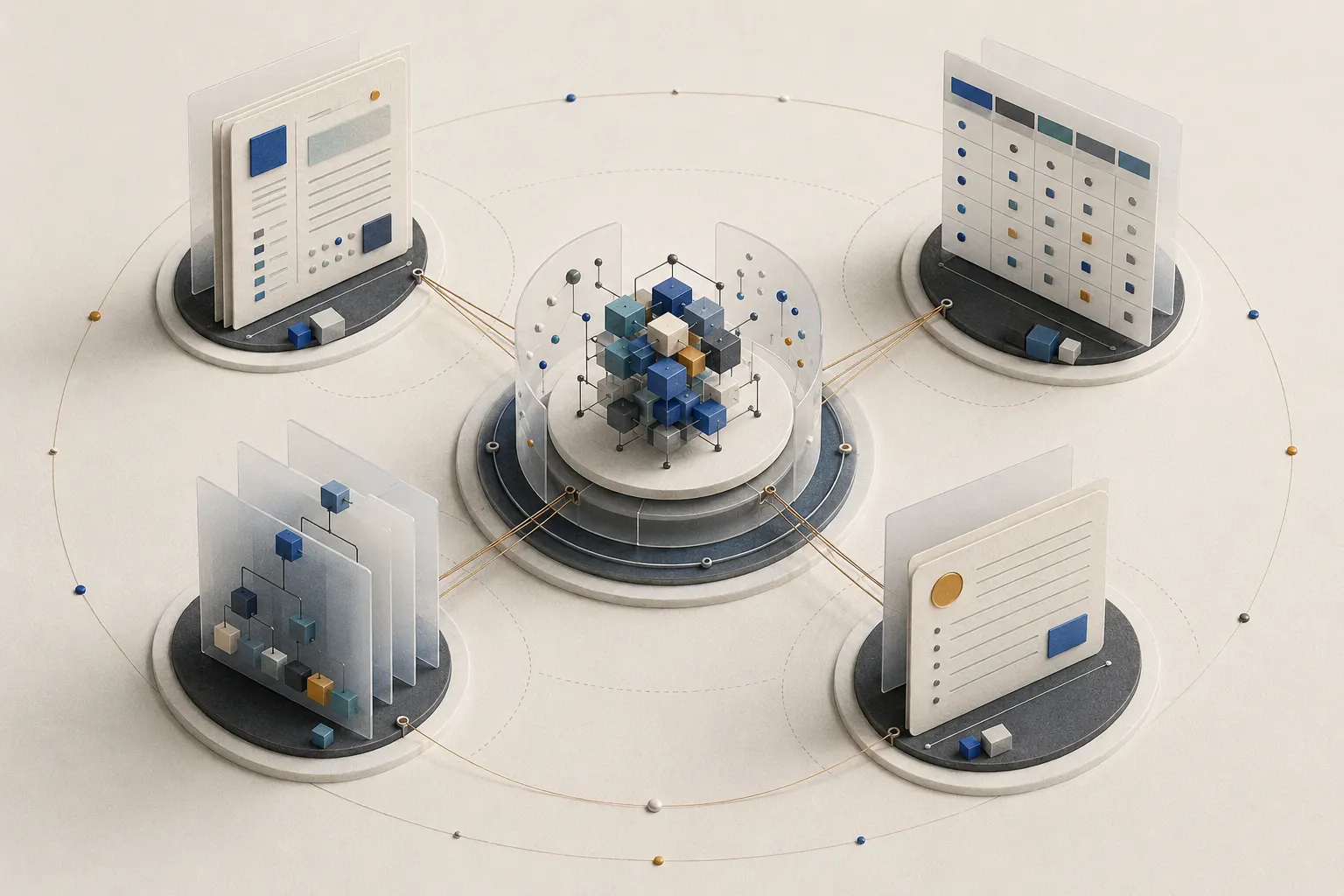
Every form reveals something and hides something else
Information has no neutral form. Prose can explain a relationship while making individual values difficult to compare. A table creates comparability but may reduce the reasoning behind the values. A chart reveals patterns while hiding the underlying numbers. A presentation directs attention but often compresses sources, exceptions, and intermediate steps.
Formats are therefore more than containers. They decide which properties of information become easy to access and which later work remains necessary. A document may be excellent for human reading and difficult for a machine to extract reliably. A strictly structured object may be processed unambiguously by software while providing too little explanation for professional review.
AI projects bring these requirements together. People need context, argument, and visual orientation. Search and processing systems need stable identifiers, explicit fields, relationships, and rules. Good information design does not force every kind of content into one universal format. It translates between representations without losing origin or meaning.
The central question is not: Which format is best? It is: What work should this information make possible next?
A PDF is a view, not a data model
PDF illustrates the confusion between representation and data. It preserves the appearance of a page with considerable reliability. That is precisely why it is valuable: a document can look similar on different devices, page numbers remain stable, and an approved layout can be archived and cited.
The same strength can complicate machine processing. A PDF often describes where characters appear on a page rather than the professional role those characters play. Two visually adjacent columns may be merged during extraction. Headers and footers may recur in every text segment. Tables can lose row and column relationships. Charts become images without the data from which they were produced. A scanned report may contain no embedded text at all.
This does not make PDF unsuitable. It means its role must be precise. As an unchanged original, approved view, or citable record, it can be extremely valuable. Search, analysis, and agentic processing may require supplementary representations: extracted text, structured tables, image descriptions, section identifiers, and links back to the original pages.
The derived representation must not silently replace the original. It is an interpretation. Its quality depends on the parser, layout assumptions, optical character recognition, language models, and post-processing. If only the extraction is stored, the most important reference point for later error analysis is lost.
Markdown, tables, and structured objects serve different contracts
Markdown works well for durable, human-readable knowledge objects. Headings, lists, links, and metadata can be edited with little friction. The text remains understandable without a specialised interface. In a local knowledge space, individual notes can be versioned, linked, searched, and exported. This portability makes Markdown a strong bridge between human writing and machine processing.
Markdown is not automatically structured enough for every task. A table containing thousands of measurements, an event stream, or an object with strict mandatory fields requires another form. Tabular formats work well for homogeneous records when columns are defined, units documented, and null states distinguished. JSON and similar structured formats suit nested objects, interfaces, and machine-readable contracts. Yet they too remain ambiguous without schemas and professional definitions.
A useful architecture is often layered: an unchanged original serves as the evidential anchor; a human-readable working representation carries explanation, context, and links; a structured representation enables validation and automation; an index or graph supports search and relationship analysis; and provenance connects all representations.
No single layer is the whole truth. Together they form a controlled space of translation.
Structured and unstructured data are not opposites
The common distinction between structured, semi-structured, and unstructured data is useful as long as it is not mistaken for a hierarchy of value. Unstructured text is not devoid of structure. It contains arguments, sequences in time, rhetorical relationships, implicit roles, and professional exceptions. That structure is simply not fully represented in fixed fields.
Conversely, a table is not automatically unambiguous. A column called „Status" may refer to technical availability, professional approval, or progress in a workflow. An empty field may mean unknown, not collected, or not applicable. A number without a unit or period is formally structured and semantically open.
AI can help make implicit structures visible. It can classify documents, identify entities, group themes, propose tables from prose, and mark possible relationships. These proposals are useful because they make large volumes navigable. They remain models. Every model selects, simplifies, and may draw false boundaries.
A good pipeline therefore stores not only the result of a classification but also the source object, method, version, confidence, and decision status. If a term was misclassified, it must be possible to correct it without erasing how the error arose.
Parsing is an editorial decision
Parsing sounds like a technical intermediate step: a document is read, divided into components, and converted into a more processable form. In reality, parsing determines what later counts as a unit of meaning.
Does a heading remain connected to its paragraph? Are footnotes associated with the passages they qualify? Does a caption belong to the image, the next section, or the entire document? Are merged table cells reconstructed correctly? Does the system preserve that a sentence states an exception rather than the main rule?
A parser can succeed syntactically and fail semantically. The file has been processed, text exists, and the pipeline reports no error. Yet relationships have disappeared. Such silent failures are more dangerous than visible exceptions because they surface only in later answers.
Parsing therefore needs its own quality checks. Samples compare original and extraction. Tables are tested for row, column, and unit relationships. Section identifiers are retained. Uninterpretable elements are marked rather than improvised. Important document types are represented by test cases, including difficult layouts and expected edge conditions.
The rule is simple: successful extraction proves that something was produced. It does not prove that meaning was preserved.
Harmonisation must not clean away meaningful differences
Data from different sources uses different terms, date formats, units, currencies, categories, and identifiers. Without harmonisation, comparison and combined processing become difficult. Yet every standardisation carries the risk of flattening a distinction that matters professionally.
If two departments define the same term differently, a common label does not create common meaning. If currencies are converted, the result needs an exchange rate and date. If time zones are normalised, the original reference must be retained. If categories are merged, the mapping rules and unmappable cases must remain visible.
Good harmonisation therefore distinguishes three layers: original value, normalised value, and transformation rule. The original remains unchanged. The normalised value allows comparison. The rule explains how the translation was performed and with which version. Uncertain or ambiguous mappings are not silently forced.
This makes harmonisation reversible and reviewable. A changed terminology map can be applied to affected objects. An error in a conversion can be located. A later user can determine whether two values are genuinely comparable or were only grouped for a particular purpose.
A data pipeline is a sequence of governed states
The terms import, cleaning, and export make a pipeline sound like a conveyor belt. Data enters, is processed, and emerges improved. This image obscures the fact that every step creates new objects, decisions, and potential errors.
A robust flow distinguishes at least capture, validation, extraction, harmonisation, enrichment, qualification, approval, delivery, and retirement. Not every object passes through every state. What matters is that states and transitions are visible.
Every transition needs a condition. A source does not become active merely because it was imported. An extracted table is not approved merely because its columns can be read. Enriched metadata does not become fact merely because a model reports high confidence. The transition requires the appropriate review and, depending on impact, an accountable approval.
Errors belong in the data model as well. A rejected object, incomplete extraction, or unmappable value should not disappear into a generic residual category. Its state must explain what is missing and which repair path remains available.
Seen this way, a pipeline is not a linear production line. It is a system of state transitions with questions, repetitions, stops, and reversals.
The lifecycle does not end with export
Every use creates more data: extracted representations, chunks, embeddings, summaries, decisions, logs, and approved outputs. If a source is corrected or deleted, these derivations may otherwise remain unnoticed.
A data lifecycle therefore covers more than retention and deletion of the original file. It must also account for dependent objects. A deletion event may affect index entries, caches, derived datasets, and, where necessary, published results. Archiving may change an object's role in active retrieval while preserving it as historical evidence.
Formats influence how well these lifecycles can be governed. Stable identifiers, explicit relationships, and versioned schemas support forward and backward tracing. Opaque export packages or proprietary states may prevent dependencies from being identified reliably.
Choosing a format is therefore always a decision about future control: What can be migrated, compared, revoked, deleted, and explained?
IV. A Knowledge Space Is More Than Storage

Storage answers where, not what something means
Folders are among the most successful metaphors in digital work. They give files a location and make hierarchical navigation possible. For small projects, that is often enough. Their limits become visible when one object belongs to several topics, decisions, or processes at once.
A file can occupy only one primary place in a hierarchy even when it has several professional relationships. Copies appear to solve this problem, but they create new version conflicts. Links help as long as their meaning remains clear. As a collection grows, the number of folders therefore becomes less important than the system's inability to represent relationships.
A knowledge space answers more questions than a filing system: What is this object? What does it belong to? What was it derived from? Which decision does it support? What does it replace? Which open questions does it touch? Who may use it? What state is it in?
Location still matters, but it becomes one property among several.
Project boundaries are a quality instrument
The appeal of a central knowledge pool is obvious. If all information lives in one place, nothing seems likely to be lost. For AI systems, however, an unbounded pool can weaken orientation, permission controls, and purpose limitation.
Project-specific knowledge spaces create a controlled boundary. They contain the sources, rules, decisions, and working states relevant to a defined assignment. Through a source map, they can refer to external or archived collections without automatically pulling those collections into every processing step.
The boundary does more than prevent irrelevant results. It makes responsibility visible. A project can define which sources are authoritative, which data zone it belongs to, which roles have access, and when content should return to a durable archive or a broader body of knowledge.
Boundaries must still remain permeable. An isolated space can miss important counterevidence and generate duplicates. It therefore needs governed transitions: import with source review, export with a handoff, references to shared terminology, and procedures for promoting accepted findings.
A good knowledge space is neither a silo nor an unfiltered lake. It is a governed working surface with known entrances and exits.
The local knowledge core externalises memory
Long projects lose quality when their state exists only in conversations, chat histories, or individual memory. A new phase then begins with reconstruction. Decisions are discussed again, sources are uploaded again, and discarded paths reappear as supposedly new options.
A local, file-based knowledge core can externalise that state. People and agents can find the project brief, source index, decisions, current working state, acceptance criteria, and handoffs there. Open formats keep this information readable and versionable outside any single interface. Links connect content without duplicating it.
A Markdown-based knowledge environment is particularly useful when it is designed not as a private notebook but as an operational system. Front matter describes status, source, language, responsibility, and relationships. Maps of Content provide curated entry points. Source maps connect public material with internal evidence. Templates ensure that decisions, data cards, and handoffs use comparable structures.
The knowledge core does not replace a database at every scale or an index for semantic search. Its strength is portability and legibility. It preserves canonical meaning outside transient sessions and proprietary surfaces.
Relationships carry more than categories
Categories answer which group something belongs to. Relationships explain how objects affect one another. An article addresses a topic. A decision rests on a source. One dataset contradicts another. A workflow uses a template. An evaluation case tests a capability. A new version supersedes an earlier one.
These relationships can begin as simple links. Their value increases when their meaning is typed. supports, contradicts, derived_from, supersedes, requires, and evaluates are not interchangeable. They enable different questions and different controls.
A knowledge graph formalises such relationships more strongly. It can connect entities, properties, and edges across many documents, revealing paths that a folder structure cannot express. A graph can show which decisions depend on a source, which terms are only weakly connected to the rest of the collection, or where a process has no accountable actor.
But a graph is not automatically true. Its edges are claims too. They need an origin, a definition, and sometimes confirmation. An automatically detected connection can be a valuable research lead, but it must not quietly become an accepted professional relationship.
Graph and vector answer different questions
Vector search arranges content by semantic similarity. It is strong when different formulations express the same or a related meaning. A knowledge graph, by contrast, works with explicit entities and relationships. It is strong when paths, dependencies, and defined connection types matter.
The approaches do not necessarily compete. They answer different questions.
Vector search asks: Which segments resemble this query in semantic space? The graph asks: Which known relationships connect these objects, and which paths are permitted? A local knowledge base adds another question: Which curated documents, decisions, and working states govern this project?
In a combined architecture, the knowledge core can carry governed meaning, a graph can expose relationships and gaps, and a vector index can find semantically relevant passages. Retrieval does not improve automatically as a result. It does, however, acquire more control points. A semantic match can be filtered by status and permission, expanded through graph relationships, and traced back to a canonical source.
The architecture should start with the use case. Small collections do not inevitably need complex graph and vector infrastructure. Good file boundaries, metadata, and full-text search may be superior because they are easier to operate and review. Complexity is justified only when it answers a concrete question more reliably.
Maps of Content are editorial interfaces
A Map of Content is more than an automatically generated table of contents. It is an editorial view of a knowledge space. It explains which entry points are useful, how topics relate, which sequence helps, and where open questions remain.
Automated search usually optimises for a query in the moment. A curated map can carry meaning over time. It reveals core concepts, boundaries, and cross-connections that may not appear completely in any single document. For a new person or agent, it shortens orientation without loading the entire collection into active context.
Several maps can open the same collection from different perspectives: by topic, process, role, risk, or lifecycle. These multiple views avoid the false assumption that knowledge has exactly one natural order.
The map is itself a governed object. It needs a validity status, maintenance, and a visible editorial intention. An obsolete map can mislead just as readily as an obsolete document.
A knowledge space must know its own state
A growing knowledge collection cannot remain reliable through good content alone. It needs state information: Which sources have been reviewed? Which claims remain open? Which links are broken? Which topics lack current evidence? Which articles use a term inconsistently? Which decisions are awaiting review?
These questions turn the knowledge space into a data product. It acquires ownership, quality rules, update events, and evaluations. A dashboard or status page can provide orientation, but it cannot replace the underlying evidence.
Forgetting matters as well. Not every working note belongs permanently in the canonical collection. Discoveries begin in a working area. Only after review are they promoted into the knowledge core as a decision, source, term, or approved content. This promotion protects the core from speculative material without preventing exploration.
A knowledge space is therefore valuable not because it remembers as much as possible. It is valuable because it can distinguish raw material, hypothesis, evidence, decision, and valid working state.
V. Retrieval Is an Editorial Act

RAG relocates the truth question
Retrieval-augmented generation is often described as a simple remedy for missing model knowledge: a query is submitted, relevant documents are found, and the model answers with that additional context. This description is not technically wrong, but it understates the number of decisions between question and answer.
RAG does not automatically make a model truthful. It relocates the truth question into the retrieval pipeline. Which sources entered the index? How were they extracted and segmented? What query was actually searched? Which candidates were excluded? Which passages reached the context? How faithfully did the model turn them into an answer?
Every one of these steps can introduce an error. Strong generation cannot repair weak retrieval. It can only express the weakness convincingly.
Similarity is neither authority nor validity
Vector search is useful precisely because it finds more than identical words. A query and a document can be semantically close even when they use different language. But proximity in semantic space says nothing about whether a source is current, approved, independent, complete, or accessible to the person asking.
A detailed draft may be semantically closer than a concise approval. A confidential report may contain the perfect answer and still need to be excluded. A widely copied claim may produce many similar hits without providing any additional evidence.
Semantic search must therefore operate inside a controlled candidate space. Permission, tenant, status, validity period, language, and purpose cannot be left to the generating model's discretion. They act before or during retrieval as technical rules. Only within the permitted space should similarity determine relevance.
Editorial decisions remain even then. Should retrieval favour source diversity or several passages from the same document? Does the question require a current policy, historical development, or independent perspectives? Must the system actively search for counterevidence? Relevance is not merely a score. It is a relationship among the question, its purpose, and the evidence required.
Chunking determines which ideas survive
Documents are usually divided into smaller segments for semantic search. These chunks must be small enough to retrieve precisely and large enough to carry their claim. No universal size resolves that tension.
A chunk that is too small can separate a definition from its exception. One sentence states a rule and the next limits it, yet the index presents them independently. A table value loses its row heading and unit. A conclusion is retrieved without the assumptions on which it rests. A chunk that is too large, on the other hand, contains many topics, dilutes similarity, and consumes context with irrelevant passages.
Good chunking therefore follows document structure and question type. Headings, paragraphs, lists, tables, and argumentative units provide clues. Overlap can preserve transitions, but it also creates duplicates and the appearance of multiple sources. Parent-child methods can connect a small match to broader context. Tables and code need different rules from essays or meeting records.
Metadata inheritance is crucial. A chunk must retain its document ID, version, position, heading, language, permissions, and provenance. Otherwise a passage becomes floating text with no reliable route back to its source.
Chunking is therefore not merely a technical optimisation. It is an editorial decision about which ideas survive as a unit.
The query is interpreted before the search begins
Many systems do not search the user's original question. They rewrite it, add terms, split it into subquestions, or generate hypothetical answers in an attempt to find better matches. These methods can resolve ambiguity and increase recall. They can also shift the user's intent.
A rewritten query can turn an open investigation into a confirmatory search. An added synonym can broaden a technical term incorrectly. A subquestion can lose its temporal or legal frame. Query transformation therefore belongs in the provenance chain. The original question, the derived search queries, and their results must remain comparable.
For critical tasks, several search strategies may be combined: exact keywords for identifiers and specialist terms, semantic search for varied formulations, metadata filters for validity, and graph paths for defined relationships. Their results should not simply be added together. They need to be deduplicated, grouped by origin, and checked for conflicts.

A graph makes relationships visible—and absence investigable
Retrieval usually searches for content that exists. Many important questions concern what is missing: an unsupported assumption, an undocumented handoff, a weak connection between two topics, or a stakeholder group absent from every source.
Graph analysis can make such patterns visible. When terms and entities appear as nodes and their relationships as edges, clusters, bridges, and isolated regions emerge. A weakly connected node may indicate a specialist topic, a data gap, or simply an extraction problem. A missing edge is therefore not proof of missing knowledge. It is a research question.
That is the value of gap analysis. It does not manufacture automatic truth about a gap. It prioritises places where researchers should look deliberately for counterevidence, transitions, or missing perspectives. A consulting process can use it to test whether a concept describes benefits and technology in detail while scarcely connecting them to responsibility, data origin, or exit options.
Combining semantic search with graph analysis changes research. The system does not only look for answers. It examines the structure of available knowledge and proposes justified questions at its edges.
Retrieved passages must become an evidence packet
A bundle of highly ranked chunks is not yet a sound basis for an answer. The passages may depend on one another, repeat the same original source, or describe different time periods. Before generation, they need to be assembled as evidence.
An evidence packet groups matches by source, preserves their position, removes redundant derivations, and marks contradictions. It contains supporting passages, but also counterevidence and open questions where relevant. For a decision, it may additionally show status, validity, and accountable roles.
The generating model then receives not an unsorted carpet of text but a small, reasoned case file. It can bind claims more tightly to evidence and leave uncertainty visible. Human review also becomes more efficient because each finding does not have to be reconstructed from scratch.
This assembly is editorial. It decides which perspectives should be read together, which differences must remain visible, and when the evidence does not permit a single synthesis.
Citation is a review step, not decoration
An answer can name sources and still misrepresent them. A link may exist while the cited passage fails to support the claim. A document may support a statement only under a condition omitted from the synthesis. Several sentences may share one citation even though only one is evidenced.
Citation quality must therefore be evaluated separately from writing quality. For every material claim, the reviewer asks: Is there a source? Is it accessible and permitted? Does it actually contain the asserted information? Has the scope been represented correctly? Is it a primary source, a summary, or a derivative account?
A robust answer also distinguishes source from inference. When several pieces of evidence are combined into a new assessment, the connection must be recognisable as synthesis. The model must not imply that the conclusion appears verbatim in a source.
Citation is therefore a control interface among retrieval, generation, and review.
Retrieval and generation need separate evaluations
A poor answer can result from wrong matches, missing matches, or an unfaithful synthesis. If only the final answer is evaluated, the system gives no indication of which component needs to improve.
Retrieval evaluation tests whether relevant and permitted evidence appears in the candidate set, how highly it is ranked, and whether critical counterevidence is absent. Generation evaluation tests whether the answer uses that evidence accurately, completely, and with appropriate uncertainty. End-to-end evaluation additionally asks whether the answer is useful and safe for its actual purpose.
Test cases must include more than straightforward knowledge questions. Negative cases examine whether the system excludes obsolete, blocked, or merely similar sources. Repairable cases test whether it detects a missing approval and identifies the right next step. Conflict cases check whether contradictions remain visible. Unanswerable questions test whether the system limits itself instead of inventing.
Metrics provide signals, not a complete judgement. High recall can be purchased with many impermissible or redundant matches. A correct citation can accompany an answer that remains incomplete for its purpose. Good evaluation combines fixed cases, technical measurements, and professional review.
The knowledge base is part of the attack surface
RAG systems move not only knowledge but also risk into the data collection. A manipulated document can contain instructions that a model interprets as a work order. False metadata can make a source appear more authoritative. Weak tenant separation can place confidential material in the wrong context.
External content must therefore be treated as data, not as authority over the system. Instructions found in documents must not override project rules, permissions, or approval boundaries. Source intake, parsing, and indexing need security checks. Permissions must remain attached down to segment level.
A warning in the prompt is not enough. Security-critical boundaries belong in the surrounding architecture: tool allowlists, data zones, quarantine, approvals, and logs.
Retrieval is the politics of attention
Every retrieval system decides which parts of a knowledge space receive attention at the moment of answering. The decision may be computed technically, but it remains professionally consequential. What is not found cannot be cited. What is ranked too low may never reach the context. What has been copied many times can become disproportionately visible.
Retrieval is therefore an editorial act. It orders evidence before a sentence is written. Responsible systems make that order visible, testable, and correctable. They do not confuse similarity with authority, graph gaps with proof, or citation with ornament.
Until this point, AI has mainly read, selected, and formulated. The next transition changes the risk class of the work: a system receives tools, writes files, changes data states, and continues processes. A sound knowledge space is no longer enough. The order before the answer must become an order before action.
VI. When AI Changes Data, Data Management Becomes Operations

The decisive transition is effect, not intelligence
A system that summarises a report produces a proposal. A system that renames the report, adds metadata, updates an index, or prepares a message produces a new state. As soon as tools touch the world beyond the answer, the nature of the task changes.
This difference is often described with the word agent. Yet not every apparently independent output is agentic, and not every agentic architecture requires a dramatic degree of autonomy. The decisive element is a loop of action: the system receives a goal, observes a state, plans steps, uses tools, checks results, and continues the work. Every cycle can alter files, databases, configurations, or external systems.
Data management then becomes operations. Sources are no longer only material to be read. They become objects on which actions are performed. The knowledge space becomes a workspace. Metadata governs not only retrieval but permissions and state transitions. Provenance records not only where a claim came from, but which step triggered a change.
The relevant leap in quality is therefore not that a system „thinks independently." It is that its output has consequences.
A persona confers no authority
Agentic systems often begin with role descriptions. The model is asked to behave like an experienced analyst, reviewer, or project lead. A persona can influence tone, perspective, and level of explanation. It cannot create a real permission.
The sentence „You are responsible for approval" is not an approval. A linguistic role has neither an authenticated identity nor a professional mandate. When persona, permissions, and project data are mixed in one large instruction block, they form a power bundle that is difficult to inspect. A change in tone can touch rules. A project-specific path enters a reusable template. Confidential example data becomes part of a general skill.
A durable architecture therefore separates at least six layers. The persona determines presentation and interaction behaviour. The role describes responsibility in the specific workflow. The skill encapsulates a reusable method. The tool performs a technically defined operation. The policy limits permissions and approvals. The project context contains the task, sources, state, and operational data.
These layers are composed for a specific run. Each has its own lifecycle. A persona may remain unchanged while a skill improves. A tool can be replaced without rewriting the professional method. Project data can be deleted without leaving traces in the global rules.
Separation is not bureaucratic elegance here. It limits failure and prevents data from bleeding across contexts.
A skill is executable knowledge with a contract
A long prompt can describe a method. A skill goes further. It defines when it should be used, which inputs it expects, which steps it performs, which tools it requires, which outputs it creates, and how success or termination is recognised.
This makes procedural knowledge testable. A source-review skill might require the system to determine a source's authority, mark time-dependent claims, record contradictions, and keep unsupported assertions out of a draft. A metadata-harmonisation skill might preserve original values, create normalised values, and record every mapping with its rule version and uncertainty.
Facts and procedures remain separate. The skill contains the method, not the current data collection. Sources, client data, and project paths are bound only through a validated invocation. The same capability can therefore operate in different data zones without transferring information between them.
Determinism is distributed deliberately as well. Unambiguous transformations, validations, and checksums belong in scripts or other controllable components. The language model handles the steps that require interpretation. A good agentic system does not use generative flexibility where a fixed rule would be more reliable.
The workspace is the task's memory
An agent needs more than a role. It needs a workspace in which the current state exists outside its transient context. That workspace includes the project brief, task contract, source index, decisions, acceptance criteria, working notes, change log, and handoff.
The project brief describes the outcome, scope, users, data zone, and priority. The task contract translates a single assignment into inputs, permitted tools, protected areas, expected output, and stop conditions. The source index orders authority and currency. Decision records preserve only accepted determinations. Working notes may contain hypotheses, but they are not the source of truth. The handoff tells another person or a later run what happened, what uncertainty remains, and what must be reviewed next.
These files are not documentation added after the real work. They are the operational state. Without them, a system has to infer project status from chat histories and artefacts. Every restart becomes a reconstruction, and every reconstruction can shift earlier boundaries.
A well-designed workspace keeps active context small. The agent does not read the entire archive, but the few files that define the assignment, sources, and boundaries for the current step.
State changes need before, after, and reason
When an agent changes a file, the result is not only the new content. Reconstructability requires at least the initial state, the change, the outcome, the tool, the time, the task, and the accountable approval.
Technical versioning preserves differences. An operational change log explains their meaning. Was the change local and isolated? Does it change behaviour? Does it affect structure, permissions, or production data? The greater the effect, the deeper the planning, review, and approval must be.
A simple classification can distinguish minor text corrections from behavioural changes, structural migrations, and high-impact actions. Not every step needs the same process. Yet irreversible or external effects must not become easier merely because they require only one technical tool call.
Before-and-after documentation also enables recovery. A checkpoint is not simply a copy, but a verified restart point. An isolated working branch allows change without immediately overwriting the approved state. A review compares the result with the acceptance criteria. Only the gate decides whether the change is adopted.
Controllable agents are not defined by rarely making mistakes. They are defined by mistakes that can be contained, detected, and repaired.
Observability is not the same as control
A detailed log can show that a tool was called. It does not prove that the call was permitted, professionally correct, or successful. Observability, audit trail, and provenance answer different questions.
Observability helps reveal runtime state and technical failure. An audit trail records events relevant to security or decision-making. Provenance links artefacts to sources and transformations. Evaluation compares behaviour with defined expectations. Only together do they form a resilient picture.
Complete logging can itself create risk. Tool parameters may contain secrets, personal information, or confidential content. Good logging preserves stable identifiers, approved excerpts, status, and correlations without unnecessarily multiplying sensitive raw data.
A dashboard is therefore only the visible surface. Control comes from the rules beneath it: Which events must be recorded? Who may see them? How long are they retained? Which signal stops a run? What evidence is required for approval?
External effects have asymmetric costs
Not every state change is equally dangerous. A locally generated note can be deleted or discarded. A sent message, a published claim, a triggered payment, or a change to production data can create consequences that cannot be fully reversed.
This asymmetry must be visible in the workflow. Preparation and execution are separated. The agent may gather material, produce a draft, display recipients and payload, and name possible consequences. The external action remains locked until a gate approves that exact state. Approval applies only to the described case; it does not become a silent standing permission.
The language of rollback must remain honest too. A database change may be reversed technically while information already seen cannot be „unseen." A published error may be corrected, but its circulation cannot be fully controlled. A good preview therefore names not only technical rollback but irreversible social, legal, or economic consequences.
Agentic maturity appears here as the capacity for restraint. A system must recognise when persuasive preparation is the correct final product and the actual effect lies beyond its authority.
The smallest safe agent is often the best beginning
The fascination with agentic systems encourages grand designs: multiple roles, persistent memories, many tools, and parallel work. Yet every additional capability increases the number of possible interactions.
A safe maturity path begins with one agent, a bounded task, a clear data space, and manual review. Once the workflow is repeatable, standardised contracts, tests, and handoffs can follow. Planning and review may then be separated, tools bound more tightly, and negative evaluations introduced. Parallelism and persistent capabilities should follow only when the simpler form is stable.
This sequence is not a sign of mistrust in intelligence. It is sound system design. Autonomy is granted not as a personality trait, but as a verified capability in a defined context.
VII. Autonomy Requires an Architecture of Limits

Autonomy is a bundle of distinct rights
„The agent works autonomously" is not an adequate system description. Autonomy consists of specific rights: reading information, creating files, changing existing content, executing code, calling external services, preparing messages, sending messages, spending money, or affecting production systems.
Each right has its own radius of effect. A system may work largely independently during research and stop before publication. It may change files in an isolated workspace while updating the approved collection only through review. It may prepare an external action completely while reserving execution for a human gate.
Breaking autonomy into rights replaces the vague question „How autonomous may the AI be?" with an inspectable matrix: Which capability, for what purpose, in which data zone, with which tool, up to which outcome, and under which approval?
A capability registry makes that matrix visible. A capability is not approved merely because a tool is installed. It begins as a draft, is tested in safe cases, evaluated with evidence, and only then released for limited use. If ownership, sources, rights, or review status become unclear, the capability is paused.
The task contract makes the assignment finite
Many agentic failures begin with an open-ended instruction. „Optimise the project" has no testable end. The system can always read another file, discover another problem, and propose another change. Initiative gradually becomes scope expansion.
A task contract bounds the assignment. It names the goal, expected artefact, sources, affected areas, forbidden actions, permitted tools, acceptance criteria, and stop conditions. It also states what lies outside scope.
The contract need not be long. Its strength is decidability. At the end, reviewers can determine whether the required result exists, protected areas remained untouched, and the specified tests were run. Unexpected problems do not silently enlarge the assignment. The agent records them and requests a new decision.
Scope thus becomes a safety boundary. A system that „helpfully" performs unrequested side work can be as risky as one that executes the main task incorrectly.
Roles separate outcomes, not only personalities
Planner, researcher, executor, reviewer, and gatekeeper are not theatrical roles. They have different inputs, outputs, and permissions.
The planner decomposes the task and identifies risks, but performs no external action. The researcher evaluates evidence and changes no systems. The executor works within the approved plan and does not extend the scope. The reviewer examines the artefact, acceptance criteria, and evidence. The gatekeeper decides whether to approve, revise, hand off, or stop.
In small tasks, one person or model may perform several roles. The artefacts must still remain distinct. A plan is not an execution log. A self-assessment is not a review. A successful check is not automatically permission to perform an irreversible action.
High-impact work requires genuine distance. The creator of a solution is more likely to overlook the assumptions embedded in it. An independent review uses the same acceptance criteria, but not the same preferred narrative.
A gate is an artefact, not a moment in dialogue
An agent can ask for permission in a conversation. For consequential actions, however, a fleeting „yes" is insufficient. A robust approval describes the action, target, payload, expected effect, data zone, reason, and rollback option.
The person must know what they are approving. A request such as „Should I continue?" transfers the analytical burden to the approver without providing the information needed to carry it. A good gate offers at least three options: allow this case, reject it, or require revision. Permanent expansions of rights need a separate policy decision.
The position of the gate matters too. It must appear before irreversible effects occur. The workflow needs a preview state: the message is prepared but not sent; the migration is planned and tested but not run in production; the report is ready for approval but not published.
The gate separates preparation from effect.
Human-in-the-loop requires time, information, and authority
Human approval does not automatically improve quality. If reviewers face too many cases, too little time, or inaccessible evidence, review becomes a ritual. Persuasive presentation can amplify automation bias. The person then approves the surface rather than the substance.
Effective oversight needs a review packet: task, sources, decision-relevant differences, uncertainty, model or tool version, affected data, and expected consequences. It also requires real authority to stop, return, or escalate a case.
The capacity for human control therefore belongs in the system architecture. A process that generates a thousand decisions per hour and allows five minutes of total review may formally have a human in the loop, but it has no effective control point.
Oversight itself must be evaluated. Are critical errors detected? How often are proposals accepted without inspection? Are there systematic differences among people or case types? Which information genuinely helps, and which merely adds cognitive load?
Parallelism requires ownership and merge rules
Several agents can accelerate research and implementation when their tasks are truly independent. Without clear boundaries, they multiply conflicts instead. Two instances change the same file, use different source states, or adopt contradictory assumptions. The apparent time saving is lost during integration.
Each parallel branch therefore needs a bounded assignment, its own source set, an expected output format, and an ownership rule for artefacts. Before work begins, the merge method and the authority for resolving conflicts must be clear. Shared context should be limited to canonical rules and accepted decisions; unreviewed notes from one branch must not silently become truth for the others.
The real team achievement lies not in the number of agents working simultaneously, but in integration. A gatekeeper or named merge role compares results against shared acceptance criteria, keeps differences visible, and decides whether a branch is adopted, revised, or rejected.
Parallelism pays only when a task can be divided faster than it must later be untangled. In many cases, one well-directed agent with a robust workspace is more reliable than an artificial team with overlapping roles.
Evaluation also tests the correct no
Agentic systems are often demonstrated through success scenarios. The system receives an appropriate task, available sources, and functioning tools, then produces the expected result. The demonstration proves possibility, not operational readiness.
Evaluation needs at least three types of case. Positive cases test permitted tasks. Negative cases test whether forbidden or impermissible actions are refused. Repairable cases test whether the system recognises missing sources, unclear scope, or failed checks and identifies the correct next step.
The correct no is a capability. An agent must be able not only to act, but to refrain for a reason. Equally important is the correct not yet: the task is permissible in principle, but only after another source, approval, or correction.
Every evaluation case needs fixed inputs, sources, permitted tools, expected output, and acceptance criteria. Cases are rerun after changes to rules, models, skills, or tools. A favourable impression is not repeatable evidence.
Incidents should make the system more precise, not more rigid
When an agent crosses a boundary or a review fails, the intuitive response is a new global rule. Over time, a growing catalogue of prohibitions, exceptions, and counterexceptions makes the system contradictory and difficult to use.
A sound incident process first preserves minimal evidence, contains the affected capability, and identifies the decision that failed. It then adds or adjusts an evaluation case. The correction stays as close as possible to the actual failure mode.
Not every incident proves that the entire architecture is wrong. Source classification may have been ambiguous, a tool may have been too broadly authorised, or a gate may have appeared too late. Precise causes produce precise changes.
Autonomy therefore matures not through ever more rules, but through a cycle of bounded capability, observation, evaluation, incident learning, and renewed approval.
VIII. Data Spaces Are Orders of Power and Ownership

Data location is only the beginning
Discussions of data sovereignty are often reduced to whether a system runs locally or in the cloud. Location matters, but it does not answer who is actually in control.
A local server may use shared administrator accounts, untested backups, external updates, and undocumented remote access. An external service may have strong technical controls while creating dependencies an organisation cannot resolve on its own. No deployment model carries sovereignty as a natural property.
Data sovereignty is the demonstrable ability to determine, limit, inspect, transfer, and terminate processing. It includes raw data and every derived artefact: chunks, embeddings, caches, logs, outputs, configurations, evaluation data, and backups.
Anyone who looks only at primary storage misses the actual data journey.
Control has several dimensions
Sovereignty decomposes into concrete control questions. Who determines purpose and rules? Who operates the infrastructure? Who owns identities and keys? Which subcontractors or technical dependencies exist? Can data and metadata be exported completely? Can deletion across copies and derivations be demonstrated? Can the organisation continue operating after changing providers?
An architecture can be strong in one dimension and weak in another. Owning hardware increases physical control but requires internal capacity for patching, recovery, and incident response. A managed service may improve operational security while limiting portability or key control.
Broad labels therefore help little. Every material control claim needs an owner and evidence. „Our data remains in this region" is a hypothesis until data flows, support paths, telemetry, and subcontractors have been reviewed. „We can leave at any time" remains a claim until a test export containing schemas, relationships, versions, and rules has been restored successfully.
Identity is a moving boundary
In distributed systems, the security boundary no longer follows a building or network reliably. People, services, devices, and agents access data from different zones. Identity therefore becomes the central control layer.
Every access needs a justified purpose, limited rights, and a reviewable duration. An agent does not receive generic „file access," but access to defined paths and operations for one task. A service account has an owner and an expiry or review date. Administrative rights are not granted permanently for convenience.
Local systems benefit from the same discipline. Internal location does not create automatic trust. A compromised device, shared account, or uncontrolled automation key can make the physical boundary irrelevant.
Sovereignty therefore begins with the ability to distinguish identities and revoke rights effectively.
Encryption is only as sovereign as its keys
The statement that data is encrypted does not reveal who can decrypt it. Encryption in transit, encrypted storage, application-level encryption, and key management protect different transitions. What matters is the full chain of key custody: Who generates a key? Where is it stored? Who may authorise its use? How is it rotated, blocked, backed up, and recovered in an emergency?
Organisation-controlled keys increase control only if the organisation can carry that responsibility reliably. An unrecoverable key threatens availability. An exportable key with too many authorised users threatens confidentiality. An externally managed key may provide professional operation while limiting technical independence.
Agentic systems add short-lived credentials and automation keys. They must not enter prompts or persistent logs. Their permissions must remain bound to the task, tool, and time. An agent that only needs to read one file does not need general storage access. An agent preparing an export does not automatically need permission to transmit it.
Cryptographic control is therefore not a single product feature. It is an operating process of identity, permission, logging, rotation, and revocation.
Derived data remains part of the responsibility
Embeddings, summaries, or features generated from sensitive documents may appear more abstract than the originals. Abstraction does not automatically make them anonymous or harmless. Derivatives can preserve information about content, relationships, or membership. They may also persist in indexes and backups after the original has been removed.
A data-flow map must therefore represent transformations as well as storage locations. Which data leaves a controlled zone? Which minimised artefacts are created? Can information be reconstructed from them or connected with other sources? Which deletion and update events propagate to the derivatives?
These questions are especially important in hybrid architectures. Raw data may remain local while a remote interface produces embeddings or processes telemetry. The surface appears local; the complete data journey is not.
Data sovereignty is decided at transitions.
Portability is more than an export button
A system is not portable merely because content can be downloaded as a CSV or ZIP file. Without schemas, relationships, version history, permission models, rules, and provenance, the export may be professionally unusable.
Exit capability must therefore be designed before adoption. Which objects can be exported? Are stable identifiers preserved? Are open formats available? Can workflows and evaluations be reused in another environment? How are identities, keys, and access terminated? Who confirms deletion of remaining copies?
A tested exit is part of the architecture, not a contingency plan for the end of a contract. Regular test exports reveal whether the organisation actually owns its knowledge or merely rents access to an interface.
The question also concerns human agency. If nobody understands how data, rules, and decisions relate, technical exportability may exist while operational sovereignty has already been lost.
Platform power operates through standards and convenience
Power in digital data spaces arises not only from ownership in the legal sense. It emerges through standards, interfaces, fees, rankings, identities, and the design of possible actions. A platform can determine which formats are easy to import, which relationships remain exportable, and which functions work only inside its environment.
Convenience is a powerful binding mechanism. The more working state resides in proprietary automations, hidden storage forms, and platform-specific rules, the more expensive migration becomes. Lock-in then affects not only files but organisational knowledge.
A canonical, portable knowledge core limits this dependency. Project briefs, source indexes, decisions, contracts, skills, and evaluations remain in readable, versioned formats. Platform adapters contain only the local translation. Replacing a tool does not require the entire meaning of the system to be invented again.
Sovereignty does not mean rejecting every external technology. It means choosing dependence consciously, measuring it, and retaining the ability to end it.
Data spaces are societal decisions
The data collected, connected, and automated determines who becomes visible and who does not. A data space can represent some perspectives in detail while systematically excluding others. A knowledge architecture can strengthen accountability or disperse it behind technical processes. A ranking can concentrate attention without formal censorship.
Data management is therefore never entirely neutral. Classifications, metadata, retention periods, and access rights embody interests and assumptions. The question „Who owns the data spaces of AI?" concerns more than property. It concerns the authority to define categories, create relationships, grant access, and make errors correctable.
A responsible data space needs routes for objection. Affected people and professional roles must be able to determine which data is used, what meaning has been assigned to it, and how correction is possible. Transparency is not merely a notice that AI was involved. It is the ability to trigger an informed action.
Technical quality and societal legitimacy are different. Yet both depend on the same fundamental question: Is the order used by the system visible and changeable?
IX. Twelve Theses for Reliable AI Systems
1. Every answer carries the state of its sources
A linguistically brilliant answer cannot be more reliable than the order from which it emerged. Source state means more than content: origin, currency, status, permission, completeness, and relationship to other sources. These properties disappear in the finished wording unless they are preserved deliberately. Evaluating answers therefore also means evaluating the candidate space the system was allowed to see. The essential question is not only whether a sentence sounds plausible, but why this evidence in this state was used.
2. Data quality is always a decision about purpose
There is no universally clean data. Completeness, currency, accuracy, and representativeness acquire meaning only in relation to a concrete task. A collection may be excellent for historical analysis and unsuitable for a current decision. Quality therefore begins before cleaning, with a definition of purpose. Without it, teams optimise easily measured properties and overlook decisive gaps. A quality profile is robust when every rule is connected to an effect.
3. Provenance is a functional feature, not an appendix
Origin must not be reconstructed only after a critical question. It must enable backward tracing, correction, revocation, and impact analysis. A source list at the end of a report is not enough. Provenance connects the original, transformation, tool version, decision, and derived output. It does not prove truth, but makes review possible. Systems without provenance can produce results; they can barely govern their own mistakes.
4. A format determines which future work remains possible
Formats preserve some properties and lose others. A page image protects presentation, a table comparability, a structured object validation, and a Markdown file readability and portability. Good architectures do not select one format for everything. They connect the original, working representation, machine-readable structure, and index through stable identities. Format choice thus becomes a decision about migration, retrieval, versioning, deletion, and future automation.
5. Retrieval is selection and therefore responsibility
A retrieval system orders attention before the model writes. It determines which sources become visible, which are ranked too low, and which filters exclude. Semantic similarity is only one criterion. Authority, validity, permission, and diversity require technical and professional controls. Retrieval is therefore not a neutral search function but an editorial infrastructure. Its decisions need tests, provenance, and routes for correction.
6. Missing relationships are data in their own right
Knowledge gaps appear not only as empty fields. They emerge as missing connections among terms, decisions, sources, and responsibilities. Graph and gap analysis can expose these weak points. A detected gap is not yet proof; it is a prioritised research question. Organisations improve quality when they examine not only available statements but also the perspectives, counterevidence, and transitions that are absent.
7. A knowledge space needs boundaries, not only size
More context does not automatically provide more orientation. A governed knowledge space distinguishes active collection, archive, hypothesis, evidence, and decision. Project boundaries do not constrain thought; they make source authority, data zone, and purpose visible. Governed transitions allow import, export, and reuse. The best knowledge space is not the largest, but the one that can explain why an object is active for a particular task.
8. A skill becomes knowledge only when it can be executed and tested
A method does not become reusable through detailed description alone. A skill needs activation conditions, inputs, steps, tools, quality criteria, and failure states. Facts remain in project context, permissions in policy, and deterministic operations in controllable components. This separation makes professional knowledge versionable and evaluable. A skill without negative and repairable cases is an interesting instruction, but not yet a robust capability.
9. Write access turns assistance into operations
Once a system changes files, data, or external states, linguistic quality criteria are no longer sufficient. Every change needs an assignment, permission, initial state, outcome, review, and recovery path. The important distinction is not between „simple" and „advanced" AI, but between proposal and effect. Agentic systems must therefore be treated as operational systems, with state models, logs, tests, gates, and incident learning.
10. Automation increases the need for visible control points
Speed does not automatically reduce work. It can generate more results, more exceptions, and more demand for review. A human in the loop is effective only when that person has time, evidence, and authority. Control points must precede the effect and offer a real alternative to approval. Good automation moves human work from repetition toward meaning, limits, and exceptions. It does not eliminate responsibility.
11. Sovereignty begins with exportability, rights, and exit options
Local operation can be dependent, cloud operation can be controlled, and either can fail. Sovereignty appears in concrete capabilities: limiting identities, controlling keys, inspecting data flows, updating derivatives, revoking rights, exporting knowledge, and ending an operation. An exit that has never been tested is a hope. Portability must include canonical meaning, relationships, rules, and provenance—not only files.
12. Humans remain responsible for approving consequences
Machines can order evidence, generate options, check rules, and prepare actions. They cannot assume responsibility through linguistic roles. Responsibility means understanding consequences, balancing interests, allowing objection, and standing behind a decision. The human must not become a decorative click at the end. They need an architecture that reveals uncertainty and genuinely enables stopping, questioning, and correction.
Conclusion: Not More Data, but Better States
The history of artificial intelligence is often told as a history of larger models. More parameters, wider context windows, new tools, and faster systems mark visible progress. Yet in daily work, reliability is decided in less spectacular places.
It is decided when a draft remains recognisable as a draft. When a number retains its time period. When an extracted passage leads back to its original page. When a knowledge space does not confuse an open question with a plausible assertion. When a retrieval system ranks an approved source above its many copies. When an agent prepares a change but stops before its effect. When an export preserves not only files but relationships and rules.
These are questions of state.
A data object does not simply exist. It is raw, reviewed, approved, superseded, withdrawn, or archived. A piece of knowledge is not simply known. It is evidenced, disputed, derived, uncertain, or open. A capability is not simply installed. It is a draft, pilot, approved, paused, or retired. An action is not simply possible. It is permitted, limited, approval-bound, or forbidden.
These states are the operating system of artificial intelligence. They connect technical processes with professional meaning. They make visible when a system may read, infer, act, or stop. They allow errors not merely to be detected, but their consequences to be traced and corrected.
The decisive progress therefore does not lie in a world where AI always answers. It lies in a world where systems can distinguish among answer, question, hypothesis, proposal, and action. A reliable system need not appear omniscient. It must know its own working basis.
That changes the human role as well. The human is neither the opponent of automation nor the passive recipient of machine output. Their central task lies in shaping purpose, meaning, and limits. They define which source counts for which decision. They determine which uncertainty is acceptable. They decide what effect an approval may have and which forms of objection must remain possible.
This responsibility cannot disappear into a prompt. It must be embodied in data models, workspaces, contracts, gates, and evaluations.
Data sovereignty begins here too. Anyone unable to export, inspect, and change the order of their information possesses it only in a limited sense. An organisation can control every file and still depend on an opaque logic of relationships. Conversely, it can use external infrastructure while deliberately preserving its canonical meaning, rules, and exit paths outside individual platforms.
The question is not whether technology should be avoided. The question is whether its dependencies remain visible and negotiable.
This essay began with an excellent answer built on the wrong foundation. The older draft prevailed because its language was signalled more strongly than its status. The solution would not have been a longer prompt. It would have been a better order: stable identities, a confirmed supersession relationship, an active source space, temporal validity, and a retrieval test built around precisely this conflict.
The example is small. Its logic reaches far. The more AI systems read, connect, and act, the more important becomes the infrastructure that limits their attention and effects. Without it, productivity is not the only thing that scales. Ambiguity, repetition, and difficult-to-revoke errors scale too.
The future of reliable artificial intelligence therefore does not begin with a demand for ever more data. It begins with better states: sources whose origin is visible; formats that preserve relationships; knowledge spaces that know their boundaries; retrieval that accepts responsibility for selection; agents whose actions can be reconstructed; and humans who remain capable not merely of participating, but of deciding.
Some questions deliberately remain open. How can uncertainty be represented so that people neither ignore nor overestimate it? What granularity of provenance is sufficient without creating new stores of surveillance data? How can graph gaps be prioritised as research questions without treating absence prematurely as proof? Which evaluation cases detect not only technical errors but gradual shifts in purpose and responsibility?
Another open question is how organisations can examine their own knowledge spaces when the categories and source hierarchies already shape the perspective of the examination. A system can be transparent about its processing while still relying on a one-sided data space. Technical traceability must therefore remain connected to professional dissent, plural perspectives, and the possibility of correction.
Finally, there is the question of speed. Agentic systems can generate more changes than people can meaningfully evaluate. The right response is not indiscriminate slowing. We need architectures that automate low-risk repetition while deliberately slowing consequential changes in meaning. The bottleneck of human attention must not be concealed; it must become a visible planning variable.
These open questions are not a defect in the design. They mark the places where reliable AI cannot emerge from another tool alone, but only from continuing organisational and societal work.
For that reason, the operating system described here must not be understood as a fixed final architecture. Concepts, risks, tools, and responsibilities change. The rules that govern a system also need versions, tests, and a traceable way to be dismantled. A sensible boundary today may be too narrow or too broad tomorrow. Durable reliability does not emerge from immutable rules, but from a process that makes change visible, tests its effects, and preserves the capacity for objection. The order before the answer is therefore not a one-time exercise in tidying up. It is an ongoing shared practice of attentive observation, responsible decision-making, and effective correction.
The answer comes at the end. The governed order must already be there.
0 comments
● Loading comments…