Why Project Planning Is What Makes Agentic AI Steerable
Agentic AI does not become controllable because a human watches every step. It becomes controllable when the plan makes objectives, inputs, outputs, roles, boundaries and decision points explicit enough for autonomy to operate inside a reliable frame.
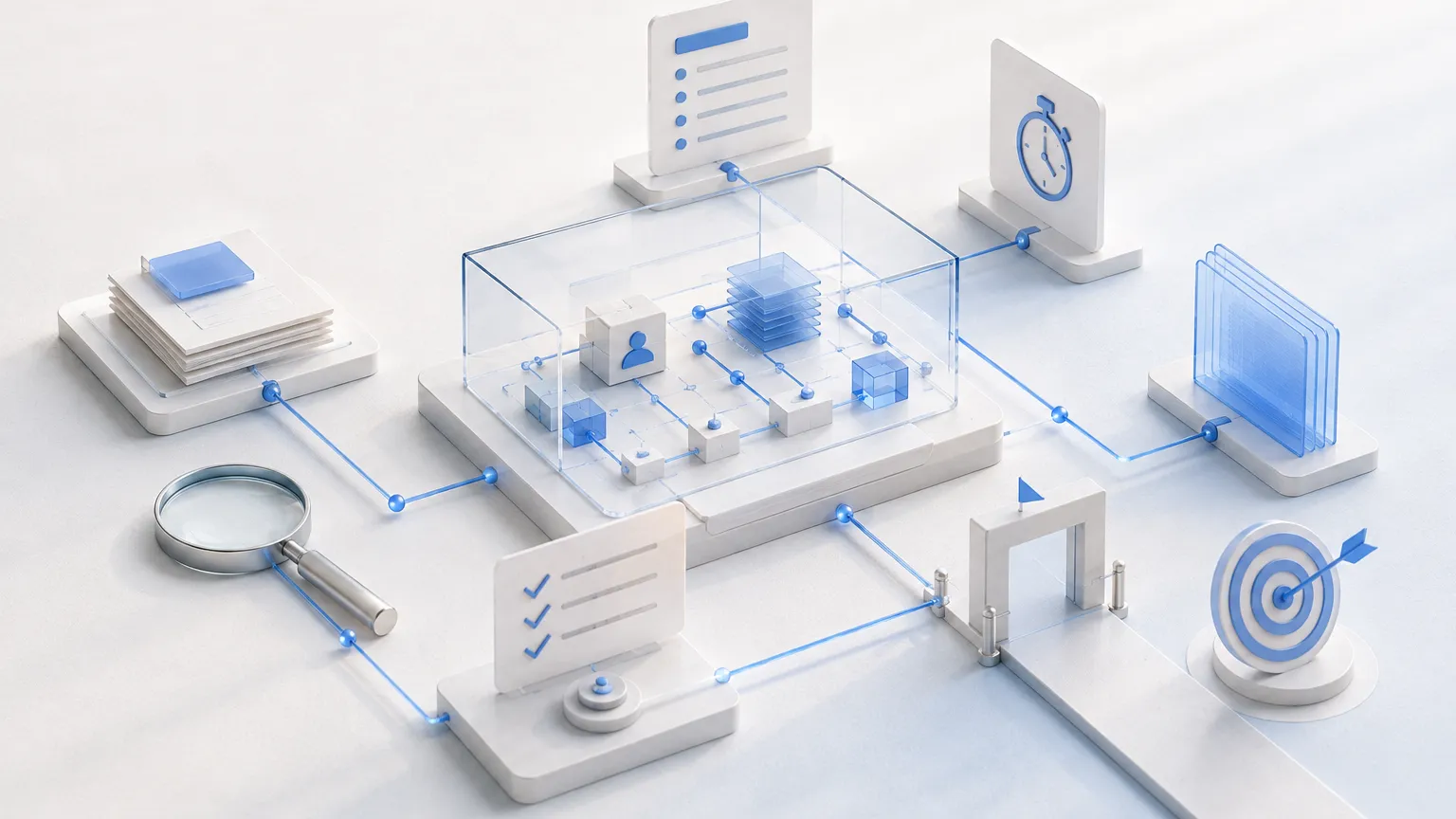
Agentic AI changes the logic of project work. A conventional assistant waits for the next prompt. An agentic system can decompose tasks, use tools, create intermediate results, trigger further work and pursue a goal over longer stretches with a high degree of independence. That is precisely where its value lies — and precisely where the steering problem begins.
The more latitude a system receives, the less a vague task description is sufficient. "Finish the project" is already imprecise for a chat assistant. For a group of agents it is an invitation to fill in missing decisions on its own. That can look productive while the implicit assumptions happen to be correct. When they are wrong, autonomy scales deviation rather than quality.
Practice therefore develops a clear counter-position to the idea that agents mainly need to be "set free." The project manager's role can already be described precisely: the human sets direction, objectives and the definition of success and makes the decisions; specialised agents can handle daily flow, quality assurance, documentation or the processing of feedback. In July, this logic becomes more formal: Orchestrator, Reviewer, Specialist and Human Authority are conceived as defined roles, human intervention is concentrated at gates, and agentic execution is aligned to a project plan with evidence and stop logic.
The central thesis of this article is therefore: In agentic AI, project planning is not preliminary bureaucracy. It is the control layer that makes responsible autonomy possible in the first place.
Autonomy amplifies what is already embedded in the assignment
In manual work, an unclear assignment can often be compensated for through questions. People frequently notice when an objective is contradictory, context is missing or a decision is politically sensitive. They pause, ask or proceed cautiously based on experience.
An agent can also detect uncertainty. But if its instruction is optimised for continuation and contains no escalation logic, it will often close gaps with plausible assumptions. That is not necessarily a model failure. It is often a project-design failure.
Agentic systems therefore expose an old management rule: delegation only works when the mandate, the decision space and the return point are clear.
The more autonomous the execution, the more important six planning questions become:
1. What outcome must be achieved?
2. Which information and resources are binding inputs?
3. Which outputs must exist, and at what quality level?
4. Which role is allowed to make which decision?
5. At which points must work be reviewed, escalated or approved?
6. Under which conditions must the system stop?
These questions are not an additional documentation layer beside the project. They are the project's operating frame.
The project plan becomes a control contract
A traditional plan is often understood as a timeline and task overview. That is not enough for agentic work. An agent-ready plan must also define how work may be interpreted.
It can be read as a control contract. The contract does not describe every single action. It defines the conditions under which actions are valid.
At minimum, such a control contract contains:
Objective and purpose: What should be achieved — and why?
Scope and non-scope: Which results belong to the project, and which explicitly do not?
Inputs: Which data, sources, files, decisions and prerequisites define the starting state?
Outputs: Which artefacts or states must be produced?
Quality criteria: How do we know an output is sufficient?
Roles: Who or what plans, produces, reviews, documents and decides?
Gates: What evidence must exist before the next stage can be released?
Stop conditions: When is the system not allowed to simply continue?
Escalation: Who is called when a gate fails, rules conflict or context is missing?
The difference from a long prompt sequence is fundamental. A prompt sequence tells the system what to do next, step by step. A control contract tells it inside which architecture it is allowed to act independently.
Objectives must be actionable
"Create a good website" is a wish. "Develop a clickable prototype for three defined user journeys that can be tested against five specified tasks" is an actionable objective.
Agents need objectives that are open enough for problem solving but narrow enough for evaluation. Objectives that are too narrow lead to micromanagement. Objectives that are too broad force the system to invent product strategy, prioritisation and quality definitions on its own.
An actionable objective typically contains four elements:
• the desired state,
• the relevant audience or usage situation,
• observable success criteria,
• a boundary defining what is not part of the current assignment.
The human does not need to prescribe every method. On the contrary: a good agentic assignment leaves method choice open where alternatives are useful. But it keeps purpose and evaluation stable.
This is the difference between direction and route. The project plan defines direction, guardrails and checkpoints. The agent may optimise the route inside that frame.
Inputs are not just files; they are valid context
Agentic systems rarely work from a task alone. They work with project folders, knowledge bases, repositories, research results, prior decisions, tool access and intermediate states. These inputs must be understood as part of the plan.
An input is not automatically valid merely because it is available. A project folder may contain obsolete versions. A knowledge base may contain conflicting sources. An earlier concept may have been superseded by a later decision.
An agentic work block should therefore clarify:
• Which sources are binding?
• Which version is current?
• Which information is background only?
• Which assumptions remain open?
• Which data may be used?
• Which tools or environments are approved?
Context thereby becomes a controlled resource. Later articles in this series will deal in detail with project folders, handoffs and knowledge spaces. For planning, one point is enough: an agent can act only as reliably as the valid context can be identified.
Outputs must be testable rather than merely plausible
An agent can produce a great deal very quickly. Volume is therefore a poor steering indicator.
Good planning defines outputs so they can be checked. "Complete the research" is not a clean output. A better definition might be: "A consolidated source overview containing five open points of dispute, three decision hypotheses and references to the primary sources."
"Build a landing page" is also too broad. A reliable output could be: "A responsive clickable landing page with a defined conversion path, working form, documented dependencies and a passed review against the acceptance criteria."
An agentic output therefore needs at least:
Artefact: What exactly exists after the work?
Format: How must it be handed over?
Acceptance criteria: Which properties must be satisfied?
Evidence: Which tests, sources or logs demonstrate quality?
Status: Is the result a draft, reviewed, approved or blocked?
The clearer these fields are, the less the human has to observe every intermediate action. Attention can move to the quality of handoffs.
Roles separate production from control
One of the strongest ideas in this approach is the separation of specialised roles. QA, documentation and feedback agents are among the roles this typically includes. The logic matters more than the names: the system that produces should not automatically be the only instance that evaluates its own work.
In July, this becomes a clearer role model with Orchestrator, Reviewer, Specialist and Human Authority.
For project planning, that means:
Orchestrator: keeps the objective, sequence, dependencies and states coherent.
Specialist: handles a clearly bounded professional work block.
Reviewer: checks outputs against defined criteria and evidence.
Documentation function: records decisions, changes, versions and proof.
Human Authority: decides where project value, risk, priority or irreversible consequences are involved.
Not every project needs five separate agents. Roles can be combined technically. What matters is functional separation. The plan must know whether work is currently being produced, reviewed, documented or decided.
A later article in this series will examine this role architecture in detail. Here it matters primarily as a planning principle: roles make responsibility addressable.
Gates replace continuous surveillance
Many teams respond to autonomous systems by wanting to read everything. That does not scale. If an agent has to be checked every minute, work has been delegated but steering has not been gained.
● Members only
Read the full article and download all files with a membership.
Unlock full article + downloads → Subscribe0 comments
● Loading comments…