Scrumban for AI Projects — Combining Sprint Rhythm with Continuous Flow
Scrumban is not the polite middle ground between Scrum and Kanban. In AI projects, it can become a deliberate cadence architecture: protected focus windows where an outcome must be finished coherently, and continuous flow where feedback, operational tasks and new information keep arriving.
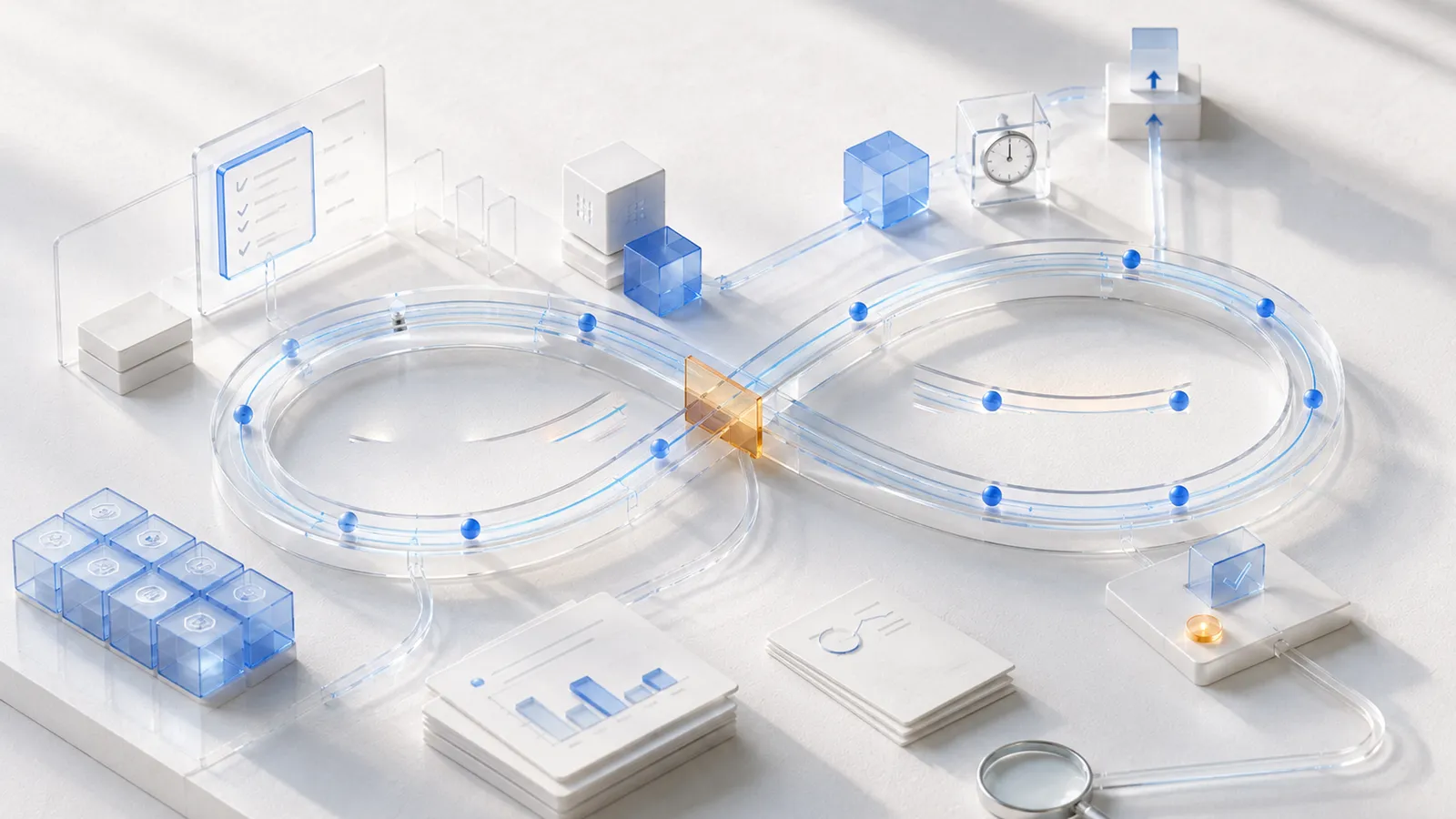
If Scrum and Kanban are reduced to two boards with cards moving in slightly different ways, their most important distinction disappears. Both methods organize work, but more fundamentally they organize time, attention and change differently. Scrum establishes a rhythm in which a team protects a selected amount of work for a limited period. Kanban establishes a flow in which new work is pulled when capacity becomes available.
AI projects often need both logics at the same time. A feature, prototype or defined integration stage may require several days of concentrated work before any meaningful evaluation is possible. At the same time, new findings, user feedback, data issues, content tasks, bugs, model tests and operational requests continue to arrive. If everything is forced into sprints, backlog and rigidity grow. If everything is placed in an open flow, teams can lose focus and start new work faster than they finish important work.
This is exactly where a practical bridge toward Scrumban emerges. Scrum and Kanban are deliberately not treated as competing beliefs here. After comparing them, one thing is clear: neither is a "golden rule" — the choice depends on the project, phase and task. In practice, most recommendations naturally converge on combinations — a mix of Scrum and Kanban, using the term "Scrumban" for that hybrid.
For this series, Scrumban is therefore not presented as a rigid framework that must be copied from an external playbook. It is first understood as a project-control logic drawn from practice: Where do we need a protected sprint rhythm, where do we need continuous pull-based flow, and how do we stop those two systems from undermining one another?
Two clocks inside the same project
Scrum and Kanban are differentiated mainly by the way work is admitted and protected. Scrum is a sprint-based cycle: plan, build, test, review. A selected amount of work is handled with focus for a defined period. New requirements should not constantly restructure the running sprint. At the end, a review takes place; depending on the result, the work is accepted, changed or followed by another sprint.
Kanban, by contrast, is a continuous process. Work moves through states, and new work is pulled when capacity becomes available. The system therefore responds more directly to priority, bottlenecks and available processing capacity than to a previously closed package of work.
The two logics solve different problems. A sprint protects concentration and commitment. Flow protects movement and throughput.
| Control question | Scrum logic | Kanban logic | Scrumban translation |
|---|---|---|---|
| When is new work accepted? | Before or between sprints | When capacity becomes available | Planned sprint intake plus a defined flow channel for ongoing work |
| What is protected? | The sprint goal and selected work | System capacity and steady movement | Focus work is protected while operational work remains mobile |
| How does the system react to new requirements? | They often wait for the next planning window | They are pulled by priority and capacity | New work is classified as a sprint candidate, flow task or genuine escalation |
| How is overload recognized? | The sprint goal becomes unstable or work remains unfinished | Too much simultaneous work and slowing flow | Loss of focus and flow congestion are observed separately |
| When are decisions revisited? | At sprint boundaries and reviews | Continuously as capacity and priority change | Tactical decisions remain continuous; strategic changes occur at defined boundaries |
The table reveals the real value of the hybrid logic. Scrumban is not two methods glued together. It is a way of coupling two different forms of time.
Feature development is not the same as content production
One clarifying example: in one case, Scrum was proposed for feature development and MVP logic because a clear sprint rhythm made sense. Content production surrounding the launch, however, was better suited to Kanban because an ongoing pipeline and faster iteration matched the nature of that work.
This distinction matters greatly in AI projects. A feature often has a state in which several dependent steps have to be completed together before the result is meaningful. An interface, agent workflow or retrieval component cannot always be treated as finished after each small intermediate step. The team needs a protected window in which it can build, test and evaluate the work package as a coherent unit.
Content, support, small data corrections and recurring operational tasks behave differently. They arrive continuously, differ in size and priority, and do not necessarily benefit from being forced into an artificial two-week package. Continuous flow is often more natural.
Scrumban becomes useful when different types of work inside the same project require different cadences.
A sprint is a protected space, not a calendar ritual
A common mistake is to reduce Scrum to the existence of a two-week calendar. The more important point, however, is the sprint's protective function. The team selects relevant work and focuses on it. New requirements do not automatically become immediate reprioritization.
This protection is especially valuable in AI projects because AI work has a dangerous property: new possibilities appear faster than old ones can be validated properly. While an agent workflow is being built, someone discovers a new model. While that model is being tested, a new tool idea appears. While a data pipeline is being stabilized, a deep-research run produces three additional architecture options.
If every new possibility is allowed to enter current work immediately, the result is not agility. It is permanent context switching.
A good sprint therefore creates temporary decision protection. For a limited period, a particular goal, hypothesis or deliverable is worked through to a level that can actually be evaluated. New ideas do not disappear. They move into an ordered intake channel and are assessed later.
This is where Kanban becomes the natural complement.
Flow is a pressure valve, not an unfiltered inbox
Kanban is a continuous process based on pull logic and work-in-progress limits. For this article, the most important element is the pull principle: work is not started merely because it exists. It is started because the system has capacity to move it forward responsibly.
That difference is fundamental.
An open task pool without capacity logic is not a flow system. It is a queue that generates guilt.
In a Scrumban model, the continuous channel therefore has a specific function. It accepts work that can be handled quickly, independently or operationally without repeatedly destroying the protected focus of a sprint. Small corrections, content tasks, documentation maintenance, bounded tests and support cases can move through that channel according to priority and capacity.
Work-in-progress limits, rolling waves and the deeper design of controlled work packages will be treated later in this series. For Scrumban, one principle is sufficient at this stage: flow should admit only as much work as can actually be moved forward.
The most important Scrumban boundary: what is allowed to interrupt a sprint?
The quality of a hybrid system is not revealed by the elegance of its board. It is revealed by the rule that separates sprint from flow.
If every new flow task can interrupt a sprint, there is effectively no sprint. If no urgent finding is ever allowed to influence the sprint, the sprint becomes a shield against reality.
AI projects therefore need an explicit interruption logic. A new model idea is usually not a reason to stop current work. A promising optimization suggestion is not either. A security problem, corrupted data foundation or new evidence that invalidates the sprint's core assumption can be different: those may represent genuine escalation.
A professional way to express the distinction is:
Does the new information merely expand our options, or does it destroy the validity of the work we are currently doing?
Only in the second case should interrupting the sprint be seriously considered.
This keeps the project open to evidence without allowing every new impulse to govern it.
User stories, review, and the logic of the "small deliverable piece"
A function is decomposed into smaller describable work units; difficulty or effort is estimated roughly; after implementation, a review takes place and feedback influences whether the result is accepted, changed or developed further.
This matters because it protects Scrumban from a common misunderstanding. "Small tasks" are not automatically good work units. What matters is whether a piece of work is testable and connectable to the next decision.
For an AI project, "improve the agent" would be a weak work unit. It is open-ended, unmeasurable and produces no clear review.
A stronger unit would be: "The research agent must create a structured draft from ten approved sources and make every central claim traceable to a source; traceability will then be tested on three cases."
● Members only
Read the full article and download all files with a membership.
Unlock full article + downloads → Subscribe0 comments
● Loading comments…