Consultation Instead of a Tool Pitch
How affected perspectives, fair work on conflict and a limited pilot can turn an AI idea into a reviewable governance decision

A small continuing-education provider is considering using a language model to render course materials into additional languages. At the first meeting, the choice of software is already on the table: which product is fast, affordable and privacy-friendly? One instructor asks who will review the translations. Another voice counters that careful review could consume the hoped-for time saving. Learners ask whether examples and tone will still fit their everyday context. The organisation has not yet decided whether AI will be used at all, which content might be suitable, or who can report an error.
The example is entirely fictional. It leads to a fundamental question: When does listening to different views become responsible consultation that can actually change an AI decision?
The short answer is: when it is clear before the conversation what will be decided, who may be affected by the decision, what influence participants have, and how their feedback enters a reasoned decision. Good consultation does not have to produce agreement. It has to make visible where knowledge, values or interests diverge, and show what the organisation does with that difference.
The question of technology conceals the question of responsibility
A tool pitch usually frames the future in advance: the organisation apparently needs an AI system; only the choice of system remains open. Other questions then slip from view. Should the work be automated at all? Is the task translation, summarisation, idea generation, or a decision about people? Are publicly available texts being handled, or sensitive information? Does a human review every draft? Who can reject it? Which non-technical option remains available?
These questions belong to governance. They determine who sets objectives, who must bear risks, who can stop an intervention, and who is accountable. The technical function is one part of the sociotechnical arrangement. The same service can be a limited aid in an internal writing experiment and, in another process, change selection, assessment or access to a service.
Consultation therefore begins before procurement and before testing. This does not mean that every person must co-decide every technical detail. It means that the organisation does not quietly narrow the subject of the conversation to a vendor choice. It states the real decision question, names the provisional solution space, and makes explicit which options remain open. This includes the possibility of using no AI, organising a process differently, or postponing an initiative.
The proposed Consultation Model K understands ethics as learning and governance work across objectives, perspectives, analysis, recommendations, feedback and application. In this article it is not a decorative slide of phases. It must change an option in the case: the original idea of preparing all materials with AI becomes a tightly limited and reversible pilot proposal after consultation.
Participation needs three separate examinations
An organisation can collect extensive feedback and still miss the most important questions. It is helpful to distinguish three kinds of reasoning. In this article, they are editorial lenses for examination, not an established measurement scale.
Epistemically, the issue is knowledge: what information is missing from the project team? How do people actually experience the process? Which language variety, accessibility barrier or everyday situation remains invisible in a product specification? Employees, instructors, learners and customers have different forms of experiential knowledge. This knowledge is not automatically infallible, but it can be an important source of new hypotheses and counterexamples.
Procedurally, the issue is the quality of the process: was the question understandable? Could participants respond without unreasonable effort? Were they told what they could influence? Did they learn how the decision was made? An invitation to a workshop demonstrates neither co-determination nor influence. A fair process includes a clear scope, accessible participation formats, a traceable decision, and a way to record unresolved objections.
Distributionally, the issue is who receives the expected benefit and who bears costs or risks. Who gains time? Who has to take on extra review work? Who encounters incorrect, exclusionary or unsuitable content? Who gets an opportunity to correct an answer, and who has to live with the result? A measure may appear more efficient overall while shifting work or error risk to a less powerful group.
These examinations are related, but they are not interchangeable. A broader information base does not yet make a process fair. A fair conversation does not prove that the later technology produces good results. And a useful pilot does not by itself justify having the same people always bear its costs.
For class discussion, the distinction can be tested with three follow-up questions: What do we learn through participation? Who may influence the decision? How are benefits, effort and possible harms distributed? If an answer is missing, it should not be replaced by the number of participants or the length of the minutes.
Do not harmonise difference prematurely
Intercultural ethics requires more than inviting people of different nationalities. Culture is not a fixed attribute that can be inferred from origin. Within the same language or organisation, people may have different experiences of authority, privacy, professionalism, mistakes or fair treatment. Such differences may also relate to occupation, age, role, accessibility barriers, status and individual preference.
A consultation process should therefore not make one person the spokesperson for an entire group. It asks about concrete experiences and reasons: which meanings are lost in a translation? Which form of address feels respectful or condescending? What would need to be visible for learners to review a machine-assisted draft meaningfully? Which feedback format would be safe and realistic? Different answers are documented; they are not prematurely compressed into an alleged shared cultural value.
A common moral standard may include human rights, dignity, non-discrimination and avoidance of foreseeable harm. It does not, however, automatically yield one single correct concrete implementation. UNESCO’s Recommendation on the Ethics of Artificial Intelligence addresses cultural identity and diversity, participation, inclusion and linguistic plurality; it also notes possible cultural effects of automated translation. This is normative orientation, not evidence that people in different contexts set the same priorities or that consultation must create consensus. [5]
When disagreement remains, the task is not always to “vote more.” Perhaps the options are not equally accessible; perhaps one group bears risk without having influence; perhaps a relevant voice is missing. For these reasons, the organisation can reject, change, limit or pause an option. It should not record dissent as resolved merely because a decision is ultimately made.
Who is heard—and who can change something?
Sherry Arnstein’s well-known ladder of participation was formulated for citizen participation in urban and planning decisions. It is not a universal metric for AI projects. As a critical aid to thinking, it nevertheless raises a useful question: How much decision-making power is actually shared? Informing, asking for views, co-designing, and binding co-decision are different relationships. A company should not define its own level through a friendly workshop; it should name the limits openly. [2]
Research on participatory AI also distinguishes between the mere presence of affected people and substantive agency. Delgado and colleagues describe how the strength of agency in participatory approaches is not always easy to assess. This does not entail a general rejection of consultation. It entails a duty to examine: what can change after the conversation? Is there a concrete point at which participating voices can stop a further step, trigger a renewed review, or revise the recommendation? [3]
Power differences do not disappear in small organisations. An employed instructor may withhold criticism when management is present. A course participant may assume that dissent will affect their assessment. An external language service may know where quality breaks down but have no access to the decision. A workshop with everyone at the same table can intensify these differences.
Countermeasures are no guarantee, but they change the conditions: paid working time for employees; simple and accessible routes to participate; a way to submit contributions without one’s direct manager; clear rules against disadvantages for critical feedback; understandable examples instead of inaccessible model terminology; and feedback on which proposals were accepted, limited or rejected. Where a small group could still make an anonymous response identifiable, the company does not promise anonymity it cannot ensure.
The organisation must formulate a commitment to influence in advance. For example: “The pilot scope, permissible content, human review and stop criteria are open. The vendor and annual budget are not the subject of today’s decision.” Such a boundary can make participation credible. It prevents the conversation from quietly becoming retrospective approval of a purchase already fixed. After consultation, management records in writing which proposals were adopted, limited or rejected, and why. The pilot does not begin while necessary review expertise, an effective stop trigger, or sufficient time resources are missing.
Consultation Model K: four steps in the core cycle
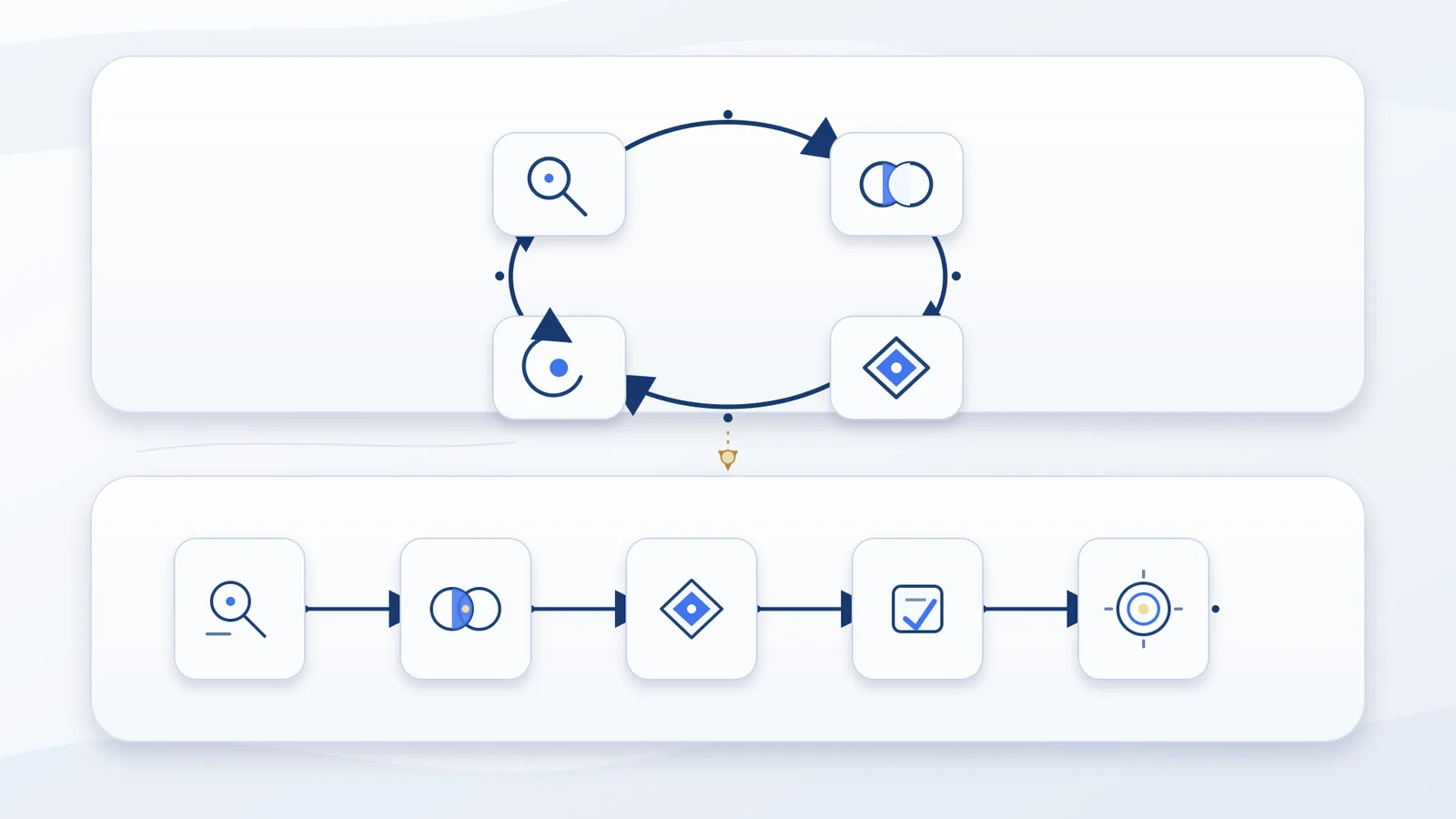
Model K describes an interdisciplinary learning and governance process. Its methodological core cycle has four steps: exploration, reflection and analysis, decision-making and recommendation, feedback and evaluation. The final step does not simply close the process. New feedback can lead back to exploration or analysis. [1]
| Step | Guiding question | Visible result |
|---|---|---|
| Exploration | What is the case, who is affected, and what information is missing? | Shared case description, participation framework and open questions |
| Reflection and analysis | Which values, benefits, risks, power differences and alternatives are in conflict? | Conflict map with evidence, assumptions and dissent |
| Decision and recommendation | Who decides, for what reasons, and under which limits? | Reasoned recommendation or decision with roles, conditions and an open counter-position |
| Feedback and evaluation | What does application show, who benefits, and what must be changed or stopped? | Feedback, evaluation and a documented revision or stop step |
The four steps do not merely arrange a consultation conversation in time. Each step changes the question that the organisation can answer. Exploration can reduce the scope of use. Reflection can expose hidden work. A recommendation can make human review a condition. Feedback can reopen an option that was previously decided.
In the elaborated case scenarios of the K original, this core cycle is developed through five application steps: exploration and data collection, reflection and analysis, decision and recommendations, implementation or pilot, final assessment and optimisation. The additional implementation step makes the path into practice visible; the final assessment marks a later point of review. This is an elaboration of case scenarios, not the definition of the four-stage core cycle.
These five scenario steps must in turn not be confused with R. R is an independent five-phase advisory model for concrete specialist questions. For a specifically delimited legal, contractual or regulatory question, it can structure a separate specialist-review assignment. This article does not set out R in full. If, for example, data processing, licence rights or a specific legal duty become decisive in the case, a qualified specialist review receives a clearly delimited assignment. K remains responsible for the broader governance decision.
An external parallel can be found in the voluntary NIST AI Risk Management Framework: GOVERN 5 describes procedures for collecting, weighing and incorporating feedback from people outside the development or deployment team into design; MAP 5.2 identifies documented practices and responsibilities for regular engagement and the integration of feedback as an outcome. This similarity does not confirm the effectiveness of Model K. It does, however, make a shared governance question visible: after reasoned assessment, how is feedback translated into a change, limitation or rejection? [4]
The K original also proposes a ratio of 70 percent practice and 30 percent theory. For a course, this can be a debatable design option. In the absence of a comparative educational study, neither an optimal ratio nor a proven effect may be inferred from it. The model likewise describes an approach, not a certified ethics standard or automatic approval.
The case: a small course provider reviews AI drafts
A fictional provider of vocational continuing education wants to make selected, freely available course materials accessible in more languages. A limited decision framework is already in place for consultation:
Should the provider use a limited pilot to assess whether one freely available course module can be offered in additional language versions? The options are a manual translation, an AI draft with human review, postponement, or not proceeding. The target groups, participation format, scope of review, resources, data rules, stop signals and conditions for a renewed decision remain open.
The series role is clear: “From the first idea to a better question” addresses F v5; in suitable projects, clarification of questions and assumptions there can prepare a handoff to K. The course-provider case used here is independent and not a continuation of the case there. This article assumes an already delimited decision framework and examines how K translates affectedness, influence, dissent and feedback into a governance decision. Question expansion is not taught again.
1. Exploration: delimit the case and participation
First, the organisation determines what the group can genuinely discuss. It wants to improve access to learning and is considering AI-generated translation drafts. The scope, suitable content, human review, feedback option and continuation remain open. Personal learner data, automated grading, individual performance profiles and vendor selection are not part of the first round. This separation reduces the risk that participants are asked to comment on a system whose concrete use has not even been explained.
The affectedness map includes instructors who create materials and would later have to correct them; learners who work with the content; a person with expertise in language and accessibility; the person responsible for course operations; and the person who determines resources and approvals. Some roles overlap. Not all must be represented in the same session, but each must be able to explain how its experience enters the decision. If the target group for a language version cannot yet be involved, this gap is recorded as an open dependency rather than filled by an assumption about its wishes.
The organisation also explains participation rights: the group can change pilot scope, review rules and stop triggers. Management makes the formal operational decision and bears responsibility and costs. After the session, it documents which suggestions it adopts, limits or rejects, and for what reasons; unresolved objections remain visible. A defined stop trigger and a responsible person with real authority to pause are prerequisites before the pilot may begin. The session is not a vote on the value of a language or the credibility of a group. It examines which criteria apply to responsible content and which option meets them.
2. Reflection and analysis: keep conflicts visible
Reflection reveals at least three legitimate goals: faster access to learning materials, reliable subject-matter meaning, and culturally appropriate language. Effort and power also matter. If each translation has to be fully reviewed anew by a specialist, additional work arises. If a draft is used without adequate review, learners bear the consequences. If an editorial team considers only the most widely used languages, it may reinforce existing inequalities. If a pilot looks only at time saved, it leaves invisible whether the content is understood.
A conflict is not automatically an error that the workshop must eliminate. One person may consider it responsible to test an AI draft as a starting point if a human checks it. Another may doubt that cultural appropriateness can be ensured through a late correction round. Both positions need an opportunity to state their reasons. The group distinguishes what it knows, what it assumes, and what it must still examine.
The analysis therefore compares several options. On the fully manual path, established review practices remain, but expanding course offerings may be slower or more expensive. AI drafts for all language versions promise large scope, but could overload review and distribute errors unevenly. A small pilot with an open, non-personal module and up to two language versions makes limited review possible, but does not represent all language situations. There is also the option of postponing the initiative until language-review capacity exists.
3. Decision and recommendation: the organisation commits itself
The recommendation is to prepare only a small pilot. It covers a single freely available module and at most two language versions. The selection is justified using documented need, a reachable target group, available independent review expertise, expected additional work, and expressly recorded reasons for exclusion. In this way, “prioritised” is not equated with mere market size. If a reachable target group or review expertise is lacking, the respective version is postponed. Before the start, a responsible review role, its authority to approve, protected time budget and a substitute in case of absence are fixed. This role reviews every version proposed for publication for meaning, subject-matter terminology and accessibility. AI drafts are not published automatically. A manually produced alternative remains available; no learner is required to use it.
The recommendation also documents what it does not resolve. Two language versions say nothing about the quality of all further languages. Specialist review does not demonstrate that every cultural nuance is correct. Good feedback from the pilot is not evidence that the procedure will work in the same way in larger courses or with other target groups. The conflict map records that some participants reject the use of AI itself, and that this position is not reinterpreted as consent.
● Members only
Read the full article and download all files with a membership.
Unlock full article + downloads → Subscribe0 comments
● Loading comments…