Coherence
Sentences fit together linguistically. That does not show that they match the facts.
AI ETHICS
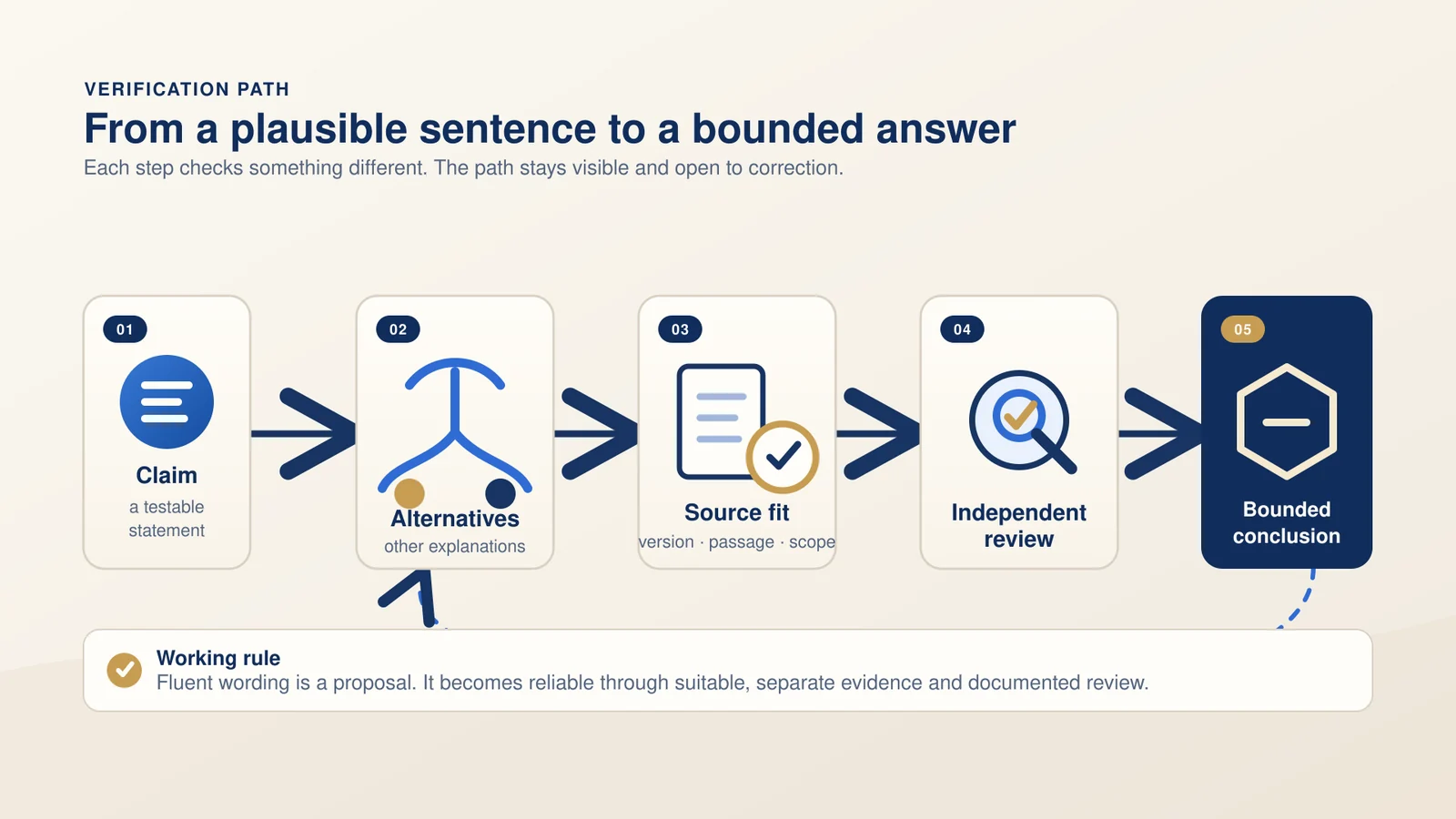
Fluent language is a proposed answer. Reliability comes from checking individual claims against suitable evidence and documenting their limits.

Which suitable source supports an individual claim for this question—and how will we know when it must be corrected?
An assistant claims that Python is a prerequisite for an introductory course. The approved programme does not require it; an optional supplementary sheet recommends Python only for an advanced exercise. The case is entirely invented.
Sentences fit together linguistically. That does not show that they match the facts.
One verifiable statement. Facts, value judgements, forecasts, and recommendations need different review methods.
A suitable, current source that supports, contradicts, or leaves open the specific claim within the right scope.
Studies of summarisation, truth benchmarks, and RAG identify errors in the tasks and model cohorts they examined. Source-attribution research evaluates whether a statement is supported by an identified source. Calibration, uncertainty, and self-correction research offer limited signals—not a general guarantee of truth.
“The approved introductory programme lists no Python prerequisite. The supplementary sheet uses Python for an optional advanced exercise. The current version must be checked for any other course run.”
Fully reviewing every reversible internal wording choice can be disproportionate. Claims about access, safety, or hard-to-reverse decisions need stronger evidence and effective approval. Without a suitable source, leave the answer open or refer it onward.
The four-step core cycle considers purpose, affected people, and knowledge gaps; reviews values and evidence; sets a provisional organisational rule; and defines feedback and revision.
The separate advisory model R structures a specific expert-review assignment, for example when a real legal, contractual, or regulatory question arises. It does not replace K.
Research findings apply to the tasks and models studied; they are not blanket metrics for current systems. F, K, and R are applied didactically here and are not presented as empirically validated or legally binding procedures. The case work and checklist are editorial teaching tools.