From personal assistant to team intelligence
Shared AI work does not begin by giving everyone the same chatbot. It begins with shared knowledge, clear rights and visible responsibility.
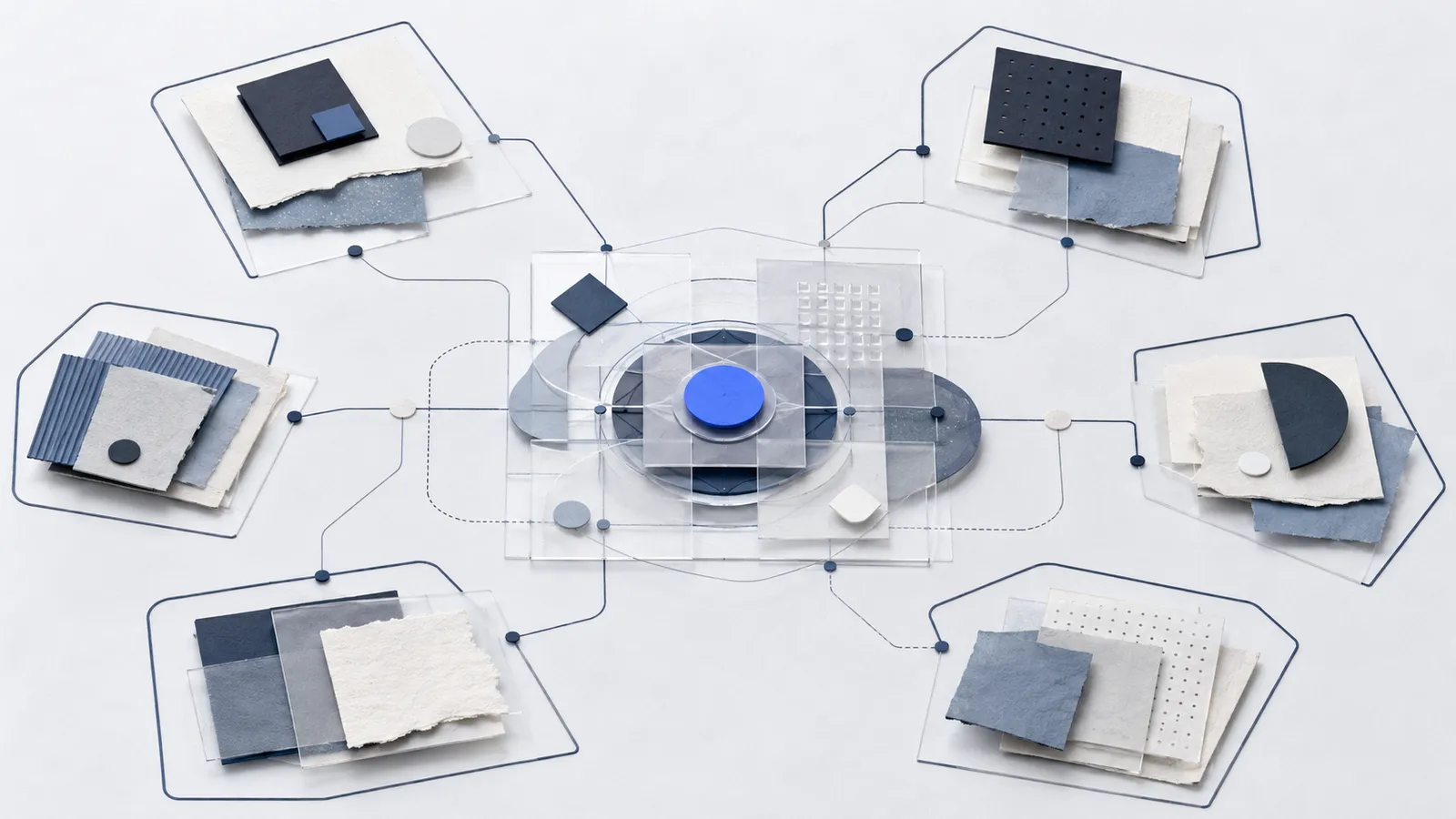
A personal AI assistant can be remarkably useful. It knows preferred formats, supports thinking and accelerates recurring work. Once several people collaborate, that form of personalisation is no longer enough. Individual chats contain different decisions, files and assumptions. What is obvious to one person remains invisible to the team. Team intelligence therefore grows not from more assistants, but from an architecture in which personal context is protected, shared knowledge is maintained and decisions remain traceable.
Personal productivity is not yet team capability
An individual assistant optimises around one person’s way of working. It can learn tone, terminology and routines. That closeness is valuable but not automatically transferable. When outcomes exist only in a personal history, nobody else can verify the foundation or know whether a decision remains current.
The team then faces a paradox: every person works faster while the shared project becomes harder to understand. Several good individual answers may create conflicting directions. Knowledge spreads across private conversations, local files and different model versions.
The transition to team intelligence begins with a new question. Not: What does my assistant know about me? But: Which information must be visible to whom so that shared work remains connected, testable and accountable?
Three context domains must remain distinct
The personal domain contains work preferences, private notes and individual drafts. It supports thought but does not automatically belong in shared knowledge. The project domain contains objective, roles, approved sources, current decisions, open items and present state. It is binding for collaboration.
The organisational domain preserves reusable rules, standards, templates, security boundaries and tested methods. It outlives individual projects but must not override every local exception without review. These domains have different owners, lifecycles and access rights.
A good interface does not transfer whole chat histories. It publishes selected artefacts: a decision, verified insight, template, test case or hand-off. Personal exploration may remain free; shared work begins with deliberate transfer.
Shared memory consists of decisions, not conversations
A team does not need a complete archive of every exchange. It needs reliable memory of what continues to apply: a short current brief, source index, decision log, open risks and traceable changes.
Each entry needs status and provenance. Is it a decision, proposal, model inference or untested assumption? Who approved it? Which version applies? Without these details, summaries quickly turn into apparent facts.
Shared memory should be light enough to maintain. A few authoritative documents are better than a large repository without authority. Team intelligence comes not from storing everything, but from finding and interpreting important material together.
Rights follow responsibility
Not every person or agent needs the same access. Reading, contributing, changing, deciding, approving and publishing are different rights. They should follow task and responsibility rather than technical convenience.
A team can distinguish four roles. Contributors create material. Reviewers inspect quality and sources. Decision-makers choose between options. Approvers carry responsibility for external effect. One person may hold several roles, but the transition should remain visible.
Agents receive roles rather than general authority too. A research agent reads approved sources, a production agent prepares drafts and a review agent looks for deviations. Publication, binding change and sensitive approval remain tied to an explicit checkpoint.
Orchestration makes work visible
Team intelligence does not mean launching the greatest number of agents. Orchestration arranges tasks, hand-offs and decisions. It defines which outcome a role produces, which status follows and who may take the next step.
Every assignment needs a small work contract: objective, material, output, acceptance criteria, permissions, stop conditions and accountable hand-off. The agent becomes a traceable function in the process rather than an invisible colleague.
Good orchestration exposes bottlenecks. Where does work wait for approval? Which source is repeatedly missing? Which agent causes excessive rework? This view helps a team improve not only output speed but the way it works.
Quality needs dissent and conflict rules
Shared AI work can amplify differences. Models produce different recommendations, teams weight objectives differently and personal assistants mirror their users’ perspectives. Conflict is normal architecture, not an exception.
Define in advance which source takes precedence, who resolves domain disputes and when a question escalates. A majority view is not automatically correct. Nor should the most persuasive model win by default.
A conflict record helps: disputed claim, competing foundations, possible consequences, deciding role and reasoned resolution. Dissent becomes testable quality work rather than another hidden chat branch.
Shadow AI grows where workable paths are missing
When official processes are slow, unclear or impractical, people build their own. They copy files into personal tools, keep secret prompt collections or automate steps without shared review. This is not merely a discipline problem. It shows that a usable common workflow is absent.
Prohibition alone often pushes shadow AI further out of view. A better approach provides approved workspaces, clear data zones, reviewed skills and a simple route for turning good personal methods into shared standards. Security and usefulness must be designed together.
Transparency requires trust. Teams should be able to report mistakes and uncertain experiments without every deviation triggering punishment. Only then do incidents become learning material rather than reasons to hide them.
Team intelligence grows in stages
The first stage is individual assistance: people use AI for their own drafts. The second creates shared artefacts and hand-offs. The third standardises recurring workflows, roles and verification. Stronger orchestration with several agents or automatic routing becomes worthwhile only afterwards.
Each stage needs observable maturity. Are sources maintained? Are decisions documented? Are rights and approvals understandable? Can outcomes be reproduced and errors traced? If these foundations are absent, additional autonomy only expands ambiguity.
Maturity is not the number of models. It is the ability of a new team member to understand the current state, an agent to perform only allowed work and an important decision to retain its origin, review and accountable approval.
People design shared attention
In a good team architecture, people do not control every step. They design what the system attends to: which objectives apply, which sources carry authority, which uncertainty must remain visible and which effect requires approval.
This role is more than supervision. It includes prioritisation, conflict resolution, maintenance of shared terms and the decision about which knowledge should become a rule or skill at all. The person becomes an orchestrator without becoming a permanent micromanager.
Team intelligence is therefore not a property of a machine. It is a quality of collaboration. AI becomes valuable where it makes knowledge accessible, improves hand-offs, organises dissent and leaves people more capable of decision at the right points.
The team intelligence charter
A compact charter records what is personal, project-bound and organisation-wide — and how roles, conflicts and hand-offs are governed:
# TEAM INTELLIGENCE CHARTER

**Shared objective**
Which outcomes should collaboration enable reliably?

**Context domains**
What remains personal, what belongs to the project, what applies organisation-wide?

**Authoritative artefacts**
Which documents carry state, sources, decisions and open risks?

**Roles and rights**
Who may read, contribute, change, decide, approve and publish?

**Agent roles**
Which clearly bounded functions do systems perform?

**Conflict path**
Which source prevails, who decides, when does escalation occur?

**Hand-off and approval**
Which artefact, status and check open the next step?

**Learning loop**
How do incidents, good methods and new test cases enter the standard?
The path from personal assistant to team intelligence is not a larger quantity of automated answers. It is a maintained shared reality: clear contexts, visible decisions, bounded rights and a culture in which responsibility is not handed to systems but exercised more effectively through them.
Worksheet: Design a team intelligence architecture
Choose a real team or project. Design a small shared workspace that connects personal freedom, shared knowledge and accountable decisions.
1. Separate context domains. Assign typical information to personal, project or organisational context. Explain two borderline cases.
2. Choose authoritative artefacts. Select no more than five documents for state, sources, decisions, risks and hand-offs. Give each an owner.
3. Map roles and rights. Separate contribution, review, decision, approval and publication. Give agents only minimum required rights.
4. Design conflict and hand-off. Write one precedence rule, an escalation path and the artefact that permits the next working step.
5. Test maturity and learning. Define three signals of team maturity and one path for turning incidents or good personal methods into reviewed standards.
● Members only
Read the full article and download all files with a membership.
Unlock full article + downloads → Subscribe0 comments
● Loading comments…