Beyond the Prompt
The operating system for working with artificial intelligence. A long essay on prompting, context, knowledge, agents, quality and digital sovereignty.
We are not merely at the beginning of a better input line. We are at the beginning of a new question: How should people organise their thinking when a system beside them can understand language, arrange knowledge, operate tools, and propose actions?

Contents
- Introduction: The moment after the astonishment
- I. The prompt was never the centre
- II. Context: the invisible infrastructure of judgement
- III. Knowledge that continues to work
- IV. Quality is not a feeling but an architecture
- V. The agent: from answer to action
- VI. Boundaries, data, and the question of sovereignty
- VII. The new studio: people, models, and workspaces
- VIII. Twelve theses for the age beyond the prompt
- Conclusion: the machine does not decide
- Questions for further thought
Introduction
Almost everyone who works seriously with a large language model encounters the same moment. You type a sentence—perhaps a question, perhaps the outline of an unfinished idea—and seconds later a text appears that is not only grammatically sound but surprisingly orderly, attentive, and sometimes more articulate than what you could have written at that moment. The experience is seductive. It makes the technology look like a shortcut, as if the only thing separating an intention from a result were a good prompt.
That is precisely where the misunderstanding begins.
The prompt is visible, and therefore overrated. It is the point at which a hand touches the machine, not the point at which good work comes into being. Good work begins earlier: in clarifying what is actually meant; deciding what is allowed to count; determining which knowledge matters and which merely creates noise. It also continues afterwards: in checking whether the result is true, whether it fits the situation, and whether it could trigger consequences no one has considered.
The more capable the systems become, the more dangerous it is to confuse language with judgement. A language model can formulate an objection without endorsing it. It can design a strategy without bearing its consequences. It can draft a letter without knowing who will actually receive it. This is not a weakness that will disappear with the next model generation. It is the structural difference between a machine that calculates possibilities and a person who assumes responsibility.
The decisive question of the coming years is therefore not: How do I write the perfect prompt? It is: How do we design a form of collaboration in which language, knowledge, tools, and decisions do not collapse into one another?
That question reaches from the individual to the institution. It concerns the person who must make notes readable not only to themselves but also to a model. It concerns teams balancing rapid production with traceable quality. It concerns organisations that are not merely buying a model but arranging data spaces, permissions, accountability, and liability. And it concerns society, because a technology that can write, research, plan, and act cannot be governed by better answers alone.
This essay attempts to turn many individual practices into a coherent picture. It is about prompting, but not prompting as magic. It is about context, but not context as merely filling a window. It is about agents, but not agents as a story of autonomy that makes people superfluous. And it is about sovereignty, because every form of intelligent collaboration ultimately determines where knowledge lives, who may act, and who bears the consequences.
The proposition is simple: artificial intelligence becomes genuinely useful only when we stop treating it as an answer machine and start treating it as one component in an operating system for thought and action.
I. The prompt was never the centre
A prompt is an opening. It may be precise or vague, generous or controlling, curious or authoritarian. Yet it is always only the visible slice of a larger situation. Someone who asks, “Write an article about artificial intelligence,” has not yet formulated an assignment. They have indicated a direction. Between that direction and a publishable text lie audience, tone, sources, length, position, objective, risk, visual language, legal boundaries, and the question of what the text is meant to achieve.
Prompts are overrated because they create the appearance of control. They can be copied, stored, and scored. Libraries of “ultimate prompts” promise to turn a machine into an expert with a few sentences. But expertise is not the ability to reproduce many technical terms. Expertise is knowing, in a particular situation, which information counts, which exception is dangerous, and which question must not yet be answered.
A good assignment therefore begins not with phrasing but with a position. What should be different after this work? Who should understand, decide, or do something better? What would happen if an answer sounded convincing but was wrong? What is explicitly outside the assignment? Only when these questions have been answered does a topic become a workable object.
This also changes the idea of an “AI work profile”. A model does not need to know everything about a person. On the contrary, an overloaded profile quickly becomes a mixture of self-description, aspiration, and outdated habits. What a model needs is a usable map: Which language is preferred? How are decisions made? What counts as evidence? What must never happen automatically? Where is the boundary between a draft and publication?
A good work profile is therefore functional rather than intimate. It does not describe the person as a data set; it describes the collaboration as a contract. It says: this tone applies in this space. These sources are binding. This kind of uncertainty must be visible. This step needs approval. Such a profile does not turn an AI into a person, but it prevents every new session from starting at zero.

From a wish to a working question
The difference becomes visible through a small shift. “How can I use AI in my company?” sounds reasonable, but it is too broad to answer well. It contains several undecided questions: For which task? With which data? For whom? Under what risk? In what infrastructure? According to what quality standard?
A workable version might read: “Design a decision brief for an internal research workflow that produces a summary for project owners from three approved sources. The summary must not retrieve external data. Every material claim must be traceable to a source. The draft must not be sent automatically.”
The second assignment is longer, but not more complicated. It has simply made visible the complexity that was already there. This is the first mark of maturity in working with AI: not to make the world appear simpler by squeezing it into one sentence, but to name the relevant distinctions clearly enough that the machine does not have to guess.
This clarity is not bureaucracy. It is care for one’s own work. It protects against the peculiar disappointment that occurs when an AI has done exactly what was written while completely missing what was meant.
Intent, context, and form
A viable assignment has at least three layers. The first is intent: Why is the work being done? The second is context: Which facts, sources, decisions, and boundaries apply? The third is form: What should the result look like? Many poor prompts are not poorly written sentences. They are assignments in which one of these layers is missing.
Without intent, the AI produces something plausible but arbitrary. Without context, it produces something polished that does not fit the situation. Without form, a good idea often arrives in an unusable container. Only their combination makes an assignment dependable.
Not everything has to live inside the prompt. The prompt can refer to a project brief, a source register, or a decision log. That is often better. A prompt is a fleeting moment; a project brief can be an inspectable document. Separating the two brings a decisive advantage: the collaboration becomes repeatable.
Why “master prompts” must disappoint
The myth of the master prompt is attractive because it moves responsibility into a file. One text is supposed to make the model intelligent, cautious, creative, precise, safe, and enterprise-ready. Yet the more a file promises, the more likely it is to become a museum of conflicting rules. It grows long, is rarely maintained, and eventually contains decisions whose origins no one remembers.
A better model is modular. There are a few durable house rules, a current project brief, a task contract for the present run, a source map, and a handoff at the end. These documents are not spectacular. That is exactly why they work. They distribute responsibility instead of compressing it into a magic sentence.
The prompt does not become unimportant. It becomes more precise. It no longer has to contain the entire organisation, a whole personality, and every imaginable exception. It can say what should happen now, because the world in which that sentence applies has already been described.
The AI prompts back
So far, prompting may sound like movement in one direction: the person formulates, the machine responds. In reality every answer begins a movement in the opposite direction. The system chooses terms, sets priorities, mirrors the other party’s tone, and proposes a next step. It therefore structures not only information but the person’s attention.
This effect is easy to overlook because it feels cooperative. Language models are optimised to be responsive. They often affirm the direction of a question, absorb its assumptions, and phrase objections so politely that they barely feel like resistance. People read this as cooperation. But cooperation and correctness are not the same. An answer can feel exceptionally good and, for that very reason, stabilise a poor assumption.
The essential media literacy of the AI age therefore includes more than writing good inputs. After an output, it asks: What has this text just done to my perception? Which option now appears more probable? Which alternative has disappeared from view? Did the system test my position, or merely phrase it more elegantly?
These questions are especially important when people are uncertain, tired, or emotionally involved. A subordinate clause can then have more effect than the main claim. A recommendation can look like a neutral possibility while shifting the entire decision space. The machine has no hidden intention. That is precisely what makes the situation demanding: effects do not require intentions.
Mature prompting therefore creates a small degree of epistemic distance. It asks not only for agreement but for counter-assumptions. It requests the strongest opposing position, makes uncertainty explicit, and separates observation from interpretation. Above all, it does not treat the output as the end of thinking. The person remains a reader of their own susceptibility to influence.
II. Context: the invisible infrastructure of judgement
If the prompt is the door, context is the room in which an answer acquires meaning. Without context, a model knows how language generally works. With context, it can recognise what should count as relevant in this project, for this person, at this moment.
Context, however, is not a reservoir. More context is not automatically better context. Giving a model a hundred documents, long chat histories, old drafts, contradictory rules, and unverified web findings does not necessarily make the system more intelligent. It first increases the number of ways in which the system can be wrong.
A model’s context window is often mistaken for memory. It is closer to a temporary stage. Everything placed on it may be important in one moment and obscured by something newer in the next. The distinction is practical: it determines whether a project still knows three days later why a decision was made, or merely reproduces the wording of the latest message.
Good context is curated. It contains not everything ever said, but what applies to the decision at hand. It marks which source is authoritative, which serves only as an example, which information may be outdated, and which question remains open. It turns an accumulation of files into a description of the situation.

The art of omission
Many organisations collect knowledge as though completeness were already a form of quality. Documents are filed, chats exported, presentations archived. Later, a model is placed before this mass and asked to produce “everything important”. The result is often a persuasive surface without dependable depth.
The better question is: Which information changes the decision now facing us? If a document does not answer that question, it may remain in the archive. It need not enter active context. This omission does not reduce knowledge. It is the condition under which knowledge becomes capable of action.
A source map helps. It records not only filenames but authority, recency, data zone, and purpose. A binding contract has a different role from a blog post. An old decision may explain why something exists, but must not quietly become the current rule. An uncertain web finding may initiate research, but it cannot create permission.
Once those distinctions are visible, the collaboration changes. The model no longer has to pretend that all sources are equal. It can say: here is a direct statement; here only an interpretation; here two sources conflict; here a decision is missing. Such sentences are often more valuable than a fast and polished conclusion.
Context has a saturation point
Long projects rarely fail with a visible explosion. They gradually lose definition. A term begins to be used differently, an early constraint disappears, a provisional draft is mistaken for the binding version. The fuller the workspace becomes, the harder it is for both people and models to distinguish what matters from what is merely new.
This is context decay. A system can accept a great deal of text and still perform worse because relevance, source clarity, and compactness decline. The technical size of a context window therefore says little about the amount of meaningful work it can contain. The decisive measure is not maximum capacity but signal quality.
Robust context can be tested with three questions. Is the material relevant to the current task? Is it clear which authority belongs to which source? Is the representation compact enough that central decisions do not disappear beneath repetition? These modest criteria transform project management. They turn context into something maintained rather than merely filled.
For extensive work, a phase-based logic is therefore useful. One workspace produces; another observes the project plan, accepted results, and open dependencies. When the first becomes overloaded, the project does not improvise a restart. It performs a deliberate handoff. Only working results, relevant sources, decisions, and risks move forward. This is not artificial amnesia. It is the ability to retain the thread by leaving ballast behind.
The handoff as a form of respect
A handoff is not a protocol for forgetful people. It acknowledges that work is larger than the session in which it arose. Anyone transferring a project to another model, a colleague, or their future self does not simply transfer files. They transfer a state of judgement.
A good handoff states what has been achieved, which sources count, which decisions are accepted, which assumptions remain uncertain, which tests have run, and what next step makes sense. It is brief enough to be read and precise enough to avoid reinventing the story.
This matters because AI systems encourage a dangerous illusion: they always appear present. A new chat can be opened, the same instruction entered, and language appears immediately. But continuity does not arise from availability. It arises from good memory outside the model.
III. Knowledge that continues to work
A second brain is not a folder full of notes. It is a system in which decisions, sources, experiences, and open questions persist in a form that improves later work. Its quality is not measured by the amount it contains but by whether someone can find a relevant insight, understand it, and transfer it into a new situation.
Artificial intelligence sharpens the issue. A person may remember the tone of a conversation, a gesture, or a moment of doubt. A model can only work with what it receives. This does not mean people must document their entire inner lives. It means only that working decisions important to collaboration need a place to live.
Knowledge becomes valuable when it has a lifecycle. It is captured, condensed, reviewed, used, reconsidered, and eventually updated or retired. Most knowledge systems do not fail at storage. They fail because no one decides what remains valid.
An old note may be true and still become dangerous when it appears in a new context as a current rule. A successful prompt may be useful and still unsuitable when the data zone or audience changes. An experience may be valuable and still resist generalisation. Mature knowledge management makes these boundaries visible.

Chats do not become archives; they become decisions
The simplest mistake is to save a long chat and call it knowledge. A conversation contains much that was necessary for its creation but unnecessary for its future: detours, repetition, false hypotheses, changes of tone, and private asides. Preserving everything also preserves ambiguity.
A better migration asks: What is the project brief? Which decision was made? Which source supports it? Which artefact was produced? What remains open? These questions do not extract the entire history, but they rescue what can work again later.
That is the difference between a chat archive and a knowledge space. The archive recounts what happened. The knowledge space makes it possible to continue intelligently.
Knowledge needs examples and counterexamples
A collection of good phrasings is not yet a knowledge base. It shows what worked once, but not why it worked or when it would fail. A pattern begins to carry expertise only when it is connected to a purpose, a valid context, verified examples, and explained counterexamples.
A strong knowledge module therefore contains more than an instruction. It includes a concise professional explanation, several successful end-to-end scenarios, and cases that are designed not to work. Negative examples are not a gallery of mistakes. They expose boundaries: a source is missing; an exception is generalised; the answer is formally correct but dangerous in context. Through these contrasts, a system learns not merely to imitate a surface but to notice differences.
The idea of a prompt library changes accordingly. It becomes a curated body of tasks, data, checks, examples, provenance, and scope instead of a collection of clever sentences. Its most valuable component is no longer the prompt itself. It is the verified experience surrounding it.
IV. Quality is not a feeling but an architecture
The strangest side effect of generative systems is not that they make mistakes. People make mistakes. It is that an error can now look exceptionally good. A plausible paragraph sounds like thought; an elegantly formatted table looks like verification; a confident tone resembles competence. Liking a result is therefore not enough.
Quality begins where admiration ends. It is the ability to test a claim against its sources, a decision against its criteria, and an artefact against its purpose. A text may shine and answer the wrong question. A program may pass its tests and remain unacceptable in a sensitive setting. An analysis may consider a hundred signals and retain one decisive blind spot. Good work treats these possibilities not as bad luck but as design requirements.
This changes the human role. People working with AI should not have to defend every line against the machine. That would be a poor division of labour. They should determine the points at which judgement is indispensable: the choice of sources, the meaning of a term, the boundary of a claim, the treatment of uncertainty, and the acceptability of a consequence. These are not annoying control costs. They are where responsibility becomes visible.

The second model
In a mature workspace, a model is not only a producer. It can also act as a critical reader. A second model, another prompt, or a deliberately different review assignment can search for unsupported claims, contradictions, missing counterpositions, security risks, and false certainty. This redundancy is valuable because it does not require the first pass to recognise its own weaknesses.
The second voice is not a final court either. Two systems may share the same false premise, amplify the same trend, overvalue the same source, or overlook the same gap. The objective is therefore not to unleash more and more models on one another. It is to connect different kinds of review.
A source review asks: How do we know this? A consistency review asks: Does this fit what has already been decided? An impact review asks: What happens if this answer is actually used? A style review asks: Is this form appropriate to the situation? And a human review asks something that cannot be completely standardised: Would I defend this decision if it harmed someone, cost money, or became public tomorrow?
These questions initially appear slower than the direct route from assignment to output. In reality they prevent the most expensive form of delay: late correction of a beautifully packaged error.
The exhaustion of verification
Verification is often described as a quick glance at a checklist. In practice, reviewing generated content is a distinct cognitive burden. The reviewer meets a text that is fluent, polite, and internally coherent. They must work against this impression, open sources, compare details, and repeatedly remember that linguistic certainty is not evidence.
This work may be more emotionally demanding than reviewing an obviously unfinished draft. A crude error creates resistance; a plausible inaccuracy invites continuation. It is therefore dangerous to fill all production time saved by AI with more production. Producing ten times as much content creates ten times as much need for review unless the architecture limits the risk.
The answer is not blanket distrust. It is better allocation of verification. Strict rules and expert systems belong where a result is clearly true or false, permitted or prohibited. Language models remain strong where variants, explanations, and drafts are required. End-to-end tests show whether both worlds work together. People concentrate on the points where professional or moral judgement cannot be formalised.
Verification thus becomes a design question: Which parts of the work can be proven automatically? Which require independent sources? Which must be seen by a domain expert? Which output must not be produced at all when its prerequisites are missing?
Tests are not decoration
Many quality processes fail because they begin too late. Only after a text is finished, a presentation designed, or a function built does someone step back and ask whether it is correct. Quality then becomes a verdict on a completed object. It is better treated as a property of the path.
Criteria stand before the work, checkpoints during it, and evidence after it. Before commissioning a report, one can define which sources are admissible, which statements require uncertainty labels, and which decision may not be automated. When developing software with agents, requirements, tests, data access, and approvals can be separate layers. When building a knowledge base, provenance, recency, and scope can be attached to every important note.
These are not bureaucratic rituals. They are the language in which a system describes its own reliability. Without them, there is only an impression. With them, an impression becomes a traceable performance.
The new meaning of expertise
It would be a mistake to position expertise against artificial intelligence. Expertise is not the ability to store every piece of information in one’s head. It is the ability to recognise relevance, ask good questions, distinguish patterns, and anticipate consequences. Precisely because systems can now formulate, search, and combine quickly, this ability becomes more visible.
The expert of the coming years will not be recognised by doing everything alone. She will be recognised by arranging a collaboration that does not collapse into arbitrariness. She knows when a tool is suitable, when a process needs a pause, and when a good result should not be published. She builds environments in which other people, models, and later versions of herself can continue safely.
This is a demanding form of authorship. It does not consist in owning every phrase. It consists in responsibility for the conditions under which a phrase was allowed to arise.
Verifiability is the boundary of automation
AI does not accelerate every task to the same degree. Work can be delegated most extensively where a result is verifiable: a program passes or fails tests; a calculation can be repeated; a file has a defined format; a citation either supports a real statement or does not.
The task becomes harder where the objective itself is unclear. When is a strategy genuinely good? When does a text respect the dignity of its audience? When is a risk socially acceptable? In such work, a system can generate valuable possibilities but cannot decide alone when the work is complete.
This distinction protects against two errors. The first underestimates automation because a machine lacks comprehensive human judgement. The second overestimates it because the machine completes a large part of the work convincingly. Mature practice uses both: immense speed in exploring variants and the human capacity to recognise the final, decisive differences. Expertise often resides precisely in this last segment—in knowledge formed by experience, embodied perception, consequences, and quiet exceptions that no data set has yet captured completely.
V. The agent: from answer to action
As long as artificial intelligence only answers, its effect remains limited. It can organise, explain, outline, translate, and draft. Once it uses tools, creates files, retrieves information, runs tests, or triggers processes, the situation changes. A conversational partner becomes an acting system. Every action raises questions that a good answer alone cannot resolve.
An agent is therefore not simply a chat with more buttons. It is a combination of objective, context, tools, boundaries, memory, and review. The decisive issue is not how many steps it can take, but whether those steps form a traceable order.
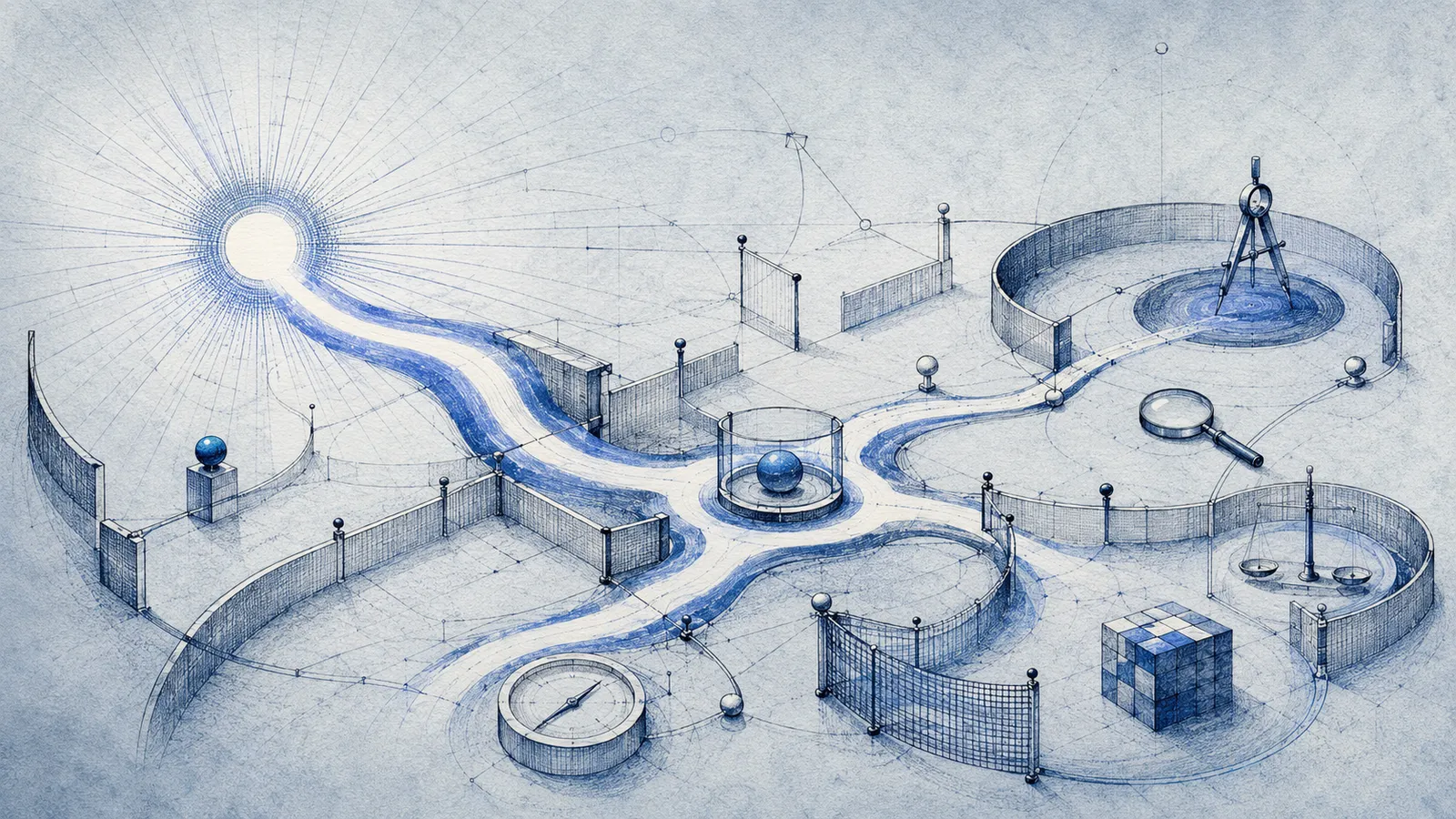
Autonomy needs a harness
The technical term is often harness: a frame, restraint, or guidance system. The image is apt as long as it is not misunderstood as mere restriction. A good harness does not diminish a system. It makes its power usable.
Such a framework answers simple but consequential questions. What must be achieved? Which information is the starting point? Which tools may the system use? What may it prepare but not execute? When must it pause and involve a person? How do we know it is finished? How can someone later understand why it chose this route?
Leaving those questions open transfers the design of the work to the accident of the next input. That may be forgivable for a draft. It is irresponsible when changing data, publishing material, messaging other people, or operating infrastructure—not because an agent is inherently dangerous, but because effects always need boundaries.
The working contract of a task
A good agent task therefore begins like a small contract. It describes the purpose and the non-goals. It names the materials, not only the desired result. It defines the expected form and acceptance criteria. It distinguishes draft from execution.
This sounds sober; in practice, it is liberating. An agent instructed to present a plan, check sources, create a draft, and request approval before any external action does not have to guess what “finish it” means. The person can spend energy deciding at the right points instead of capturing every detail afterwards.
Some tasks can safely let a system consolidate research, structure files, prepare a test environment, or compare alternatives. Others should permit suggestions only: contractual decisions, access rights, public communication, sensitive personal data, and irreversible deletion. The distinction is not about technical capability. It is about consequences.
Planning, action, control
Dependable agentic work has three movements. First comes a plan: a reasoned route through the task. Then comes action: research, editing, tool use, creation. Finally comes control: tests, critical reading, comparison with the assignment, and human approval where required.
Order matters. It prevents a system from moving at great speed in the wrong direction. It lets people intervene early without monitoring every motion. And it creates artefacts that remain useful: a plan, a record, and a review. These are not traces for their own sake. They allow a person, project, or team to learn from a successful run.
The wisest automation is therefore rarely the one that replaces the most. It removes repetition without cutting judgement out of the work.
Skills: experience becomes executable knowledge
Between a single instruction and a complete agent lies an important form: the skill. It bundles context, procedure, quality criteria, examples, and boundaries for a recurring task. A good skill is neither merely a prompt nor a rigid program. It is a small constitution for work.
The potential is substantial. A carefully constructed skill can make professional knowledge available in every new project, save context, reduce hallucinations, and stabilise a quality standard. It can specify how research should be checked, a document designed, or a technical process secured. It turns one successful performance into a reusable capability.
The same reusability creates a new risk. A skill may invoke tools, read files, and change behavioural rules. If it is accepted unexamined from an external source or updated automatically, it creates a supply chain for instructions. A manipulated webpage, compromised repository, or unobtrusive prompt injection may then affect not just one session but many projects.
Skills should therefore be treated like code: inspect provenance, read the content, minimise permissions, test in a safe environment, and rebuild sensitive ones internally. Several skills that are harmless in isolation can acquire dangerous reach in combination. Security does not lie in a seal of approval. It lies in understanding executable knowledge before granting it power to act.
When tools touch the world
A model that writes changes a draft. A model with tool access may change a repository, calendar, database, codebase, or part of the external world. That difference requires a different design ethic.
Access should be as narrow as possible. Steps should be reversible when appropriate. Important actions should remain visible. A system should receive no more context than the task requires. And it should never appear to possess permission that no one granted.
This is where the language of trust must become precise. Trust does not mean assuming that the system will do nothing wrong. Trust means designing the process so that an error remains limited, detectable, and correctable.
VI. Boundaries, data, and the question of sovereignty
Artificial intelligence is often discussed as if it were a single cloud: available somewhere, infinitely large, and essentially interchangeable. That image is too crude for real work. Data has origins, rights, risks, relationships, and contexts in which it may be read. Not everything that can technically be processed should be processed everywhere.
Sovereignty in this context does not mean isolation. It means the ability to choose. Sovereign practitioners know which information belongs in which space, which traces a tool leaves, and where a convenient connection has too high a price. This is not a romantic return to the disconnected hard drive. It is a mature approach to possibility.

The right zone for the right question
Some material may be public. Some belongs in a shared workspace. Some requires a restricted environment. Some should never leave a device, an organisation, or a small group. These zones cannot be fixed once and forever; they must fit the material, people, and task.
The important movement is not “all local” or “all online”. It is conscious selection. Open research may need a different space from a confidential client analysis. A creative draft may leave a different history from a person-specific decision. A knowledge system can be usefully connected without pulling every source into every session.
Making those distinctions early produces more than security. It creates clarity. Teams know what they may discuss. Models receive better rather than simply more context. Projects become easier to hand over because their boundaries no longer exist only in individual people’s heads.
Sovereignty is an architecture of alternatives
The robust answer to local versus cloud is seldom one or the other. It is deliberate orchestration. Confidential routines, recurring assistance, and internal knowledge work can occur in a controlled environment. Open research or particularly demanding individual tasks can use a more capable external model. Not every problem needs the same computation, and not every piece of information may travel the same route.
A hybrid system distributes work according to sensitivity, verifiability, cost, and required capability. A smaller model may classify data or prepare an internal draft. A specialised model may review code. A large model may develop complex counterpositions. A person or explicit router decides which transfer is permitted and which data must be removed, condensed, or anonymised.
This diversity also protects against dependency. If an entire organisation embeds itself deeply in one provider’s interface, memory, and proprietary workspaces, any later change becomes an existential migration project. Prices, rules, and availability can change. The organisation’s knowledge must therefore not exist solely inside someone else’s interface.
Sovereignty becomes portability. Rules, sources, skills, checks, and decisions live in formats that another system can read. Models remain replaceable without reinventing the work culture each time. This is less convenient than complete commitment to one ecosystem. It is also more resilient.
Boundaries are productive
Technology often treats a boundary as an obstacle: missing access, delayed approval, a tool restriction. Boundaries can improve work. They force the assignment to become precise, reduce unnecessary data, expose dependencies, and prevent a small convenience from becoming a large invisible risk.
A good boundary does more than say no. It indicates a route: this information remains in this space; this task may continue with an anonymised version; this step requires approval; this result may be exported after review. Security then becomes part of the choreography rather than a stop sign.

The value of traceability
When systems work with knowledge, producing a useful result is not enough. It must be possible to see which sources, rules, and decisions contributed to it. Traceability is not something attached afterwards as a log. It begins with a clear repository, explicit responsibilities, narrow access rights, and language in which uncertainty is allowed.
It also protects people from a subtle temptation: treating the system as an oracle. A traceable system reminds us that every result is a construction. It shows where data ends, assumptions begin, and responsibility cannot be delegated.
VII. The new studio: people, models, and workspaces
The future of knowledge work will not take place in a single window. It will emerge in a studio of different spaces. One is used to think and write; another to collect and connect knowledge; a third is built for concentrated technical work; a fourth helps people read large bodies of source material. People, files, decisions, and agents move between them.
This sounds less spectacular than the story of an all-knowing machine. That is why it is more useful. Good work has always needed workshops: sketchbook, archive, meeting room, laboratory, workbench. Artificial intelligence does not abolish these spaces. It changes the connections between them.
A personal knowledge space can preserve observations, concepts, sources, and decisions for reuse over years. A development environment can place rules, tests, and clear project context next to the code. A browser project can combine material, assignments, and intermediate states. A reading environment can make large documents accessible without obscuring provenance. Specialised automations can execute recurring steps as long as their responsibilities remain explicit.

A tool is an attitude in software form
It is tempting to rank tools: this model is smarter, that environment faster, this interface more convenient. Such comparisons may support an individual decision, but they obscure the more important question: What attitude does a tool write into everyday work?
A system that pulls everything into an endless chat rewards spontaneous memory. A system that makes files, rules, and checks visible rewards continuity. A system that announces actions clearly rewards responsibility. A system that connects material well rewards reuse. No interface is neutral. Each shapes what appears normal.
Selection should therefore not begin with whichever tool currently attracts the most attention. It should begin with the work problem. Do we need orientation in many sources? A safe framework for changes to a project? A repeatable editorial process? A place where an idea remains understandable after a month? Only then does a technology become an answer rather than a distraction.
From personal assistance to team intelligence
When agents enter shared workspaces, their role changes. A personal assistant knows one individual’s context. Team intelligence moves among multiple perspectives, responsibilities, and secrets. It may monitor project objectives, connect knowledge from different disciplines, and prepare work packages. At the same time, it may unintentionally erase boundaries between people.
The central question is no longer only: What may the agent do? It is: Whose knowledge may it use in which situation? A team member may have access to information without permission to share it with everyone else. An agent technically able to reach every project source therefore needs rules finer than human membership in a channel.
A new form of management emerges here. It resembles the leadership of a dynamic system more than control of individual work steps. A human orchestrator knows the capabilities of several agents, assigns tasks, observes their boundaries, and decides which results may be combined. The more production becomes possible, the more important this orchestration becomes. Automation does not remove leadership. It moves leadership from assigning small activities to designing interfaces, reviews, and spaces of responsibility.
This is also a cultural task. A team must not treat its shared AI as an invisible colleague to whom everyone casually tells everything. It needs a shared language for data zones, decision rights, sources, and dissent. Only then does a shared data foundation become shared intelligence rather than a larger space for unnoticed boundary violations.
The map is more valuable than the collection
A workspace can be full of files and still feel empty. This happens when there is no map: no starting page, no concepts, no links among source, decision, and result, no indication of what is open or valid. The consequence is paradoxical. The more that is collected, the harder anything becomes to use.
The map need not be complicated. It may consist of a few recurring locations: an overview of the undertaking, a source list, a decision logic, open questions, reusable patterns, and a history of handoffs. A perfect taxonomy is not the point. The point is that a new person, a new model, or a future self can quickly see where the work stands.
This reveals a quiet truth about AI productivity: the greatest leverage often lies not in the next input, but in the quality of what exists before it. Good folders, clear names, a maintained vocabulary, concise context sheets, and real examples are not preliminary work. They are the work that makes everything else easier.
The person at the gate
In a good studio, the person does not stand at a conveyor belt sorting every output. They stand at the gates: points where meaning, risk, and direction are decided. This may happen before research, when the question is sharpened; after a draft, when tone and responsibility are examined; before an irreversible action; or at the end, when work is published, rejected, or returned to the knowledge space.
The position is not passive. It requires attention without micromanagement, curiosity without technological infatuation, and the courage to interrupt when something is convincing only because it is well phrased.

VIII. Twelve theses for the age beyond the prompt
The following theses are not a rulebook. They are a lectern for practice: twelve propositions against which a project, an organisation, or a personal way of working can test itself.
1. A good question is already a form of work
The quality of an answer begins long before the answer. Anyone sharpening a question decides perspective, standard, and boundary. “Make something good out of this” provides no direction. “Which decision is being prepared, what evidence supports it, and who must understand the consequence?” opens a workspace. Prompting is then not magic but the craft of formulating a thinking assignment so that it can be examined.
2. More context is not automatically better context
The material for a task should be rich enough to reveal the relevant world and small enough to keep that world legible. Overloaded context creates more than cost. It creates confusion, contradictory signals, and apparent certainty. Curation does not mean omitting uncomfortable facts. It means making relevance visible.
3. Repeatable quality needs a home outside the chat
Anything worthy of a second use should leave the transient conversation: strong examples, writing rules, decisions, sources, test cases, open questions. A chat can be a workbench. It should not be the only archive. Keeping knowledge only in conversations asks the future to guess the past.
4. An agent is always an organisational decision
Once a system is allowed to act, its permissions express the values of its environment. May it only research? Change files? Prepare messages? Publish something? These are not merely technical settings. They distribute responsibility. Autonomy becomes mature when its boundaries are designed as carefully as its capabilities.
5. The fastest answer is rarely the fastest progress
When a team multiplies a false assumption at high speed, it is not productive; it is merely wrong faster. A short plan, source review, intermediate checkpoint, or test may slow the path and bring the destination much closer. Progress is not the number of generated pages. It is the distance between the initial question and a decision capable of bearing weight.
6. Redundancy is a sign of care, not weakness
A second look, an independent source, a counter-model, or a clear test costs time. It also reduces the danger of confusing plausibility with truth. Especially with systems capable of such persuasive language, redundancy is a form of intellectual hygiene.
7. Good rules do not diminish creativity
Many people fear that templates, house rules, and checkpoints make thought mechanical. The opposite is often true. A clear framework removes repetition and creates room for the genuinely new part of the work: an unexpected connection, a better question, a courageous decision. Creativity does not need chaos. It needs ground from which to leap.
8. Sovereignty begins with the ability to say no
Not every piece of information must be uploaded, every connection made, or every automation activated. A deliberate no is not technological backwardness. It is the condition under which a later yes retains meaning. People who know their data zones, roles, and approvals can use possibilities without being driven by them.
9. A format is not merely a container
The choice among note, briefing, article, table, test, protocol, or map changes what an idea can become. Good collaboration with AI takes form seriously. It asks not only what should be said but which representation supports judgement. A diagram can reveal relationships. An essay can hold ambivalence. A test can measure claims against reality. Form is a tool for thought.
10. The handoff is a quality moment
Work is not complete when it leaves its creator’s screen. It is complete when someone else can take it up without inventing its history. A good handoff is not a diary but an orientation: objective, status, sources, decisions, risks, and the next sensible movement. An individual performance becomes an asset.
11. The best AI strategy is first a strategy for attention
Models can dramatically increase the number of possible tasks. Attention therefore becomes the scarcest resource. A good environment protects it through clear working modes, limited notifications, visible priorities, small contexts, and clean closure. Without such care, artificial intelligence becomes not an amplifier but a generator of infinite beginnings.
12. Collaboration remains a moral practice
Ultimately, performance is not the only concern. The question is how people encounter one another through systems. Do decisions become more explicable or more opaque? Are people supported or bypassed? Can errors become learning, or are they hidden? Is data treated as raw material or as entrusted reality? Technology supplies no finished answers. It merely reveals whether we were willing to ask the questions.
Conclusion
Perhaps the most important disenchantment of artificial intelligence is also the most liberating. It does not relieve us of the work of thinking. It forces us to see more precisely what the work of thinking is.
It is not the formulation of a sentence. It is the decision about which sentence is accountable in which situation. It is not the retrieval of information. It is the recognition of which information matters and what consequences it may carry. It is not the ability to execute an action. It is the ability to connect an action with an objective, a boundary, and a person.
The age beyond the prompt begins when we stop treating artificial intelligence as a wish machine. It begins when we build workspaces that preserve knowledge, dose context, test quality, constrain agents, and strengthen people at the right points. AI then becomes neither a substitute person nor a mere function. It becomes a medium in which the quality of our collaboration is revealed.
That is a demanding standard. It requires patience in a culture of immediacy, structure in a culture of endless possibility, and judgement at a time when language is easier to produce than ever before.
Yet this is precisely the opportunity. If we do not merely use systems but design them, they can help us ask more clearly, act more carefully, and pass on knowledge without losing it at the next session. The decisive question for the future is then no longer: What can the model do? It is: What kind of work, what kind of organisation, and what kind of people do we want to become with it?
Questions for further thought
This essay belongs to a long tradition of writing about tools, knowledge, and responsibility. Readers wishing to deepen its ideas will find productive counterparts in the following works:
- Vannevar Bush: As We May Think (1945)—an early design for connected memory and associative knowledge.
- Douglas C. Engelbart: Augmenting Human Intellect: A Conceptual Framework (1962)—the idea of building computers as amplifiers of human problem-solving.
- Norbert Wiener: The Human Use of Human Beings (1950)—reflections on responsibility in a technological world shaped by feedback.
- Donella H. Meadows: Thinking in Systems (2008)—a lucid view of relationships, boundaries, and feedback loops.
- Shoshana Zuboff: The Age of Surveillance Capitalism (2019)—an important perspective on data, power, and the social dimension of digital systems.
The perspective developed here is deliberately not a manual for one product. It is an argument for a culture of work: clear questions, projects capable of remembering, verifiable actions, and a sovereignty created not by abstinence but by deliberate design.
© Furkan Sakızlı · Published in the Journal.
0 comments
● Loading comments…