A big job is many small steps
No single prompt finishes a large task at once. Break it into short, checkable steps and you keep quality and overview — and after each step you know whether you are still on the right track.
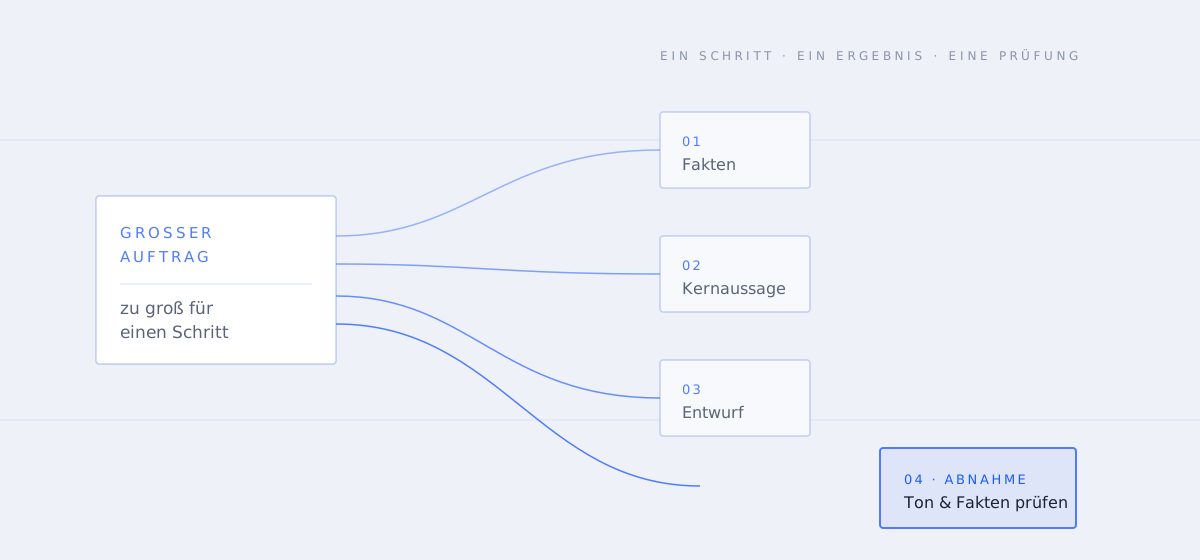
“Write me a customer letter about the price increase.” A sentence like that sounds like one task, but is really four or five: gathering, deciding, drafting, checking. Hand it over as a single prompt and you often get something that looks plausible but is wrong in one place — and you notice too late which one.
You break large tasks down not because you like being tidy, but because control is otherwise lost. A small step can be checked before the next one builds on it. That is the whole point of decomposition: not more work, but certainty at every point along the way.
Why one big prompt fails
A big request bundles many decisions into one step. Which facts are true, which message matters, which tone fits, which form it takes in the end — all of it is demanded at once. If something is missing at any of these points, the error runs through the whole result without being visible.
The model does not resist: it fills every gap with something plausible and delivers a finished text. The problem is not that it does too little, but that it does too much at once. You can only check such a result as a whole — and that is laborious and unreliable.
The right cut
Decomposing means cutting the task along its natural seams. Each step has exactly one result you can look at and judge before the next begins. Not “make the letter”, but: first the facts, then the core message, then the draft, then the sign-off.
The right cut is the one after which you can ask a clear question: is this correct? If a step cannot be checked at a glance, it is usually still too big. If you spend more time managing a step than working on it, it is too small.
Every step has a sign-off
Decomposition only helps if each step has its own sign-off — a short checkpoint where you decide whether to continue. Without this interim check, control slides back to the end and the advantage is lost.
The sign-off need not be elaborate. Often a yes/no question is enough: are the numbers backed up? Does the core message land? Does the tone fit? Whoever glances once after each step corrects early and cheaply instead of late and expensively.
| Cut | How you recognise it |
|---|---|
| Too big | several results in one step → hard to check, errors stay invisible |
| Cut right | one result, one checkpoint → after the step you know whether it holds |
| Too small | more managing than working → merge neighbouring steps again |
An example: the price-increase letter
Take the customer letter about the price increase. Step one gathers only facts: old price, new price, date, reason. The result is a short, checked list — not a sentence of prose. Only when this list is correct do you continue.
Step two sets the core message: one or two sentences the letter should carry. Step three writes the draft on that basis. Step four is the sign-off: tone, length and facts against the list from step one. Each step is small enough to judge on its own — and an error in the facts surfaces before it ends up in the finished letter.
The step plan
A step plan records this before the work begins: the goal in one sentence, the steps each with one result, the sign-off per step and the point at which you stop or ask. It must be short — if it does not fit on half a page, the task is probably not yet cleanly decomposed.
# STEP PLAN

**Goal**
The one result in a single sentence …

**Step 1**
… → delivers: …

**Step 2**
… → delivers: …

**Step 3**
… → delivers: …

**Sign-off per step**
Yes/no question: does the step hold?

**Stop**
When … is missing or unclear → ask
Decomposing does not make the work longer, but safer. Instead of hoping once at the end for one big result, you check many small ones along the way — and know at all times where you stand. That is the whole trick: not to guess faster, but to work in steps you can answer for one at a time.
Worksheet: Break down a real task
Take a recurring task from your everyday work and break it into steps, each with one result and one sign-off.
Name the task. State the large task in one sentence — the way you would otherwise hand it over as a single prompt.
Cut along the seams. Break it into three to five steps, each with exactly one checkable result.
Define the sign-off. Note a short yes/no question per step by which you know it holds.
Set the stop. Decide at which point you stop or ask instead of guessing.
Both working materials for this article — the topic overview and the worksheet with a reflection space to fill in — are available for download here:
● Members only
Read the full article and download all files with a membership.
Unlock full article + downloads → Subscribe0 comments
No comments yet — be the first.